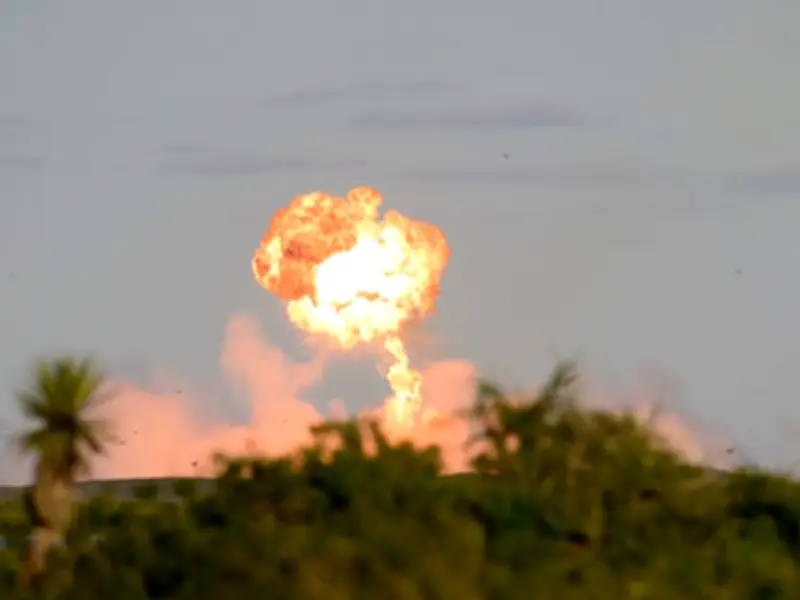
SpaceX's attempt to recover its entire Starship back at the launch pad was thwarted when the booster fell into the Gulf of Mexico and exploded Friday, but the spacecraft still soared into orbit in its boldest test yet.
Instead of returning to its Texas pad following liftoff, the first-stage booster was diverted to a point offshore. Despite the setback, the spacecraft continued on its way. It will steer toward the pad Saturday, barring further trouble. The flight could last as long as 22 hours.
First Orbital Return Attempt
It's the first time that Starship will try to return to the pad from orbit, to be plucked in midair by mechanical arms secured to the launch tower. The loss of the booster meant Elon Musk's company missed out on a double catch.
The original goal was to retrieve every single piece of the rocket for the purpose of future recycling, something yet to be achieved anywhere in the world. Musk sees this leading to the kind of fast and consistent launch rates necessary for building moon bases and sending people to Mars.
Satellites Deployed and Flight Plan
Shortly after reaching orbit, Starship dropped off 26 of the company's most advanced Starlink satellites. The plan is for Starship to complete 15 laps around the world at an altitude of around 170 miles (275 kilometers) before heading back to the launch site for Saturday's grand finale.
SpaceX had already made three booster grabs at the company's sprawling Starbase near the U.S.-Mexico border. That made Friday's miss all the more surprising.
Reaction and Context
"Well, that certainly isn't the news that we had hoped to hear for today," observed SpaceX launch commentator Kate Tice, adding that it was in line with the many rigorous safety checks to protect the pad. No explanation was provided for what went wrong.
This was the first attempt to capture the upgraded version of the booster that stretches 236 feet (72 meters) - the production model for moon and Mars expeditions. It will also be the first time the company attempts to catch the spacecraft, which spans 171 feet (52 meters). Together, they form the world's biggest and most powerful rocket - an astounding 407 feet (124 meters) in height.
The spacecraft portion of the 14 previous Starships ended up in the ocean, either by design at flight's end or by accident in a stream of flaming wreckage. During the first full-scale test flight in 2023, multiple engines failed to ignite and the tumbling rocket's self-destruct system was activated. The last test, in September, was the first to reach orbit, but SpaceX did not try to recover any of the rocket stages.