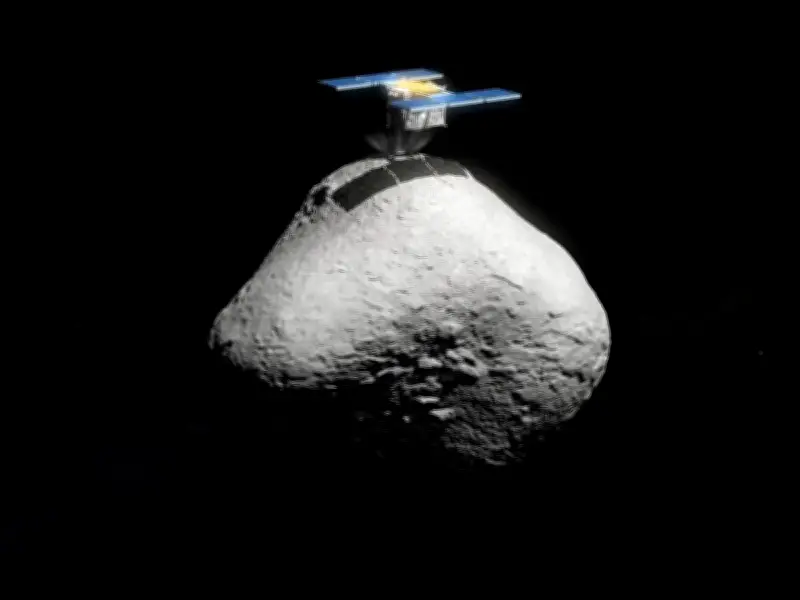
A mysterious object named 1998 KY26 has been observed accelerating as it passes Earth, in a manner that gravity alone cannot explain. Scientists are divided on what could be powering the object, with one theory suggesting it may be a lost Soviet spacecraft.
Object's unusual characteristics
The object is roughly 36 feet in length, about the size of a single-decker bus, and spins once every 5.35 minutes, making it extremely fast compared with other near-Earth rocky bodies.
Back in 2023, astronomers found that the object has been moving faster than normal, based on telescope information collected over the past 25 years. The data revealed a small and steady extra "push" that propelled the object's path differently than if it were an average space rock affected only by gravity.
Debunking natural explanations
In a new study, experts said the increased speed could not have been due to ice falling off the cosmic body. According to the study published in the journal Icarus, 1998 KY26 is too warm to carry ice water on it as it floats through space. The researchers wrote: "We determined that 1998 KY26 is likely a dehydrated asteroid."
The team also ruled out the "dark comet" theory, which suggests hidden ice contained in the asteroid could be slowly turning into gas, giving it a push as it moves through space, despite 1998 KY26 having no visible tail or dust cloud.
Phobos 1 theory
Harvard Professor Avi Loeb believes the object zooming past the planet is actually a spacecraft launched by the former Soviet Union called Phobos 1. The Soviet spacecraft was lost in space months after the vessel began its journey to Mars in 1988.
Loeb and co-authors Adam Hibberd and Adam Crowl have published their own study on arXiv arguing that 1998 KY26's characteristics, such as its size, unusually high shininess, and rapid spin, are consistent with a man-made spacecraft. Loeb has stated the object's "push" could be due to the sun's energy hitting its shiny metal surfaces and solar panels.
Using a 3D model of Phobos 1, the experts found the object matched several of 1998 KY26's brightness changes recorded by telescopes from Earth. Loeb said: "The similarity of the orbit of 1998 KY26 to the orbit of the lost Phobos 1 spacecraft suggests that the two objects are the same."