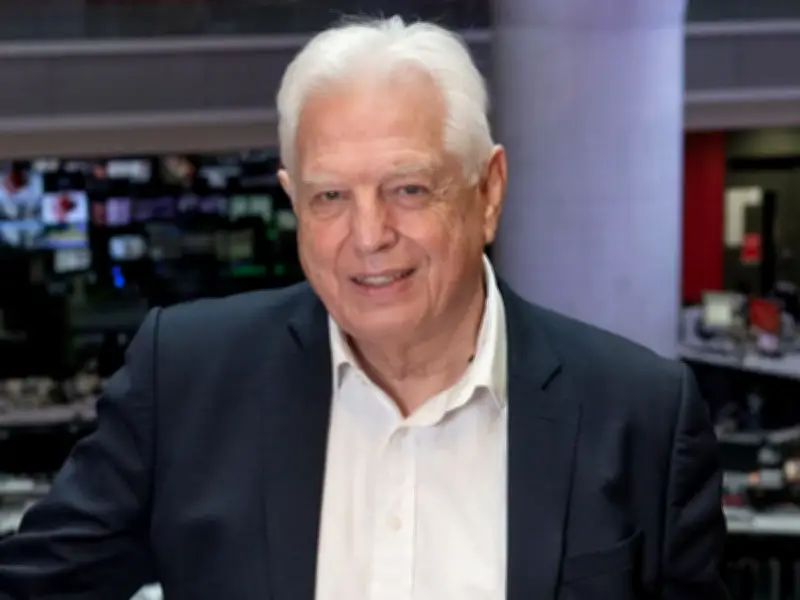
BBC World Affairs Editor John Simpson has voiced deep concerns about the future of the BBC, saying the corporation is in its "worst position ever" and could be lost unless a new funding model is agreed. In an interview with Radio Times, the 82-year-old, who has worked at the BBC for six decades, said the licence fee "has had it" as a means of funding.
Simpson, who reflected on his career, including a capture in Beirut and a mock execution, told Radio Times: "I do think this is the worst position the BBC has ever been in. I think there is a real possibility that we're going to lose it as it is unless the Government and the BBC together can come up with a decent way of funding it."
Licence fee 'has had it'
During the interview, Simpson said he wanted to get a few thoughts about the BBC "off his shoulders" and rejected the idea that the licence fee has any long-term future now non-payment has been decriminalised.
Speaking bluntly, he said: "I think the licence fee has had it. If people can decide they simply don't want to pay, which they're increasingly doing, we've had it, we're finished. Don't tell me these people [who have stopped paying their licence fee] don't watch the BBC. Of course they do. For me that's just like shoplifting."
Simpson would like to see a mandatory household levy collected for the BBC, but for now that is not something the government is interested in.
Funding concerns and recent figures
A recent report showed that about 94% of individuals use the BBC each month, but only 80% of households pay for the £180 TV licence.
In July, the new BBC director-general Matt Brittin described the traditional TV licence model as "a busted flush" and "no longer fit for purpose". In his first major interview, the former Google executive told MPs that the licence fee is "yesterday's model". Speaking to the House of Commons Culture, Media and Sport committee, he said: "We can and should be doing as much as possible on [enforcing] licence fee collection under the current model, but it's yesterday's model, it's a busted flush, it's no longer fit for purpose, and that's why we need to make the case for the BBC and a shift of the licence fee model."
A TV licence is legally required to watch TV channels on any TV service, watch live TV on streaming services, or use BBC iPlayer, according to TV Licensing rules.