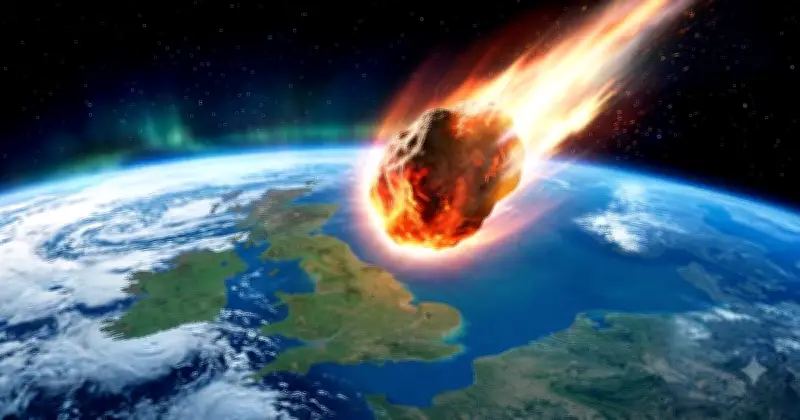
A massive asteroid slammed into the North Sea floor roughly 43 million years ago, carving out the Silverpit Crater and unleashing a tsunami more than 100 metres (330 feet) high, scientists confirmed Monday. The impactor, roughly 160 metres (525 feet) wide, struck at a shallow angle from the west, excavating a 3-kilometre-wide crater now buried 700 metres beneath the southern North Sea seabed, about 80 miles off the Yorkshire coast.
Impact and Immediate Aftermath
The collision blasted a 1.5-kilometre-high curtain of rock, sediment and seawater skyward before it collapsed, generating waves towering higher than many modern skyscrapers. The findings, published in Nature Communications, end a 20-year debate over the crater's origins.
Discovered in 2002 during oil exploration seismic surveys, Silverpit's circular shape, central peak and surrounding ring of faults had long suggested an extraterrestrial impact. Sceptics argued it resulted from salt tectonics or volcanic collapse. In 2009, geologists formally voted against the impact hypothesis.
Conclusive Evidence
New high-resolution seismic imaging, combined with analysis of rock samples from a nearby oil well, provided conclusive evidence. Researchers identified “shocked” quartz and feldspar crystals—minerals deformed only by the extreme pressures of a hypervelocity impact.
Dr Uisdean Nicholson of Heriot-Watt University, who led the study funded by the Natural Environment Research Council, said the shocked minerals were a “needle-in-a-haystack” discovery. He noted, “These prove the impact crater hypothesis beyond doubt.”
Numerical Simulations
Numerical simulations by Professor Gareth Collins of Imperial College London matched the crater's structure to an asteroid strike. Collins, who attended the 2009 debate, called the new data the long-sought “silver bullet”.
Significance and Context
Silverpit ranks among Earth's rare preserved underwater impact craters. While roughly 200 impact structures are known on land, only about 33 have been identified beneath the oceans. Dynamic planetary processes—plate tectonics, erosion and sedimentation—have erased most evidence of ancient collisions.
The event adds to a growing catalogue of confirmed marine impacts, including Chicxulub off Mexico, linked to the dinosaur extinction 66 million years ago, and the more recently verified Nadir Crater.
Nicholson noted the discovery offers a valuable window into how asteroid impacts reshape planetary surfaces, insights difficult to obtain elsewhere. The research also underscores the potential hazards of future asteroid encounters.
With the mystery resolved, scientists can now use Silverpit as a natural laboratory to study subsurface effects of hypervelocity impacts. The crater remains invisible on the modern seabed, preserved beneath thick layers of sediment.