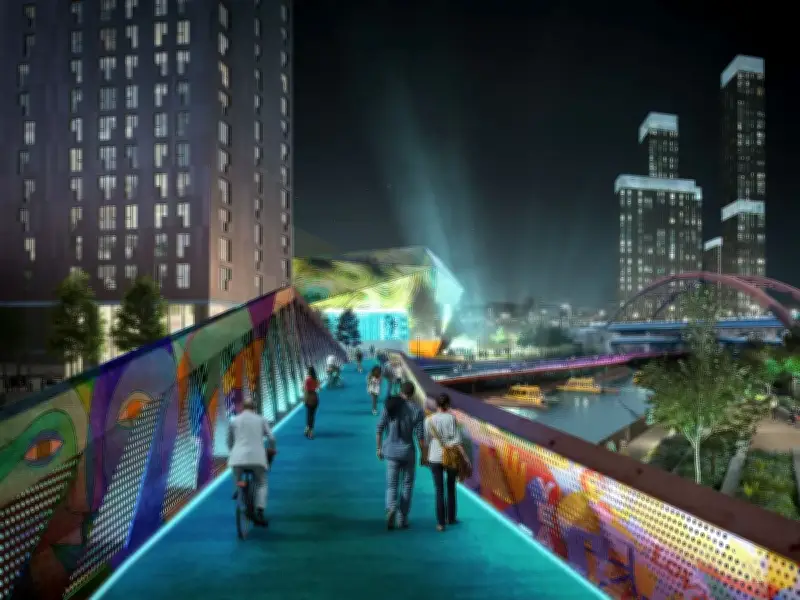
The team behind CyanLines, a £100m plan for a network of floating walkways across Greater Manchester, has announced a new Etihad Campus link in a major update on the scheme. The programme aims to create a 100-mile network of nature walkways around the region over ten years, with initial routes starting in Manchester and Salford.
Illustrations of the future scheme show how brightly-coloured walking and cycling routes could one day provide another way of getting across the city-region. The four original routes include a section from Victoria station heading north to Queens Park, a separate loop around Mayfield, New Islington and Ancoats, a route in south Manchester from St Peter’s Square to Whitworth Park, and the River Irwell and Castlefield loop which crosses the city boundary into Salford.
New Etihad Campus route announced
An expansion was announced on Tuesday (September 8) with a new route being made to the Etihad Campus from Piccadilly station. The route will start at the train station and follow the Ashton Canal through New Islington and Holt Town to the Etihad Campus, before looping back round to the city centre and back at the railway station.

In a new update issued on Tuesday, bosses leading the plans said a ‘technical feasibility study’ was commissioned for a floating walkway on the Irwell in the city centre, in a sign of the plans moving forward. The new Etihad Campus route includes an overhaul of the existing lighting and surfacing along the way, and adding new ‘rain gardens’ among other planned improvements. There are two further CyanLines routes in development in Newton Heath and Rusholme.
Leaders back the scheme
Greater Manchester mayor Bev Craig, co-chair of the CyanLines project, told the Local Democracy Reporting Service: “It’s not just about travel, the whole point of CyanLines is 100 miles of nature connected together, and yes it’s about how you move, cycle and walk, but it’s something more fundamental.”
“It’s about the access to nature that we all have across Greater Manchester, and in places where it isn’t green enough, where there isn’t enough nature, where canals don’t look like they’re looked after and rivers aren't open, this is about connecting all that together, and if we get that right over the next decade, that’s transformative for people’s wellbeing, for health, but also for jobs and for homes.”
Pete Bradshaw, director of sustainability at Man City, said: “The plans for the CyanLines route add a new layer of nature rich, innovative and imaginative active travel and community experiences for fans, visitors and those living and working in the neighbourhood.”
Funding and future expansion
A total of 24 private and public sector funding partners are backing the scheme, including Manchester and Trafford councils, the Greater Manchester Combined Authority, Man City, the Canal and River Trust, property developers Renaker and Urban Splash, and the National Trust, among others.
Asked about the motivation for property developers supporting the scheme, Tom Bloxham, co-chair of CyanLines and chair of Urban Splash, said: “I’ve been amazed by how supportive other companies have been, many of them to be fair competitors of Urban Splash.”
“But when I took my hat off and put it around, I was really surprised by the generosity of the Manchester community.”
“And no there’s no direct benefit for them, but what it does do is everyone realises in the long term that making Manchester more successful place to be, a place more people want to visit and where tourists want to come to walk the CyanLines, a healthier city and a livelier city, that’s good for all of us.”
Asked about the relationship between public authorities and property developers in the CyanLine scheme, Bev Craig said: “If you look around Greater Manchester and the buildings that have been built, we’re a place that could be greener.”
“So this has come from people across the private and public sectors, and wouldn't it be great if we all got together and made Greater Manchester greener, invested in the city centre with more trees, more parks and more green spaces, cleaning up the canals.”

“The reality is, anyone that wants to join that mission about making life better for Mancunians and making our city centre a more pleasant space, we’ve all got a role to play.”
Castlefield Viaduct expansion
In a separate announcement made on Tuesday, it was revealed that a major grant from the Bupa Foundation has been made to the National Trust towards the phase two plans for Castlefield Viaduct. The National Trust, which is a CyanLines founding partner, has transformed part of Manchester’s Castlefield Viaduct into the city’s ‘garden in the sky’, having opened in 2022 as part of an idea to ‘reclaim’ this historic part of the city centre for public use once again.
Phase two of the work will expand the ‘sky park’ destination from 120 metres to the full 330 metre length of the historic Victorian structure. According to the CyanLines team, the ‘majority of the funding’ for phase two at Castlefield Viaduct is now secured, with the National Trust seeking a final £1.6 million in investment before it can be delivered.
The Bupa Foundation is supporting phase two of Castlefield Viaduct through its healthy cities programme, which helps create greener urban spaces by improving access to nature and encouraging people to get active.
Hilary McGrady, director-general at the National Trust, said: “I’m pleased the Bupa Foundation are the first significant charitable grant we’ve received towards phase two of Castlefield Viaduct. Bupa’s funding will help the Trust extend the sky park project in Manchester, meaning more people will experience and benefit from this green space that sits in the heart of the city.”
“Initiatives like Castlefield Viaduct, CyanLines and Bupa Healthy Cities demonstrate what’s possible when we work together and will have a transformative effect on the nature network and communities in Manchester.”
“But more than that, it shows what can be done in cities right across the nation to help people and nature thrive.”