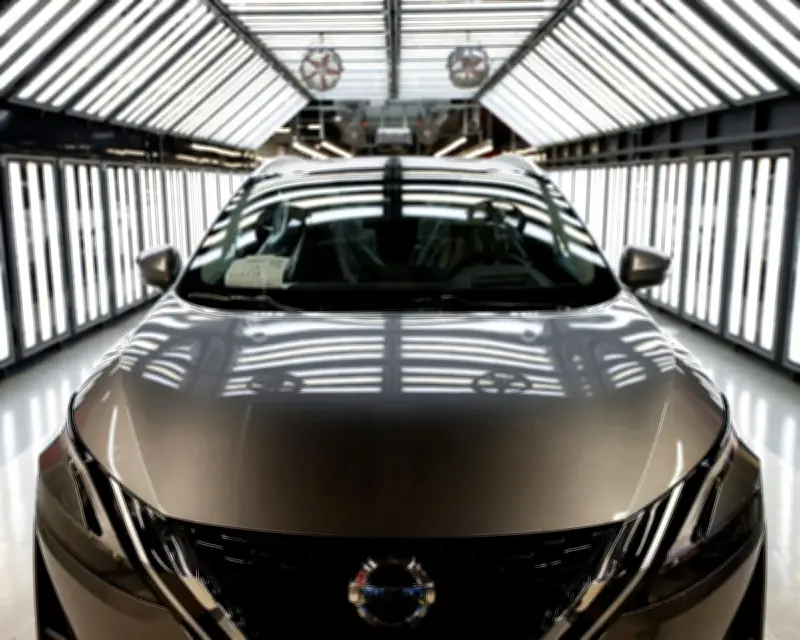
Nissan has reportedly stopped developing a fully electric version of its Qashqai, its top-selling model in Europe, as the Japanese carmaker seeks to cut a fifth of its models and slash costs.
Development Halted at Sunderland
The carmaker quietly halted development of a full EV version of the Qashqai at Sunderland, the site of the UK’s largest car factory, last year, according to a report by Reuters. Nissan is now in talks with the government about securing financial support to plan the future of the plant in north-east England.
The carmaker last month said it was closing one of its two production lines at Sunderland because of faltering demand for its vehicles. It said in April it was “looking at options” for the factory and its 6,000 workers. This includes potentially building cars for other manufacturers, with the company earlier this month signing a non-binding memorandum of understanding with China’s Chery to look at contract manufacturing vehicles.

Cost-Cutting Programme
Nissan, which reported steep losses for the year to March, is in the midst of a drawn-out cost-cutting programme that has led to the closure of seven factories and 20,000 job losses. The company committed to building a full EV version of the Qashqai in 2023, with the government at the time saying the move showed the UK was a global electric vehicle manufacturing hub.
Nissan already makes the fully electric Leaf at the plant and in April announced an all-electric Juke would be built there. Even if Nissan restarts the Qashqai EV project, it would not come to market until the early 2030s, Reuters reported.
Electrification Strategy
The company said it remained committed to expanding its electrified lineup, which includes hybrid models. It added that the European market had experienced “significant volatility” in EV demand and it was pursuing a “balanced” electrification strategy.
Nissan already sells the Qashqai in petrol and hybrid versions, and the model accounted for about 45% of its total sales of 330,000 cars in Europe in 2025. The news emerged on the 10th anniversary of the Brexit vote. The fate of the Sunderland factory became intertwined with the debate about the impact of Brexit on British industry in the years after the vote.
In 2016, the Sunderland factory made 507,000 cars, just shy of its 2012 record. Last year, it managed just 273,000 cars.
Future Plans
“Qashqai is a global bestseller and we will continue to build on our rich history of electrifying our products,” said a spokesperson for Nissan. “We’re excited to share future plans, so watch this space.”
In April, Ivan Espinosa, Nissan’s chief executive, said the company was banking on “AI-defined vehicles”, with an aim of installing autonomous driving technologies in 90% of its vehicles in the future. A fast rollout of self-driving capabilities will be a key plank of Nissan’s strategy to increase sales in Japan by 550,000 a year by 2030, and to reach 1m apiece in the US and China.
The self-driving push is likely to benefit Wayve, the British AI startup that signed its first technology deal with Nissan a year ago.
Nissan and other traditional carmakers have also struggled with the need to invest in new battery electric technologies. Some Japanese manufacturers have failed to keep up with the pace of change from Chinese companies, such as BYD, which last year overtook Elon Musk’s Tesla to become the world’s biggest seller of electric cars.
Last year, the EU confirmed plans to water down its 2035 ban on the sale of new petrol or diesel cars, yielding to heavy pressure from the car industry and leaders from several member states including Germany and Italy, proposing instead to allow 10% of European car sales to have internal combustion engines after that point.