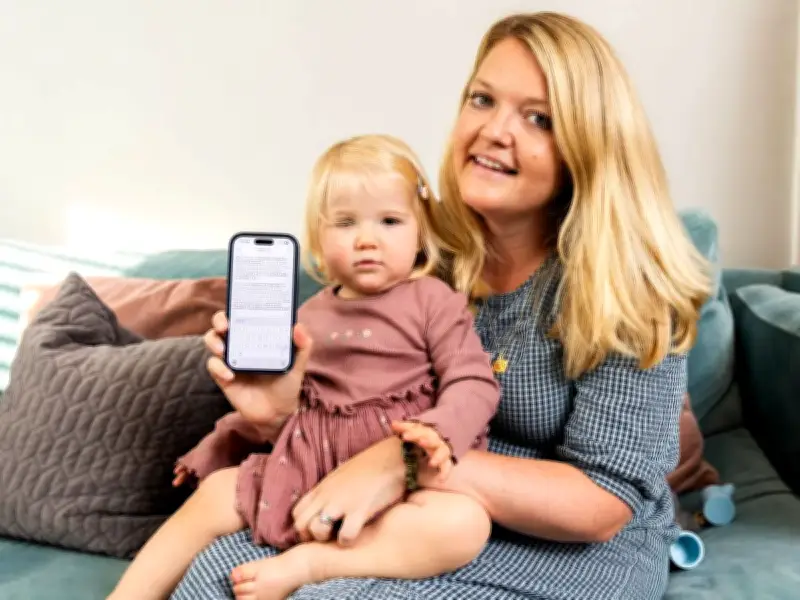
A mother who was convinced her baby daughter's health problems were connected turned to ChatGPT, which suggested an incredibly rare genetic disorder within minutes. Rosie Griffiths, 33, from Bath, Somerset, used the AI tool to identify Multisystemic Smooth Muscle Dysfunction Syndrome (MSMDS), a condition believed to affect just six people in the UK and around 70 worldwide.
Lily, now 19 months old, had undergone open-heart surgery at just four months old, but her mum still believed there was a bigger underlying issue. After entering her daughter's symptoms into ChatGPT, the chatbot suggested MSMDS, a condition that impacts smooth muscle throughout the body.
From pregnancy concerns to a diagnosis
Lily's health problems began during pregnancy when a scan raised concerns about an enlarged bladder. She initially appeared healthy after birth, but just weeks later struggled to gain weight, and doctors discovered a heart murmur. At eight weeks old, cardiologists found she had a large patent ductus arteriosus (PDA) – a blood vessel in the heart that would normally close shortly after birth – and told the family she would need surgery.
Rosie said: “It was pretty shocking. Nobody prepares you for your four-month-old baby having open-heart surgery.” But it was while Lily recovered in intensive care that Rosie began to suspect her daughter's medical problems could be connected. Nurses had become concerned about the youngster's unusually large pupils, which remained permanently dilated.
AI suggests a rare condition
Rosie said: “The symptoms just weren’t adding up. They thought they’d seen something with her bladder during pregnancy, then she had the heart condition, and then there were her eyes. Every time I looked at her eyes, I thought there was something not right here. Not many people have permanently dilated pupils. There were too many coincidences, and I couldn’t accept that coincidence was the answer.”
It was then Rosie turned to the AI tool, entering details about the bladder abnormality, heart defect and problems with Lily's eyes. When the chatbot suggested MSMDS, she immediately took the name of the condition back to medics. She said: “I ran straight back in and said, ‘I think she’s got this’. Nobody had mentioned it before and we’d never heard of it.”
Genetic confirmation and ongoing care
The family later persuaded doctors to carry out genetic testing for the ACTA2 mutation linked to the disorder. In January 2026, their fears were confirmed when results showed Lily had the ACTA2 R179H mutation associated with MSMDS. Rosie said: “It was absolutely devastating. You start to accept it because you’re convinced that’s what it is, but getting the confirmation was still heartbreaking.”
MSMDS can affect several organs across the body and has been associated with serious complications including childhood strokes and potentially life-threatening tearing to important blood vessels. Lily is regularly monitored by specialists in cardiology, neurology, urology, gastroenterology and genetics at Bristol Children's Hospital and Great Ormond Street Hospital.
Charity launched to fund research
Rosie said NHS staff had been “amazing” throughout her daughter's treatment, but believes AI helped bring together symptoms which were being looked at by different specialists. She said: “The doctors have all been fantastic, but naturally they’re focused on their own areas. This condition affects multiple systems, so we needed something that could join everything together. Within two minutes, ChatGPT suggested something nobody had previously put forward.”
Rosie and her family have since launched ACTA2 Alliance UK, a charity to fund research into the condition, which registered in April. It has already hit its first fundraising target after raising more than £40,000 towards research into potential treatments. Rosie said: “We’re going to shout as loud as we can. We can’t just sit and wait. We want to do everything possible to help find treatments and ultimately a cure for Lily and other children living with this condition.”