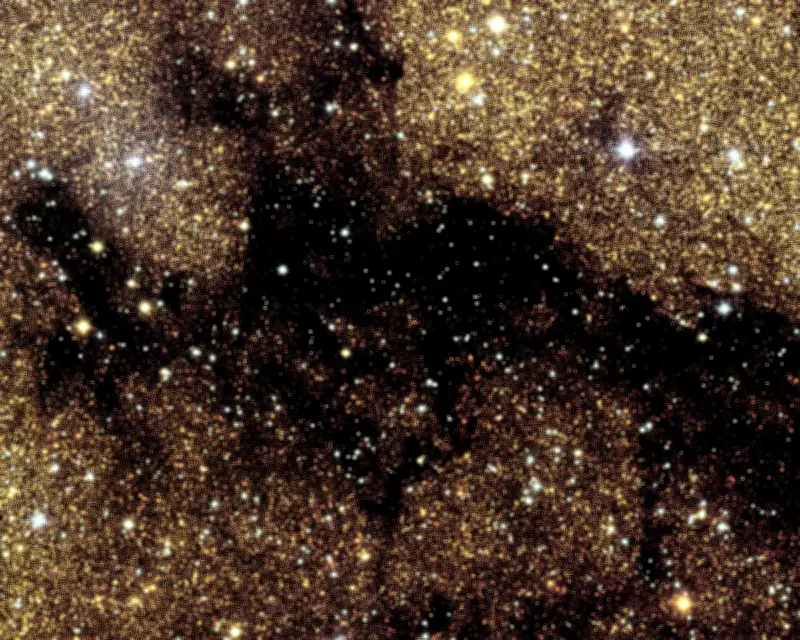
The European Space Agency's Euclid telescope has captured the largest and most detailed image ever taken of the visible light from the centre of the Milky Way, revealing more than 60 million stars in the galactic bulge. The image marks a significant milestone in astronomy, as the telescope was designed to study dark energy and dark matter but has proven exceptionally effective for exoplanet detection.
Unprecedented View of the Galactic Bulge
The mosaic image, composed of nine pointings from Euclid's visible light camera, covers an area of the sky larger than the full moon. Astronomers pointed the telescope at the Milky Way's centre for 26 hours in March last year to capture the snapshot. The galactic bulge is a densely packed region filled mainly with old, cooler stars, and Euclid's camera is uniquely sensitive enough to resolve individual stars in this crowded area.
New Era of Exoplanet Discovery
Dr. Eamonn Kerins, an astrophysicist at the University of Manchester's Jodrell Bank Centre for Astrophysics, stated: "It was never built with this science in mind, but it has proved to be a superb facility for the work. This data fires the starting pistol in a new age of exoplanet discovery, where we go from knowing about 6,000 exoplanets to finding more than 100,000 across the galaxy."

The image will significantly boost the hunt for exoplanets through microlensing, where a foreground star's gravity bends light from a background star, making it appear brighter. A planet orbiting the foreground star can create an additional spike in brightness. Euclid's image shows the same stars before they overlap, allowing astronomers to measure their motion and confirm planetary masses.
Complementary Missions
In August, NASA plans to launch the Nancy Grace Roman Space Telescope, expected to find about 1,500 microlensing exoplanets. Euclid's data will improve these measurements by up to a factor of three. The Roman telescope will also detect transiting exoplanets by observing slight dimming when a planet crosses its parent star. Euclid's data will help distinguish these from false positives like binary star systems.
Broader Scientific Goals
The €1 billion (£862 million) Euclid telescope, launched in 2023, aims to construct the most accurate 3D map of the cosmos and shed light on dark energy and dark matter, which together constitute about 95% of the universe. Only 5% is ordinary matter. The new image not only serves scientific purposes but also provides a stunning visual of our galaxy's heart.