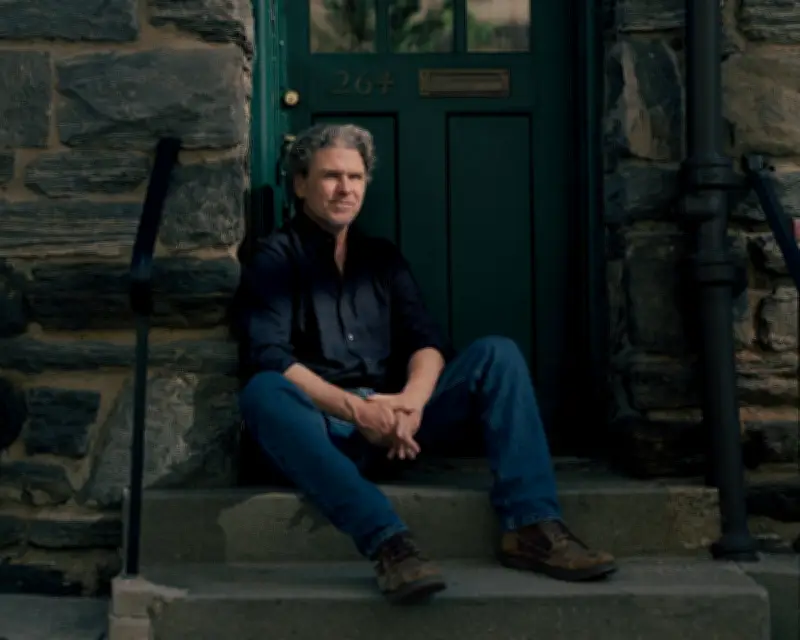
Dave Eggers, the acclaimed US author, has issued a stark warning about artificial intelligence, stating that once humans allow machines to think and write for them, 'you're cooked as a species.' In an interview to promote his new novel, Contrapposto, Eggers also discussed his ongoing efforts to nurture the next generation of creatives and his personal battle against digital distractions, which includes writing on a boat in San Francisco Bay.
AI as an existential threat
Eggers, 56, expressed deep concern over the use of AI in classrooms and creative fields. He described the AI challenge as 'beyond an existential one,' noting that even young children are using AI to generate ideas, which he considers 'far, far worse' than using it to write. 'Once you have a machine think for you and write for you, you're cooked as a species,' he said. 'That's the worse dystopian outcome there could ever be.' He criticised the dehumanising term 'content,' arguing it strips writing of inherent value and suggests it doesn't matter if humans created it.
Legal action against AI firms
Eggers and his wife, writer Vendela Vida, are part of two class action lawsuits against Anthropic for using their books without permission to train large language models. 'I guarantee you they didn't even think they were stealing anything because it's just 'content' to them,' Eggers said. He also recounted a conversation with OpenAI's Sam Altman, where he told employees that 'there's no such thing as AI art. Only humans can create art.' He described a 'really nice afternoon' of open dialogue, but emphasised that the rank-and-file workers are not always aligned with the 'maniacal illusions' at the top.

New novel: Contrapposto
Eggers's new novel, Contrapposto, spans six decades and follows the friendship between Cricket and Olympia, who meet as children and collaborate on artistic projects. Eggers started working on the novel around 20 years ago, jotting notes on copy paper that accumulated in a box. He said turning 50 helped him understand it was possible to write this story because people are surprisingly consistent. The novel explores the complex relationship between talent and success, with one character noting that the most talented guitarist might be playing in a Journey cover band in Reno—'which I've seen, you know,' Eggers said. 'Best guitarist I ever saw was in Reno in some bar.'
Nurturing young creatives
Eggers has launched numerous nonprofits to reduce barriers to literature and the arts. His latest venture, Art + Water, is an arts centre on the San Francisco waterfront that provides free studio space and mentorship. He criticised the high cost of MFA degrees, which can reach $100,000 a year, calling it an 'absurd' price that creates an 'arts industrial complex that makes everyone miserable.' At the International Library of Youth Writing, part of the 826 Valencia network, children can write with pens or typewriters, make zines, and send letters via a physical mailbox. 'If you give them a real, tangible choice, they will always choose the person, the typewriter, the tactility, as opposed to another screen,' Eggers said.
Personal habits and writing process
Eggers writes first drafts by hand and transfers them to a Mac computer from 1998 that has never been connected to the internet, now patched with duct tape. He uses an old-fashioned flip phone and writes on a boat in San Francisco Bay to escape the internet. 'I've never seen Facebook. Like, I don't know what exactly happens on Facebook,' he said. His main online temptations are ESPN sports news and watching old concerts on YouTube, such as a Kate Bush show from 1981 or a two-and-a-half-hour Sinéad O'Connor concert.
Background and early career
Born in Boston and raised in Chicago, Eggers burst onto the literary scene in 2000 with his memoir A Heartbreaking Work of Staggering Genius, which recounted raising his younger brother after their parents died of cancer. He rarely gives interviews and avoids discussing that painful chapter. He studied journalism at the University of Illinois, where professors warned students they would never get better than a B-minus. He finds fiction writing 'infinitely more fun' than nonfiction, which he describes as a 'slog' of fact-checking.

Life drawing and empathy
Eggers has been organising regular life-drawing sessions at McSweeney's offices since the pandemic. He believes figure drawing cultivates empathy: 'In three hours of drawing a human, you learn so much about them and there is so much affection that comes from carefully trying to get them right.' The session with model Prudence, who posed nude but for black knee-high socks, was a first for the interviewer.
Contrapposto by Dave Eggers is published by Canongate on 2 July.