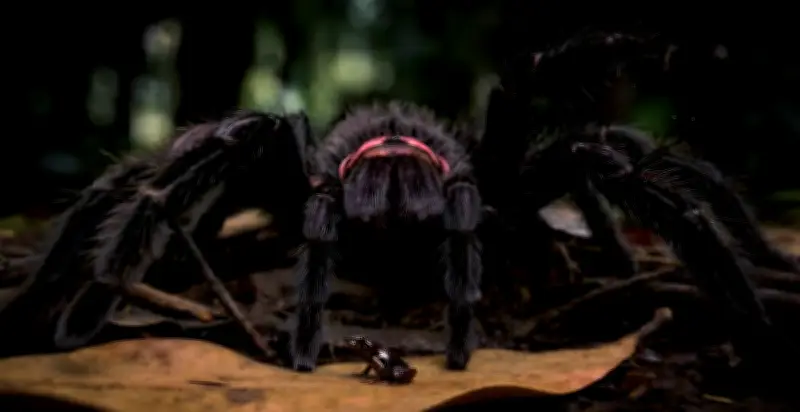
An Australian filmmaker has used artificial intelligence to create a wildlife documentary that captures a giant tarantula and a tiny frog inside an underground burrow—a scene that would be impossible to film naturally. The short film, titled Guardians of the Burrow, won a prize at the Omni International AI Film Festival, judged by a panel led by director Alex Proyas.
How the AI Documentary Was Made
Jodie Heenan, the digital content designer behind the film, says she researched how National Geographic, Animal Planet, and David Attenborough’s teams produce documentaries. She avoided AI’s capacity for cheap special effects, aiming instead for a natural look that would feel like a real nature documentary. “No fancy camera tricks and morphs and warps, none of the fun stuff that AI can do that looks really cool,” she said. “I almost wanted it be: you’re in a boring hotel room, you put on Nat Geo because there’s nothing else on the TV, and you get sucked in.”
The film depicts a symbiotic relationship between an Amazonian tarantula and a dotted humming frog, a scene that Heenan says even David Attenborough couldn’t have captured because lights and microscopic cameras would interfere with the animals’ natural behavior. “Nobody’s actually managed to capture [the spider and frog] on film in the wild, to my knowledge, so I thought that was a really great reason to use AI specifically,” she said.
Controversy Over AI in Filmmaking
Heenan has faced criticism for using AI, which is trained on content that some say was stolen from creators. Last week, musicians and authors protested at Australia’s parliament to protect copyright, and communities are mobilizing against power-hungry datacentres. Heenan is part of an international team working with Fable, a California AI studio backed by Amazon, to reconstruct Orson Welles’ The Magnificent Ambersons with the ending Welles originally wanted. The Orson Welles estate criticized the project, calling it “a purely mechanical exercise without any of the uniquely innovative thinking or a creative force like Welles.”
AI as a Creative Tool
Despite the backlash, Heenan believes AI can show the impossible and be used creatively. “I can show the detail of the relationship, I can get into the spider’s burrow … and then recreate that in AI, but put it in a natural environment, so that it feels and looks like a real nature documentary,” she said.
Another AI filmmaker, Robert Gaudette from Canada, won the best picture award at the Omni festival for his eight-minute film A Face Only a Mother Could Love. The film, which won a $50,000 grand prize at the Runway AI film festival, tells the story of Marcel Dupont, a physically disfigured man who perfects the waltz alone in his kitchen. “I knew what type of story I wanted to tell, and I knew I wanted it to be different from what a lot of other people were doing in AI,” Gaudette said. “AI is really great at creating spectacle … but I wanted to see if I could test the limits in terms of storytelling, trying to connect with an audience through a character.”
Impact on Jobs and Creativity
Both Heenan and Gaudette acknowledge that AI will replace some jobs in special effects, but they believe new roles will emerge. Gaudette compared the shift to the arrival of CGI: “In the Hitchcock era, there would be 30 to 50 people sitting on a sound stage, and then CGI came along, and there was a lot of fear, a lot of disruption, and a lot of people laid off from their traditional jobs and replaced by computers. But if you look at a Marvel film nowadays, there’s 300 to 400 people working on those projects, so there’s been a net addition in terms of the economy and employment.”
Heenan sees AI as a democratizing force in visual storytelling. “I don’t need to wait for Hollywood to allow me in as a PA, then get the gracious gift of being able to maybe be on a film set to maybe make something one day,” she said. “It’s no longer a choice—do I spend my house deposit on making a short film? I can make a short film for $500. The more stories that people can tell that don’t have the money and the resources behind them to tell their individual stories, that is just groundbreaking. It’s going to level the playing field … removing those gatekeepers stopping you from telling your story.”