A hike across the Pevensey Levels in East Sussex reveals a landscape pockmarked with horseshoe impressions, evoking the passage of an army nearly a millennium ago. The author, along with friends Annie, Mike, and dog Fflos, embarked on the 1066 Country Walk, a 31-mile trail from Pevensey to Rye, with a midpoint at Battle, the probable site of the Battle of Hastings. The walk offers a tangible connection to history, allowing participants to ask questions on foot that books cannot answer.
Day One: Pevensey to Herstmonceux
The first day covers six miles from Pevensey to Herstmonceux. The Pevensey Levels, marshland first drained in 772, are now home to sheep, cattle, and water spiders living in air-filled webs. The landscape, with its russet, sage, and ochre hues, mirrors the colors of the Bayeux tapestry. The group notes the blackthorn heavy with sloes, blackbirds feasting on blood-red hawthorn berries, and the wind in the rushes along the River Pevensey, reflecting on the contradictions of war in such a gentle place.
Day Two: Herstmonceux to Battle
The second day is the longest and steepest at 11 miles, but also a favorite. The well-signposted route passes through Wartling Wood, carpeted in acorns and lined with blackberries, then emerges into sunny fields and the village of Boreham Street. A holloway guarded by beeches leads to more fields with windswept horizons. The impression is of a settled landscape, augmented by morning tea at the Ash Tree Inn in Brownbread Street. The route creates a slippage of time, weaving in and out of darkness and light, wildness and cultivation, and shifting from present to past with each step.
Day Three: Battle to Icklesham
Starting from rented accommodation at Abbey View Cottages, which offers a view of Battle Abbey's towers, the group sets off on a nine-mile hike. A plunge off a country lane leads to a bridle path in Battle's Great Wood, where Mike gives a mushroom tutorial, identifying fly agarics, edible boletes, parasols, and great penny buns, which he calls "the Rolls-Royce of mushrooms." The route crosses a golf course and deep countryside with oasthouses tucked into hill folds. Near the Three Oaks pub, the group encounters one of artist Keith Pettit's 10 Bayeux tapestry-inspired sculptures: six hollow, Celtic-carved oak pillars planted inside with hawthorn, forming a circle of living wonder on a hillcrest.
Day Four: Icklesham to Rye
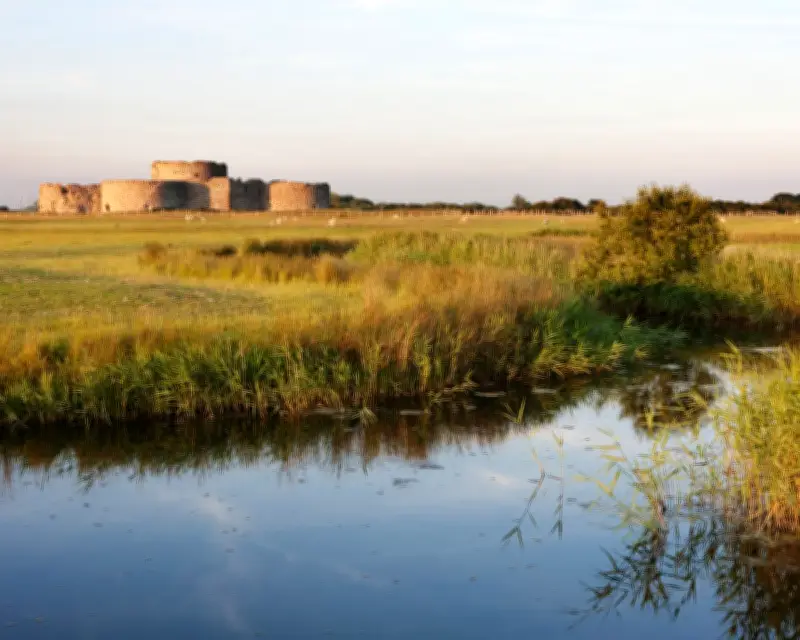
The final five-mile hike brings the group to medieval Winchelsea, rebuilt by Edward I in the 1280s after the original town was washed away. The morning traverses apple orchards in a mellowness reminiscent of Dutch landscape paintings. The modern stained glass windows of St Thomas church in Winchelsea, created by Douglas Strachan as memorials after World War I, bloom like color-saturated rainbows. From Winchelsea, the group heads to Rye across silted-in coastal lowland that would have been underwater in Edward's day. They detour past the ruin of Camber Castle, begun in 1512, finished in 1544, and demolished in the 1640s by parliamentary forces in the English civil war. The castle serves as a reminder of vulnerability and hubris. The walk ends in Rye, a town of Henry James, antique shops, and good food. The group feels more energized than exhausted, grateful they didn't have to conquer the place with anything more than their imaginations.
The Bayeux tapestry is on display at the British Museum from 10 September to 11 July 2027; tickets are now on sale. Abbey View Cottages sleeps four, from £200 a night; rooms at the Ship Inn in Rye from £75. Pamela Petro is the author of The Long Field, published by Little Toller (£14).