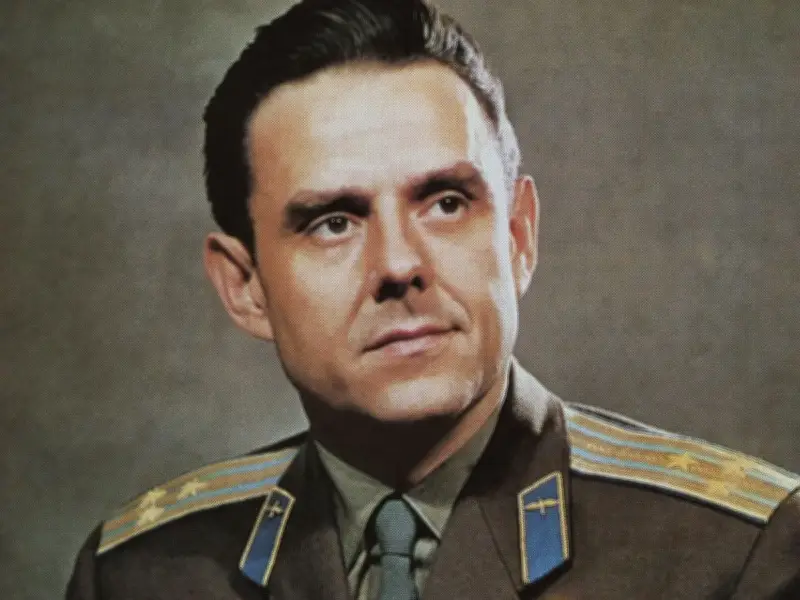
Cosmonaut Vladimir Komarov died on 24 April 1967 when his Soyuz 1 capsule crashed after a parachute failure during re-entry, leaving his body melted into a lump. Known as 'the man who fell from space', Komarov had been assigned to the same Earth-orbiting mission as Soviet hero Yuri Gagarin, and both knew the space capsule was not safe to fly.
Komarov told friends he knew he would probably die, but would not back out because he did not want his friend Gagarin to be subbed in. Gagarin inspected the Soyuz 1 craft his friend was due to fly in and had found 203 structural problems. The problem was no one wanted to tell Leonid Brezhnev, the Soviet leader desperate to win the space race.
A mission doomed from the start
Komarov met with Venyamin Russayev, a KGB agent, and said: "I'm not going to make it back from this flight. If I don't make this flight, they'll send the backup pilot instead. That's Yura, and he'll die instead of me. We've got to take care of him." Komarov cried and demanded he be buried in an open casket upon the likely event of his death.
On 23 April, Komarov embarked on his final voyage. Over a 24-hour period, he circled the Earth 16 times, but a fault with a solar panel prevented him from completing the mission.
Final words and the crash
Having survived the most dangerous stage of atmospheric re-entry, he was ordered to return to Earth. However, a parachute malfunction caused his capsule to hurtle towards the ground, resulting in an explosion that took his life.
The official transcript of Komarov's last moments, held in the Russian State Archive, reveals that one of his final statements to colleagues was: "I feel excellent, everything's in order." Shortly afterwards, he is reported to have said: "Thank you for transmitting all of that. [Separation] occurred." As his doomed spacecraft plummeted to Earth, his final words were picked up by US listening posts in Turkey. A haunting transmission captures him speaking to Alexei Kosygin, a senior official of the Soviet Union.
He is thought to have said: "This devil ship! Nothing I lay my hands on works properly."
Legacy and remembrance
The day following his death, a statement from his cosmonaut colleagues was published in Pravda: "For the forerunners it is always more difficult. They tread the unknown paths and these paths are not straight, they have sharp turns, surprises and dangers. But anyone who takes the pathway into orbit never wants to leave it. And no matter what difficulties or obstacles there are, they are never strong enough to deflect such a man from his chosen path. While his heart beats in his chest, a cosmonaut will always continue to challenge the universe. Vladimir Komarov was one of the first on this treacherous path."
Komarov was reduced to a melted, shapeless lump with his body charred beyond recognition. His wishes were granted and he was presented at his funeral in an open casket. His colleague, Pavel Popovich, spoke about Komarov: "He was respected for his humility and experience. He was already an engineer when he joined us, but he never looked down on the others. He was warm-hearted, purposeful and industrious. Volodya's prestige was so high that people came to him to discuss all questions: personal as well as questions of our work."
Komarov is now remembered for being the first known human to die in space on 24 April 1967. The asteroid 1836 Komarov, discovered in 1971, was named in his honour, as was a crater on the Moon.