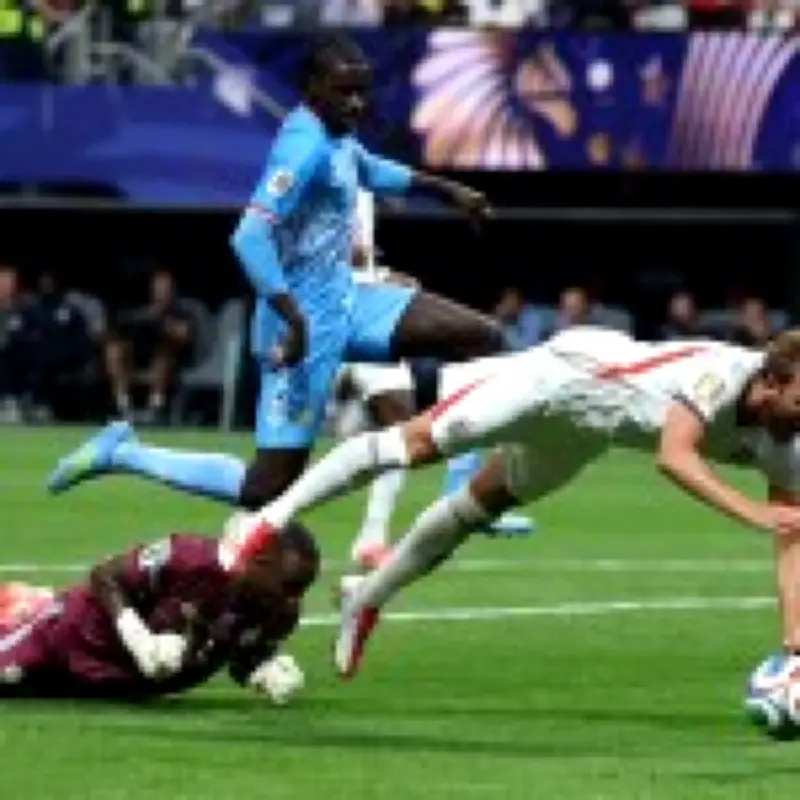
England captain Harry Kane was left furious after being denied a penalty during the World Cup round-of-32 match against DR Congo on Wednesday. The incident occurred in the 43rd minute when Kane was clipped by DR Congo goalkeeper Lionel Mpasi inside the box. Jordanian referee Adham Makhadmeh initially made a simulation gesture and awarded DR Congo a free kick, a decision that was upheld after a VAR review.
VAR decision sparks debate
Replays showed that Kane had touched the ball first before his foot was caught by Mpasi. However, VAR agreed with Makhadmeh's assessment that Kane was already on his way down after stumbling, meaning the referee had not made a clear and obvious error. Former England captain Wayne Rooney supported the decision, telling the BBC: 'I just think he trips himself a little bit then jumps into the goalkeeper a little bit. Yes, there is contact but I just think by that little trip of himself and jumping into him with two feet it's the right decision.'
Rooney added: 'He stubs his toe into the ground, his right foot, and then jumps into the goalkeeper. The goalkeeper has rushed out and has left himself in a position where he could give a penalty but I just think it looks like he's dived into him. So, I think it's probably not a penalty.'
Former referee weighs in
Former Premier League referee Graham Scott told The Athletic: 'Harry Kane only has himself to blame, by dragging his left foot into the onrushing goalkeeper, he created doubt in the referee's mind, and his penalty claim was waved away. On first viewing, England fans, including me, were no doubt screaming 'penalty' at their TV screens, and many referees would have agreed. There is a good case for one, as goalkeeper Lionel Mpasi undoubtedly makes significant contact with Kane, and there is no way the VAR would have recommended a review had Jordanian referee Adham Makhadmeh pointed to the spot. However, Kane goes to great lengths to ensure that contact occurs, plants both feet on the ground and falls theatrically – all clues to the referee that the England striker was having him on. Fair play to Makhadmeh for standing strong. Had Kane carried on running as normal, he may have been brought down anyway – and earned the penalty he craved – or he might have reached the ball and rolled it into the empty net. I wish he had.'
Clattenburg disagrees
However, former Premier League referee Mark Clattenburg, who officiated the Euro 2016 final, insisted that Makhadmeh was wrong to suggest Kane was guilty of simulation. 'My first impression was as Kane is going towards the goalkeeper, the only thing that the referee has to look at is does the goalkeeper go into the path of Harry Kane? Yes, he does,' Clattenburg told Fox Sports. 'That is not a simulation. There is a clear contact. FIFA's instructions to the referee is when there is a contact, it must be certainly not a simulation. For me, I would rather the referee have a look at this again to give a penalty kick.'
Former Premier League assistant Darren Cann also felt England should have been awarded a penalty. 'This is so difficult, there are four of us here and two think it is a penalty and two think it is not a penalty,' Cann told the BBC. 'So therefore it is not clear and obvious. There's a small touch on Harry Kane's ankle and as Joe [Hart] says, you'd be expecting to give away a penalty. From the referee's angle you can see Kane puts his two feet together stumbles and [from the angle from behind] it doesn't look to be much of a penalty, and therein lies the difference. But for me, I think that's a penalty.'
Former England keeper's view
Former England goalkeeper Joe Hart admitted he would have expected a penalty to be given against him in that situation. 'My heart here, as soon as I miss that ball and I feel Harry Kane's contact, I'm getting ready [for a penalty],' Hart told the BBC. 'If I've got it written on my water bottle, I'm working out where Harry Kane's next penalty is going to be. He will be absolutely delighted when he looks up and sees the referee not giving this, because I would expect that to be given against me.'