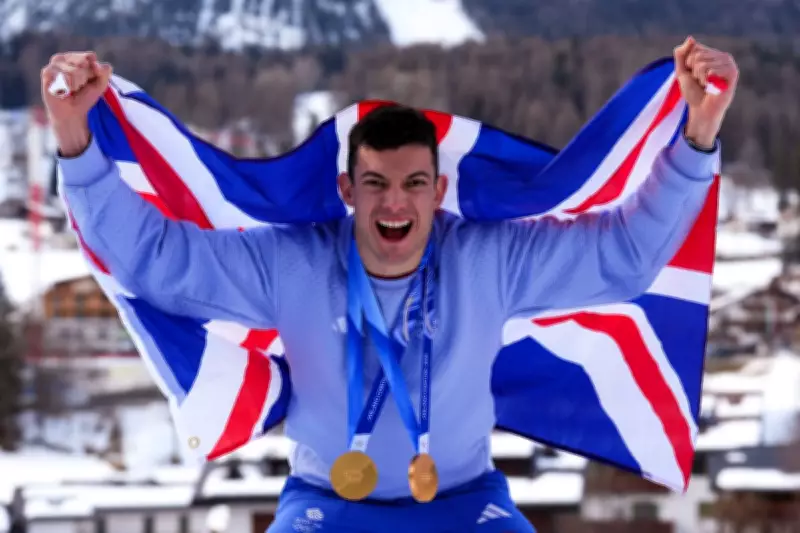
Great Britain's double Olympic champion Matt Weston has declared that his relentless pursuit of speed will continue unabated, despite requiring imminent shoulder surgery following his historic gold medal performances at the Winter Games.
Historic Double Gold Achieved Through Pain
Weston secured an unprecedented double gold for Team GB in skeleton, dominating the men's individual competition in Cortina with a victory margin of nearly a full second. He then produced a spectacular comeback in the mixed team event alongside partner Tabby Stoecker, overturning a 0.3-second deficit to win by 0.17 seconds.
This remarkable achievement makes Weston the first British athlete ever to win two medals at a single Winter Olympics. However, the champion has revealed this landmark success was accomplished while competing with a significant shoulder injury that has plagued him for approximately a year.

Surgery Scheduled Post-Games
"I'm already lined up for an operation as soon as I get back on my shoulder," Weston disclosed. "For a year or so, I've needed it but we've been holding out until after the Games."
The athlete explained that medical consultations last summer considered proceeding with surgery earlier, but the decision was made to avoid jeopardising his Olympic campaign. "We just didn't want to risk it, really," he admitted. "I've been competing with a dodgy shoulder and in a lot of pain quite a lot of the time."
The injury was so severe that Weston avoided carrying his own sled during training and competition periods. "Not because I'm being lazy and a bit of a princess," he clarified, "but physically, it would break me basically."
Weston credited his support team for managing his condition throughout the season, which also included a pre-season quad muscle tear. "I was hanging on getting to these Games and the team around me have done a very good job, just to get me here and in good enough condition that I can go and compete," he acknowledged.
Unwavering Drive for Improvement
Despite these physical setbacks and his dominant performances, the athlete nicknamed "Captain 110 per cent" remains convinced he can extract further improvements from his performances.
"I am always wanting more," Weston asserted. "I always want to be faster, I always want to be quicker, not just physically, but down the track as well. I think there's still some potential to get faster. That's one thing that is amazing, that we can still get more."
Celebrations and Surreal Success
The dual Olympic champion described celebrations that extended until 4am following his victories, powered by adrenaline and the extraordinary achievement. "The first medal hasn't sunk in, let alone the fact that I've won two," Weston confessed. "It feels pretty amazing to have both of these around my neck and very surreal. I definitely don't think it's sunk in."
Weston has deliberately avoided social media and his phone to manage the sudden attention, but has noticed increased public interest. "I'm not quite sure how life is going to change," he reflected, "but I've definitely noticed a bit of a buzz."
Boosting Skeleton's Profile
Both Weston and Stoecker, who finished fifth in the women's individual event, have become headline news across British media. They express particular satisfaction at elevating the profile of their sport, which typically receives limited attention outside Olympic cycles.
"For skeleton, it's not always the most watched outside of the Games," Stoecker noted regarding World Cup and championship events. "We've been really successful, but maybe not had as much recognition as other sports get."
"So to have this moment at the Olympics with the whole nation behind us, being front page in the news, having all the attention; it's not just for us," she emphasised. "It is for all those people who might be inspired by what we've done in any way. For me, that just feels so impactful and, hopefully, that will last way longer than we will."

Inspiring Future Generations
Weston reported a significant surge in applications to the British Bobsleigh and Skeleton Association's talent identification campaign following their Olympic success. "I think 3,500 people have applied for skeleton off the back of the last few days," he revealed. "That's pretty special to me that we've been able to be part of that inspirational journey."
The champion's immediate focus now shifts to his necessary shoulder operation, but his long-term vision remains fixed on pushing the boundaries of speed in skeleton, undeterred by physical challenges and inspired by his historic Olympic achievements.