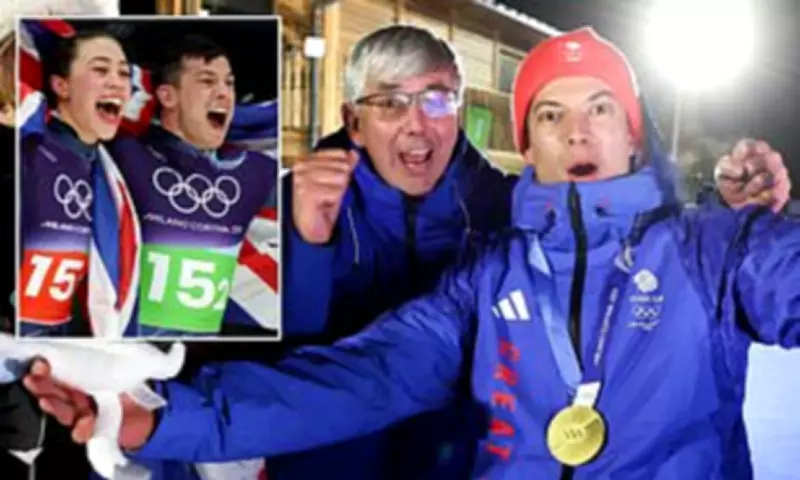
Matt Weston's Historic Double Gold at Winter Olympics
Matt Weston's first gold medal at the Winter Olympics was celebrated with a simple margherita pizza. His second victory prompted celebrations that stretched into the early hours of Monday morning, concluding around 4am. The British skeleton athlete described the experience as running purely on adrenaline, acknowledging the unique fatigue that accompanies becoming Britain's only Winter Olympian to secure two gold medals at a single Games.
Celebrations and Physical Toll
'It's going alright so far but I think I might be a bit tired later,' Weston admitted with characteristic understatement. 'We enjoyed ourselves a little bit last night. We're not known for being good drinkers, though, because we're athletes. So, we're not heavyweight, let's put it that way.'
Despite the modest celebrations, Weston's achievements in skeleton racing place him among the sport's greatest competitors. Winning the men's individual gold on Friday represented an impressive accomplishment, but following that victory by teaming with Tabitha Stoecker to claim mixed relay gold on Sunday created Olympic history.

Hidden Injuries Revealed
A significant revelation emerged on Monday when Weston disclosed he has been competing with a severe, long-term shoulder injury requiring surgery. This follows a 12cm tear in his quadriceps at the season's beginning and various other wear-and-tear issues, not including the broken back he sustained during his earlier taekwondo career.
While two gold medals provide considerable consolation, the 28-year-old athlete faces imminent surgery upon returning home. 'I think I do need to give my brain and also my body some time to rest,' Weston explained. 'There is a toll that it takes on your body to do this sport. Like the training alone. I'm already lined up for an operation as soon as I get back on my shoulder.'
The shoulder problem has persisted for approximately a year, with treatment deliberately postponed until after the Games. Weston added that his hip 'is done' and that comprehensive medical imaging would likely reveal numerous other issues.
Training Through Pain
'We considered surgery at the start of summer last year,' Weston revealed, 'just to see what we could do, but we just didn't want to risk it, really. So I've been competing with like a dodgy shoulder and in a lot of pain quite a lot of the time.'
The injury significantly impacted his training regimen, preventing proper sled work and requiring coaches' assistance for basic tasks. 'I have not really been carrying my sled around, not just because I'm being lazy and a bit of a princess, but physically, it would break me basically,' he confessed.
Weston credited his support team for maintaining his condition sufficiently to compete, stating they performed 'a very good job, just to get me here and in good enough condition that I can go and compete, really.'
Post-Olympic Plans
Following his medical treatment, Weston plans to prioritize recovery and personal time. 'I need to let my body rest, my brain rest, and have a little time to myself and me and my fiancée,' he said. 'Just chill out really.'
Immediate celebrations include his stag party ahead of a summer wedding to fiancée Alex Howard-Jones. Interestingly, Tabitha Stoecker's boyfriend, Pat, serves as Weston's best man and will organize the festivities.
'We've missed a lot in terms of the sacrifices we have to make to get to this point,' Weston acknowledged, 'so we will have a bit of a blowout, to be honest. We've been very sensible for the past four or five years, concentrating on this, and not really had that much chance to let loose, so I'm looking forward to that.'
Funding Debate and Sport's Future
While Weston's achievements are undeniable, questions persist regarding the allocation of £5.7 million in lottery funding to skeleton—a sport with limited participation opportunities in the United Kingdom. Weston defended the investment by highlighting increased public interest.

'You never know where you're going to end up in this sport,' he argued, 'it can take you on an amazing journey. I've been to countries and places I never thought I would do, I've achieved things I never thought I would do, and there's already been a pretty big uptake.'
Weston noted approximately 3,500 people have applied for skeleton programs in recent years, with over 1,000 enquiries arriving since Friday alone. 'That's pretty special to me that we've been able to be part of that inspirational journey,' he added.
Facility Challenges and Broader Impact
The reality remains that skeleton participation opportunities pale compared to more accessible winter sports like skiing. Weston and Stoecker train for six months annually on a push track in Bath, highlighting the sport's facility limitations.
The lottery funding debate centers on whether its purpose should inspire broader sports participation or maximize Olympic medal counts. Stoecker expressed hope that both objectives can be achieved simultaneously.
'For skeleton, it's not always the most watched outside of the Games,' Stoecker observed. 'We've been really successful, but maybe not as much recognition as maybe other sports get. So to have this moment at the Olympic Games with the whole nation behind us, being front page on the news, having all the attention, is not just for us.'
She emphasized the broader impact: 'It is for all those people who might be inspired by what we've done in any way - whether it's just being active, or getting into a sport, or getting into skeleton. So, for me, that just feels so impactful, and, hopefully, that will last way longer than we will.'