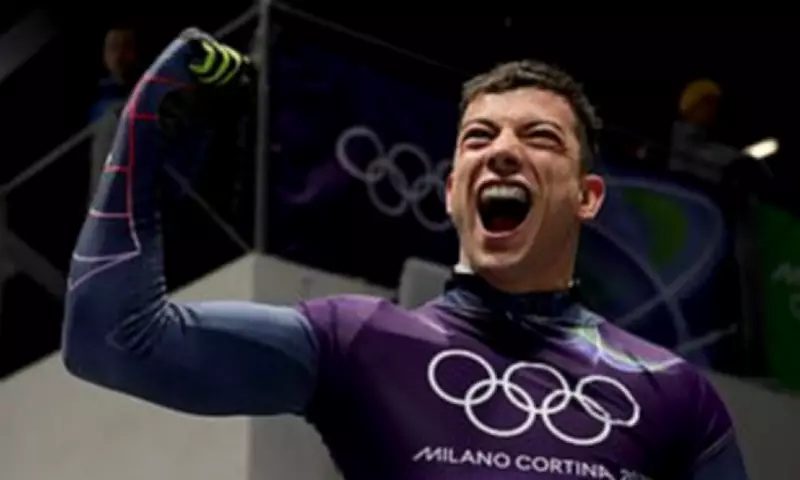
Matt Weston Dominates Olympic Skeleton, Puts Team GB on Course for Gold
Amidst a challenging Olympic campaign for Team GB, Matt Weston has emerged as a beacon of hope, surging into the gold medal position at the halfway stage of the men's skeleton event. The 28-year-old two-time world champion demonstrated exceptional composure under pressure, outrunning expectations on his sled in Cortina.
Record-Breaking Performance Secures Commanding Lead
Weston's dominance was immediately apparent when he shattered the track record during his first competitive slide down the chute. He then proceeded to lower that record again on his second run, establishing a substantial 0.30-second advantage over the field. His times of 56.21 seconds on the initial attempt and an improved 55.88 seconds on the follow-up have positioned him as the clear frontrunner.
The German duo of Axel Jungk and Christopher Grotheer, who claimed silver and gold respectively at Beijing 2022, currently complete the provisional podium. However, Weston's near-perfect first day has made him exceptionally difficult to catch, provided he maintains this formidable form through Friday's concluding two rounds.

British Contenders and Team Prospects
Fellow British slider Marcus Wyatt, with whom Weston shared a clean sweep of victories in the most recent World Cup series, finds himself in seventh position, trailing by 1.12 seconds. While such margins can evaporate with a single misjudged brush against an icy wall, Team GB's prospects for a breakthrough on the medal table have improved dramatically since the start of competition.
Weston reflected on his performance, stating: 'I was quite annoyed after the first run. Corners one, two and three have been problematic in training. I attempted to over-compensate for race-day nerves by being too relaxed, resulting in a soft approach on the initial corners that proved costly. I was relieved to correct those errors on my second attempt.'
Mental Fortitude and Championship Experience
The British slider emphasized his psychological preparedness for maintaining the overnight lead, noting: 'It's pretty incredible to be in this position, but I treat each run as a fresh start. I will completely reset myself, switch off briefly, then refocus for tomorrow. Fortunately, I have previous experience leading at major championships and understand how to handle this situation. I have learned to embrace pressure and transform expectations into motivation that fuels my best performances.'
Equipment Controversy and Competitive Context
The competition day began with dramatic developments as Ukrainian athlete Vladyslav Heraskevych faced expulsion for a helmet protest against the Russian invasion. For Weston and Wyatt, helmet issues took a different form when their new designs were deemed non-compliant just last week.
Reverting to the helmets that powered their dominant World Cup season—during which Weston secured five victories from seven events, with Wyatt claiming the remaining two—appears to have caused minimal performance disruption. Wyatt acknowledged his position requires improvement, commenting: 'My performance was acceptable with some mistakes on both runs. I remain in contention and hope for a classic comeback tomorrow to challenge for podium positions. This track presents unique challenges, particularly corners two and nine, where minor errors prove costly.'
Broader Implications for British Winter Sports
As Team GB experiences near-misses across other Olympic disciplines, the substantial £5.7 million skeleton programme continues to deliver results. The women's skeleton event commences on Friday afternoon, with British contender Tabitha Stoecker positioned as a favourite after finishing in the top two during all six training runs.
Weston's commanding performance not only positions him for individual glory but potentially signals the end of Team GB's medal drought at these Winter Games, showcasing the strategic investment in skeleton as a cornerstone of British winter sports success.