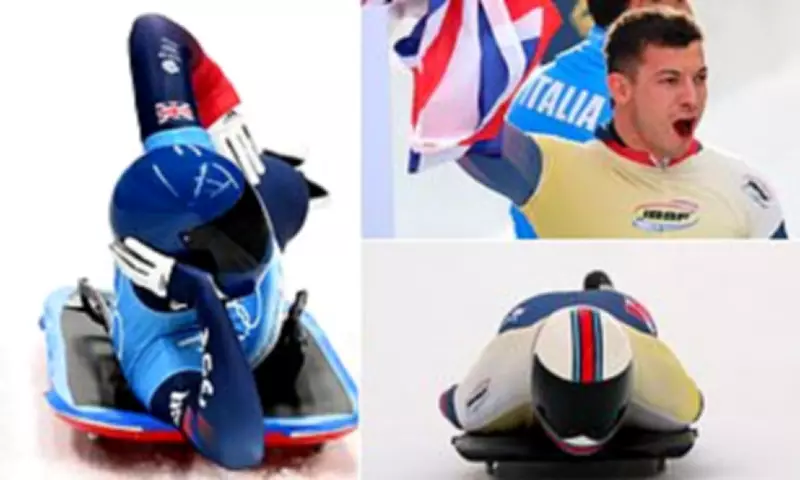
Matt Weston: The Artistic Soul of British Skeleton Racing
As Britain's leading gold medal hope for the upcoming Winter Olympics, Matt Weston contemplates the eternal battle between art and science while hurtling head-first down an ice chute at a breathtaking 90 miles per hour. For the skeleton racer, there is only one clear victor in this philosophical contest.
'Art,' he declares emphatically. 'Definitely art.'
Soon enough, the conversation turns to the athlete who embodies the opposing, scientific approach to skeleton racing - the very competitor who might pose the greatest threat to his Olympic ambitions in Cortina, northern Italy, in the coming weeks. Remarkably, that rival happens to be his own teammate, Marcus Wyatt.

The Poetry of Speed
'I stand on that start line and it's both exhilarating and terrifying,' Weston reveals. 'I've been competing in this sport for nine years now, and I've worked extensively with psychologists to prepare mentally because you really need to get your brain ready for what's coming.'
'When everything goes perfectly right, it's a beautiful thing, mate. How can I possibly describe it? It almost feels like you're flying, floating on air. We talk about being on the very edge of grip - just enough to maintain speed but not so much that you become slow. When you find that sweet spot, everything feels completely natural.'
Weston acknowledges this sublime sensation is rare, perhaps occurring only once or twice each season. 'You're moving so fast it becomes effortless, with adrenaline coursing through your body. My heart rate can reach the high 180s while I'm trying to remain calm, simply feeling the ice beneath me.'
'That's the artistic element - the vibes, the intuition. There are precise lines to follow on any track, and if you deviate even slightly, you'll be correcting at the next turn and the one after that. Ice conditions can change throughout the day, and the optimal line changes with it. You can approach this methodically or rely on feeling the rhythms and bumps, sensing the sled and knowing what feels right. That touch of artistry - I absolutely love it that way.'
A Formidable Partnership and Rivalry
It's particularly unusual to hear an athlete discuss their craft with such poetic sensibility, and rarer still to encounter a British Winter Olympian with such genuine prospects of victory. The 28-year-old Weston has established an impressive record, winning two world titles in three years, two European gold medals in the same period, and recently securing his third World Cup series with five victories from seven races.
His teammate Wyatt claimed the other two races and earned the overall bronze, creating an intriguing dynamic between the two British contenders. Both athletes have unfinished business following disappointing performances during their Olympic debuts in Beijing four years ago.
'I haven't considered anything apart from Olympic gold, to be perfectly honest,' Weston admits. 'The silver medal hasn't even entered my thoughts. Everything I've worked toward over the past four years has been focused on gold. All the world championships, European championships, Crystal Globes - they're all stepping stones leading to this moment.'
Unconventional Training Arrangements
The relationship between Weston and Wyatt features some unconventional aspects compared to other sports, particularly regarding their sleeping arrangements during competitions.
'We end up sharing a bed quite frequently,' Weston explains. 'The most recent occasion was in Sigulda, Latvia, just before Christmas. We don't have unlimited resources, so we often share a twin bedroom, and in Europe that typically means two single beds pushed together that are difficult to separate.'
'We're pretty accustomed to each other by now - we understand each other's routines. He has his side of the bed, I have mine, and there's this whole established arrangement. We resemble an old married couple sometimes, truth be told, but we maintain an unwritten agreement that the racing competition stays strictly on the track.'
'We have an excellent relationship. Truly, we do. If Marcus beats me, I'll be the first to congratulate him, and he would do exactly the same for me.'

Overcoming Past Disappointments
It might seem remarkable that these two athletes have ascended to such heights given their training circumstances. They spend much of their summer and autumn practicing on a dry push-track in Bath rather than natural ice facilities.
'I believe athletes from other nations who have grown up surrounded by ice and snow feel somewhat jealous of our achievements,' Weston observes. 'We rather enjoy that reaction.'
However, it would be misleading to portray this as a classic underdog narrative. While shared beds indicate certain limitations to their luxuries, UK Sport has invested £5.7 million of National Lottery funding into skeleton racing during this Olympic cycle. This substantial support enables access to superior technology for sleds, specialized skinsuits, and comprehensive wind-tunnel testing.
Typically, these technological advantages prove significant, but at the Beijing 2022 Games, the strategy backfired dramatically. Weston and Wyatt introduced sleds designed to revolutionize performance but instead proved disappointingly slow, resulting in 15th and 16th place finishes respectively.
Having discovered the sport by chance in 2017 during a UK Sport 'talent identification' day where he was informed he possessed ideal physical characteristics, Weston nearly abandoned skeleton entirely following the Olympic disappointment.
'That's absolutely correct, one hundred percent,' he confirms. 'The Olympics took a considerable emotional toll - it was tremendously difficult to accept. But then I shifted my mindset. I decided, "Right, enough wallowing - 2026, let's make this right."'
Recent results suggest this artistic competitor has indeed discovered how to rectify past disappointments. The evidence indicates he's currently performing at his peak, maintaining just enough control without sacrificing any velocity during his exhilarating descents toward Italy.
If all proceeds according to plan, the only individual with a realistic chance of surpassing him might just be the person occupying the opposite side of his shared bed.