Ilia Malinin's Historic Backflip Secures Team USA Olympic Gold in Figure Skating
Team USA successfully defended their Olympic title in the figure skating team event at the Winter Olympics, clinching the gold medal in a thrilling three-day competition at the Milan-Cortina Games. The Americans held off a strong challenge from Japan on Sunday night, with figure skater Ilia Malinin playing a pivotal role through his risky theatrics and exceptional performance.
The 'Quad God' Delivers Under Pressure
Ilia Malinin, dubbed the 'Quad God' for his mastery of the notoriously challenging quadruple jumps, was crucial to Team USA's victory. During his free skate, he successfully landed five of these difficult moves, scoring 200.03 points. However, it was another daring maneuver that captured global attention and helped secure the win.
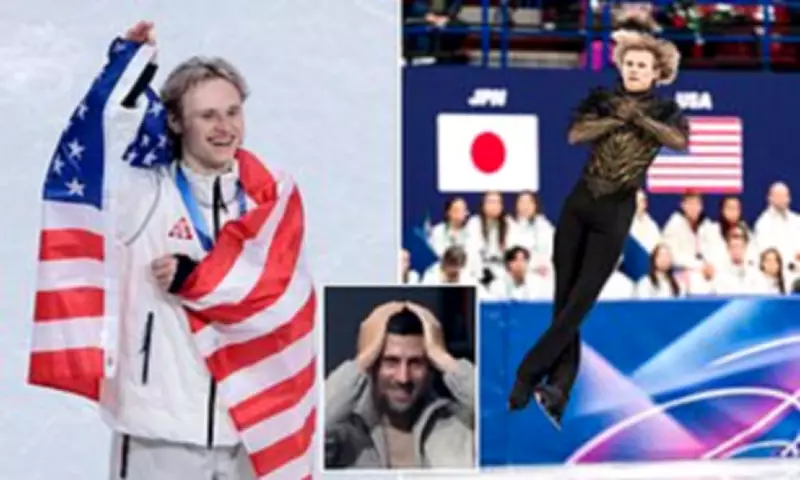
Malinin, the 21-year-old son of Uzbek Olympic skaters Tatiana Malinina and Roman Skorniakov, performed a backflip during his routine—a trick that hadn't been seen on the Olympic stage for 50 years. Setting up the move with a short rotation, the two-time World Champion briefly traveled backwards before executing the backflip into a right-legged landing, then rotating out of the maneuver with precision.

A Moment That Stunned a Tennis Legend
The historic backflip left 24-time Grand Slam tennis champion Novak Djokovic visibly stunned, with footage showing him rising to his feet, mouth agape and eyes wide in shock. 'I've heard from everyone that after I landed my backflip he was standing there, hands on his head, and I was like, "Oh my God, that's incredible,"' Malinin said afterwards. 'That's a once-in-a-lifetime moment seeing a famous tennis player watching my performance.'
The Backflip's Controversial History and Legal Return
The backflip has been prohibited at the Olympics for five decades due to its inherent danger on the ice. American skater Terry Kubicka first executed it at the 1976 Innsbruck Games before it was banned. French skater Surya Bonaly famously performed it at the 1998 Winter Olympics, landing on one blade, but was penalized as the move remained illegal at that time.
However, the International Skating Union reversed course in 2024, lifting restrictions ahead of the Milan-Cortina Games and making the backflip legal once again. Notably, while now permitted, the maneuver is not classified as a point-scoring element in competition judging.
A Narrow Victory Over Japan
With the teams tied after seven of eight performances, Malinin calmly delivered for the Americans, scoring 200.03 points for his free skate. This atoned for what he considered a mediocre short program the previous night and proved decisive against Japanese sensation Shun Sato.
Sato followed Malinin to the ice, hitting a trio of quads in his own impressive performance, but could only manage 194.86 points, securing second place. The final standings saw the U.S. finish with 69 points while Japan had 68, earning the silver medal for the second consecutive Olympics.
'I was like, "Okay, I'm the deciding factor,"' Malinin reflected after the victory. 'I need to just, you know, do what I need to do.' He opened with a big quad flip, opted for a safer triple axel over his planned quad, and overcame minor mistakes to finish strongly with back-to-back combinations that left the crowd roaring in approval.
Malinin's Strategic Approach and Sato's Valiant Effort
'I knew that it was going to be a tiebreaker between the men's event,' Malinin explained about his mindset. 'So I really just went straight into this, and just went for it. It went exactly the way I wanted, the way I planned. And you know, I'm so thankful for that.'
Sato did everything possible to give Japan a chance at gold, delivering an easier but cleaner program than Malinin. From his opening quad lutz to his finishing triple lutz, he was nearly perfect, pumping his fist as his music ended before learning it wasn't quite enough. 'I didn't really think about whether or not I could beat Ilia,' Sato said through a translator, 'but I definitely wanted to do it.'

The victory marked a redemption for Team USA, who finally received their medal ceremony after being denied at the Beijing Games due to Russian doping controversies that delayed awards for over two years. Malinin's combination of technical excellence and theatrical daring proved the difference in a closely contested competition that showcased the best of Olympic figure skating.