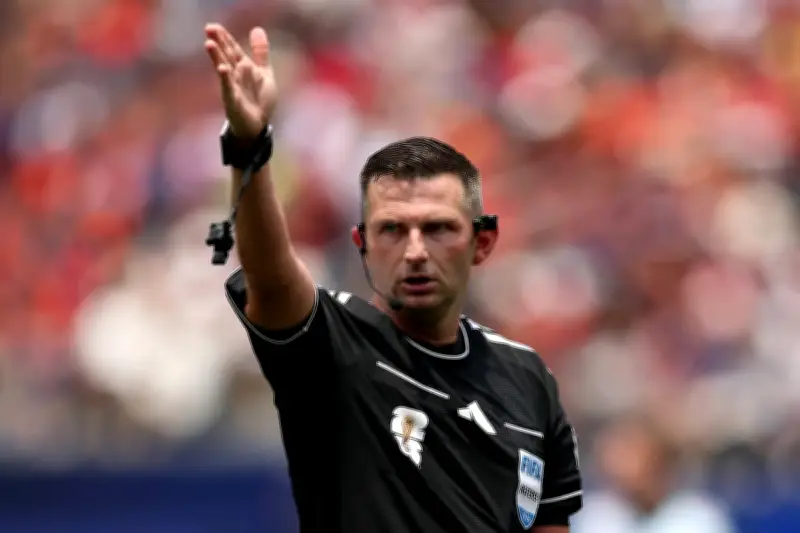
English referee Michael Oliver’s duties at this year’s World Cup are complete after FIFA protocols determined he cannot officiate Sunday’s final, even though England did not reach the match. The Three Lions faced Argentina in the semi-final, and both Oliver and fellow English referee Anthony Taylor were unable to oversee that game due to England’s participation.
FIFA Conflict-of-Interest Rules
FIFA’s regulations state that officials cannot referee a match involving their home nation. However, more surprisingly, neither Oliver nor Taylor can oversee Sunday’s final either. This restriction stems from the fact that neither can officiate Argentina’s games, owing to England’s historical conflict with the nation: the Falklands War of 1982.
The Falklands War was an undeclared conflict over the ownership of the Falkland Islands. The islands had been a British Crown colony since 1841, and many of their residents in 1982 were descendants of British settlers, thus favoring British sovereignty. The conflict began when Argentina invaded and occupied the Falkland Islands on April 2, 1982, claiming ownership. Then-Prime Minister Margaret Thatcher authorized the Royal Navy to liberate the islands, and the war ended on June 14 when Argentina surrendered and returned control to Britain. A total of 907 people were killed in the conflict.
Despite the restoration of diplomatic relations in 1989, neither country has acceded to the other’s claim for ownership. FIFA deems this history a conflict of interest for English referees like Oliver and Taylor to officiate games involving Argentina, and the same applies to Argentine referees for England games.
Impact on Officiating Assignments
Ismail Elfath will take charge of England’s semi-final against Argentina. The official for Sunday’s final has yet to be confirmed. Referees are also not permitted to take charge of games that could directly impact their nation. For example, neither Oliver nor Taylor could officiate Ghana vs. Panama, as both teams were in England’s group. Additionally, they could not have officiated Argentina vs. Switzerland in the quarter-final, as the winner would have faced England.
Oliver and Taylor’s World Cup Experience
Oliver has officiated four matches at the 2026 World Cup, most recently taking charge of Spain’s 2-1 quarter-final victory over Belgium. He oversaw three matches at the 2022 World Cup in Qatar and has been a UEFA elite referee—the highest classification—since 2018. Taylor refereed Spain’s 1-0 victory over Portugal in the round of 16 and three games overall at the tournament, in addition to two games in Qatar.
Prior to England’s match-up with Argentina, Oliver and Taylor had hoped to become the first Englishman since Howard Webb—current head of refereeing body PGMOL—to officiate a World Cup final. Webb did so in 2010, overseeing Spain’s 1-0 victory over the Netherlands, and became the third English referee to achieve this feat after William Ling in 1954 and Jack Taylor in 1974.
England and Argentina faced off in Atlanta, Georgia, with kick-off at 8pm BST. The victor will face Euro 2024 champions Spain, who dispatched France 2-0 in the first semi-final.