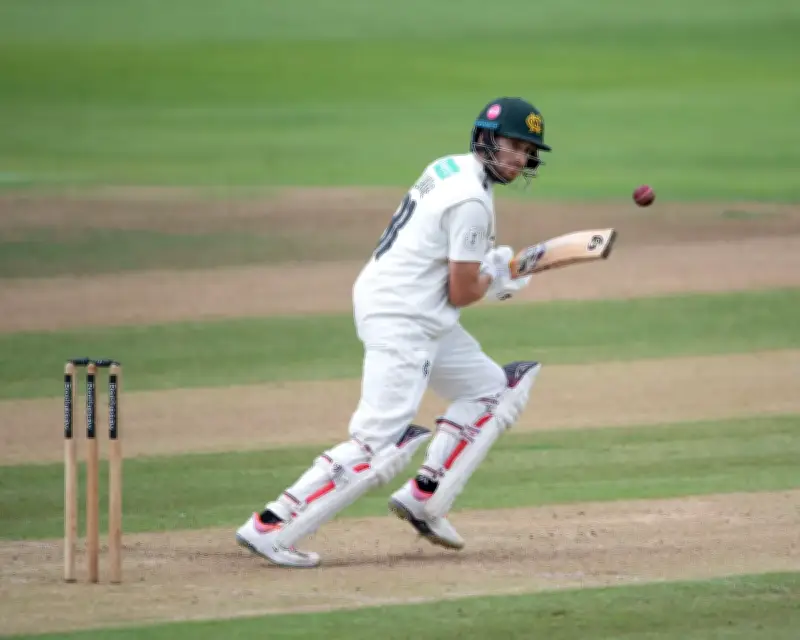
In the five draws played out in Division One of the County Championship, no team picked up more points than Nottinghamshire's 13 and no team picked up fewer than Yorkshire's nine. That four-point difference feels rather meagre in light of the 1,202 points accumulated in the table so far and, inevitably, means a great deal of endeavour did not shift the dial much with just four rounds of matches left to play.
Clarke drafting strong case for selection
That said, Nottinghamshire will take any edge they can get as they seek to retain the pennant. They drew at Warwickshire and have Joe Clarke's 150 to thank for their increased margin at the top. He passed 1,000 runs for the season with his knock and is 191 runs clear of Tom Abell as the highest scorer in the division.
At 30, he is at the peak of his considerable powers and, were it not for his disrepute charge seven years ago, would surely be a strong candidate for a winter tour. He still might be.

Bazball? No thanks
It was a disappointing final day at Hove, where Somerset batted on to leave Sussex 303 to get in 44 overs. That's not impossible under white-ball playing conditions, but proved an invitation for the relegation-threatened home side to bat out time against the red ball, which they duly did.
Starting the day two down with a lead of 119, Lewis Gregory was presented with a couple of routes to 19 points and leadership of the table. The Somerset captain could have sought agreement on a target of 303 in two sessions (achievable with some old-school declaration bowling) that would surely have tempted Tom Haines. Or he could have switched his batting into T20 mode and got there under his own steam.
Adding 83 for the loss of one wicket before lunch was neither fish nor fowl. Somerset remain in contention for that elusive first title, but it might have been rather more than that. Earlier in the match, Henry Crocombe had taken a hat-trick, offering something memorable to the crowd as he heads to The Oval next season. As it happens, his efforts over the next few weeks may go a long way to keeping Sussex up and sending Surrey down.
That's all, Foakes, as Surrey earn draw
Things could have become even worse for Surrey when Dean Elgar made a century after announcing this would be his last season as a professional cricketer. That ton seemed written in the stars.
Rahul Chahar, a spinner playing for Surrey, had taken six Essex wickets, but the home side still led by 96 runs on first innings, which looked very handy indeed when Simon Harmer and co got to work. The visitors had crawled to 92 for six off 45 overs, still in deficit with plenty of time left. The trap door was creaking.
Former Essex player Ben Foakes dug very deep to frustrate his old county with a five-hour century, finding obdurate partners down the order in Adam Thomas and Tom Lawes. Tom Westley gave the lion's share of the bowling to Harmer and Sam Cook, but had tried eight options before hands were shaken.
Essex are sixth in the table and should stay in the top flight, but Surrey need to remember how to win matches if they are to avoid the drop.
Fortune does not favour the brave
Faced with the desperation of being bottom of the table with time running out, Hampshire did what Somerset did not and crashed 176 before lunch on the fourth day, Toby Albert and Andrew Neal deploying the long handle to good effect.
Set 302 in two sessions, Glamorgan were always unlikely to chase from the get-go, but were tottering on 21 for three when Kyle Abbott, Eddie Jack and Sonny Baker were stopped in their tracks by bad light and then rain. The 162 all out versus 161 all out in the first innings meant each team took 11 points from the match, the 330 for eight and 21 for three in the second digs counting for nothing.
Alleyne a lone voice (almost)
Before the match at Chester-le-Street, Durham had won six and drawn three of their nine matches in Division Two; Gloucestershire had won one and lost eight. So the ghost of Nostradamus was not required to foresee the result, which duly arrived.
In a batting order like a Manx cat (all XI boasted a first-class century), David Bedingham made a century at just shy of a run a ball and Kasey Aldridge took nine for 63, to send the home side 40 points clear at the top and the visitors 50 points adrift at the bottom.

Bad light stopped play on day three with four runs to score in Durham's second innings. Everyone trudged back to start for six balls on the fourth day and Durham's makeshift openers did the job – off a spinner. It would be easy to ridicule the umpires but it was not their fault. They had asked for an over (even a ball) of spin in the evening gloom to get the innings under way and the match done, but Gloucestershire refused. Coach Mark Alleyne revealed his team's response to that reasonable request: “No, we'll bowl our quick bowlers, in which case it became bad light, so we'll come back tomorrow.” OK, it could have rained all day but, even if it had, a draw for Gloucestershire is neither here nor there.
The way the match ended provoked some sniggering. The county game hardly needs enemies in a national media at worst hostile to its most prestigious format. Teams should read the room better.
Play to er … draw?
Northamptonshire started their match against Kent trailing their visitors by four points in the battle for the second promotion slot, Durham very close to locking down the first. They made up that shortfall in the rain-affected draw, having batted out the fourth day, 345 playing 450 for six when the match was put out of its misery.
Cricket is full of arbitrary inconsistencies – that a captain can invite the follow-on with a lead of 150 runs but not 149 is just one example – but it's hardly breaking news to say that life is too. No player, captain or coach did anything other than act in their team's best interests but, once Luke Procter's side saw 196 for two roll round on the scoreboard, a draw was inevitable and thoughts turned to bonus points.
The fans, the players and the Championship deserve better than that. It can't be beyond imaginations reach to come up with regulations that promote opportunities to keep the game alive after time has been lost between each team's first innings and then run thousands of simulations to ensure a fair balance is struck. The computer you're looking at now could do that with some clever code.
After all, we put up with a lot of nonsense in limited-overs cricket until Duckworth and Lewis said: “Actually, we don't have to.” And now, we don't.