England are about to face the hardest challenge in international football, maybe at any level of the game. They are going to try to score against Spain. Spain conceded one goal in eight games on the way to winning the World Cup while allowing their opponents 2.37 expected goals, a mere 0.30 per 90 minutes played.
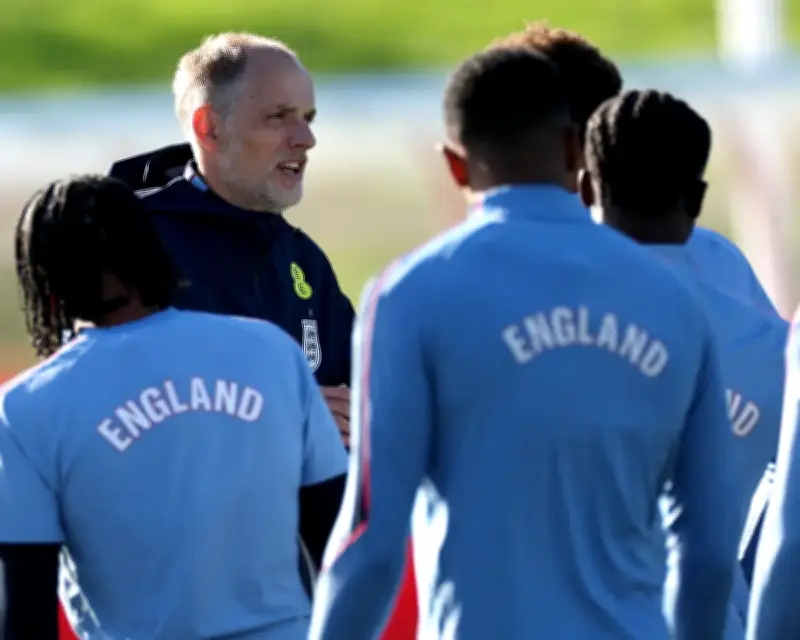
Thomas Tuchel has said he hoped his side “became for 10 minutes more like Spain” to comfortably dominate possession when the heat was on. A fine aspiration for those situations, but it is not an approach that will help England unlock the Spain backline. The pass masters cannot be toppled that way. The solution may lie elsewhere within the same Tuchel press conference.
Tuchel’s ‘chaos’ approach
Tuchel spoke of how English fans and players prefer chaos. “There is no heritage of: ‘Oh, let’s control around the middle line. Let’s do a deep buildup and then bring them out’,” he said. “It’s just like: ‘Come on. Let’s kick the ball into the opponent’s box and fight with them’.”
And this is how England can beat Spain. Granted, it requires a little more nuance than Tuchel’s simple summation. But not much. The two defeats Spain have suffered in the Luis de la Fuente era help prove the point. Both occurred in the UK.
The first was in Euros qualifying at Hampden Park in March 2023, with Scott McTominay scoring both goals in a 2-0 win for Scotland. “For me, this is not football,” Rodri said after enduring the home side’s combative, time-wasting approach. No, pal, and that is why it worked. Nobody can out-football Spain; alternate methods are required to win. McTominay’s second came after he crashed into the penalty area to fire home after David García failed to clear a Kieran Tierney cross.
When Colombia beat Spain 1-0 in a friendly at the London Stadium 12 months later, it was again a delivery from the left flank that did the damage. And again, there was a Premier League past-and-present vibe with Luis Díaz crossing for Daniel Muñoz to score.
Crosses create Spain’s conceded chances
These moments carry positive confirmation bias as they occurred in losses for Spain. They look important because they were. While no side beat them this summer, teams relied on crossing to fashion even vaguely decent opportunities.
The stats for the chances they allowed highlight this superbly. The average value of a shot is 0.1 xG. It can vary slightly from season to season or between competitions, but as a rule of thumb it works. In 750 minutes this summer, Spain conceded six chances Opta deemed to be of greater value. Lowering the bar to 0.07 xG still only finds 10 shots that were worth more. The eight teams Spain faced had to work for a collective average of 75 minutes for an opportunity that had a better than one-in-14 likelihood of becoming a goal. It was very hard graft.
It is remarkable that the highest value shot they allowed in the tournament occurred in the 121st minute of the final. A match Spain utterly dominated from start to finish might have gone to penalties had Giuliano Simeone fired under the crossbar rather than over it. The move for his chance originated from a corner, as did the cross that presented Cape Verde’s Diney with a 91st-minute opportunity to produce a titanic upset in Spain’s first game.
Charles De Ketelaere’s goal for Belgium, the only one Spain conceded, was set up by a Timothy Castagne cross. It was one of the four Opta-defined big chances Spain allowed at the World Cup; all of them headers, all set up via deliveries from wide areas.
Why crosses work against Spain
Cristiano Ronaldo had a relatively high value effort in the last-16 Iberian derby after a cross to the back post had been headed back towards him in the six-yard box. It was a better chance than any France produced in the semi-final. Their highest value attempt was rated at 0.06 xG. It came from a corner.
There seems little other way to produce even a shot against Spain. Cape Verde, Saudi Arabia and Uruguay all tried to score from within their own halves, so starved were they of goalscoring opportunities.
Crosses seem to work though, at least relatively speaking, perhaps because Spain’s key defensive players are unaccustomed to facing them too often. Pau Cubarsí’s Barcelona conceded the second-fewest crosses per game of the 96 clubs in Europe’s big five leagues last season. Athletic Bilbao, featuring the other two-thirds of Spain’s first-choice combination of goalkeeper and centre-backs (Unai Simón and Aymeric Laporte), were joint-ninth.
Cubarsí and Laporte each contested fewer than four aerial duels per 90 minutes; many centre-backs in the Premier League won, let alone contested, more than that. Balls in the air are a much bigger part of the game in England, where ‘they kick the ball into the opponent’s box and fight with them’, to re-quote Tuchel.
In an age of tactical sophistication, crossing is deemed too inefficient. It is very old-school, leaning heavily on English football stereotypes. But we are not plotting out the development programme at St George’s Park for the future of the game, we are trying to see how England can score in one match against the meanest defence in international football.
If Trent Alexander-Arnold is keen to get back into Tuchel’s good books, delivering a cross on to the head of Harry Kane against Spain would be a strong starting point. There may be no other way for him or England to prosper against the world champions.