Horse racing betting odds explained in simple terms can help new bettors understand both the implied probability of a horse winning and how much a successful bet could return. This guide covers the main formats and terms before you use any UK betting sites, including how to read fractional and decimal prices.
What are horse racing betting odds?
Horse racing odds are a bookmaker's representation of the probability of a horse winning, or placing when an each-way bet is involved. Shorter odds indicate a horse is considered more likely to win and therefore offer a smaller potential payout, while longer odds indicate a less fancied runner with a larger potential return.
Online betting apps generally default to fractional odds, although most allow bettors to switch to decimal prices in their settings. For example, a well-fancied favourite priced around 2/1 in a competitive handicap is a clear market leader, while a 20/1 outsider is a longer-priced runner with less market support.
How fractional odds work
Fractional sport betting odds show potential profit rather than total return. The number on the right is what you stake to win the number on the left, so 5/1 returns £5 profit from a £1 stake, giving £6 back in total including the original stake.
To convert fractional odds into an implied probability, divide the right-hand number by both numbers added together, then multiply by 100. For 5/1, that is 1 divided by 6, multiplied by 100, which is roughly 17%. That means an 8/1 horse in a big handicap implies roughly an 11% chance of winning once the bookmaker's overround is accounted for.
Favourites, outsiders and odds-on
The favourite is the runner with the shortest odds in a race and the one the bookmaker rates most likely to win. An outsider has longer odds and is considered less likely to prevail.
Odds-on means the number on the left of the fraction is smaller than the number on the right, such as 4/5, 1/2 or 2/5. To win £1 in profit, you must stake more than £1 because the bookmaker considers the horse more likely than not to win. Evens, shown as 1/1, represent a 50% chance in theory. A 4/5 favourite implies a probability of around 55%, while an 8/1 each-way chance sits at around 11%. Some bookmakers may also exclude odds-on selections from free bets or promotional offers, so check the relevant terms.
How decimal odds work
Decimal odds are a single number representing the total return, including the stake, for every £1 wagered. Multiply the stake by the decimal price to calculate the total return, so 6.00 x £1 gives £6 back, including £5 profit. To convert decimal odds into a probability, divide 100 by the decimal price. A price of 6.00 is 100 divided by 6, or roughly 17%, while 2.00 represents 50%.
The key difference is that decimal odds include the stake in the quoted number, while fractional odds show profit only. The same price can therefore be displayed as 5/1 in fractional odds or 6.00 in decimal odds.
What is starting price?
Starting price, or SP, is the official odds for a horse when a race starts. It is set using the on-course betting market and is used to settle bets placed at SP - this is how bookies work. Bettors can generally choose to take the price available when they place their bet or take SP instead. The available price can move before the off as money enters or leaves the market.
What is an each-way bet?
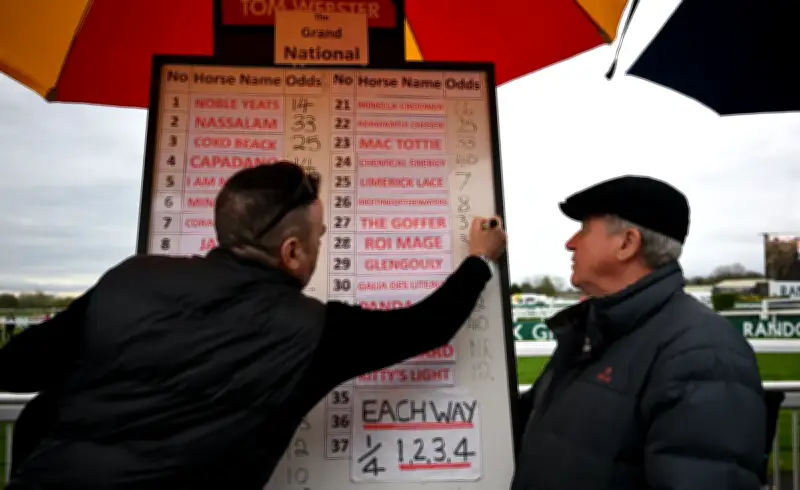
An each-way bet is effectively two equal bets in one: a win bet and a place bet, with each settled using half of the total stake. The place part pays at a fraction of the win odds, commonly 1/4 or 1/5, if the horse finishes within the stated terms, usually the top 2-4 depending on the field.
This can reduce the risk compared with a win-only bet because a horse finishing second or third at long odds can still return a profit on the place part, even though the win part loses. Bookmakers sometimes extend each-way betting terms as a promotion, such as paying extra places on a major race. The terms can vary, so check them before betting on a large field.
Responsible gambling and FAQs
Betting should be treated as entertainment and you should set a budget and stick to it. UKGC-licensed operators provide tools including deposit limits, loss limits, time-outs and self-exclusion. If gambling is causing concern, support is available through GambleAware, GamCare, Gamblers Anonymous and the NHS. Only gamble if you are 18 or over.
Odds-on means the smaller number sits on the left of the fraction, such as 4/5 or 1/2. The bookmaker rates the horse as more likely than not to win, meaning the bettor must stake more than they stand to win in profit. An each-way bet splits the stake into a win part and a place part. The place part pays at a fraction of the win odds, usually 1/4 or 1/5, when the horse finishes within the stated each-way terms, even if it does not win outright.