VAR Storm Misses Liverpool's Real Squad Depth Problem in City Defeat
Miguel Delaney argues in his latest analysis that while much of the reaction to Manchester City's 2-1 victory over Liverpool has fixated on controversial VAR decisions, the real turning point stemmed from Arne Slot's lack of squad depth and tactical flexibility.
The Critical Moment That Exposed Liverpool's Limitations
You could immediately sense the frustration, extending far beyond Liverpool's struggle to break through City's defence. As Slot's side desperately chased the game, seeking any opening around the City penalty area, a promising interchange of passes found Ryan Gravenberch in possession just outside the box. The midfielder clearly wanted to switch play to the obvious space on the right flank... but there was no one there.
Mohamed Salah might typically have occupied that position, but he was already entangled in the crowded penalty area. Dominik Szoboszlai perhaps should have been available, given his nominal right-back role, but he had already drifted infield to a more natural central position at this crucial juncture.

You could witness Gravenberch's visible irritation as he was forced to play the ball back to the Hungarian midfielder, completely sapping the momentum from the attack. Gravenberch had no alternative, but that very lack of choice resulted from much larger strategic decisions Liverpool made long before this fixture.
VAR Distraction Obscures Deeper Structural Issues
Those choices proved far more relevant to the final outcome, and to broader Premier League dynamics, than the contentious VAR decision that ultimately saw Szoboszlai sent off and Liverpool lose 2-1 rather than 3-1. While that spare goal could theoretically prove decisive in the title race or Champions League qualification chase, much will depend on other consequences from this match, which themselves hinge on different choices made during the game.
There is a genuine sense of tedium whenever VAR must be discussed, arguably more frustrating than waiting for the decisions themselves. The most exasperating aspect of this particular episode was how the common-sense interpretation so starkly conflicted with the "letter of the law". You could comprehend the basic logic behind VAR overruling the goal: Szoboszlai had impeded Erling Haaland, denying a goalscoring opportunity, leading to Haaland himself impeding Szoboszlai from preventing Ryan Cherki's strike.
Yet it seems utterly absurd when the supposed denial of a goalscoring opportunity still resulted in a goal being scored. This contradiction perfectly reflects the fundamental circularity of VAR. An increasingly broadcast and digitised game could not tolerate human error and the necessary subjectivity afforded to referees, leading to perceived "inconsistency" and ultimately VAR implementation.
Squad Depth Deficiency Proves Decisive
VAR itself represents the inevitable conclusion of excessive broadcasting, yet since it aims to eliminate human error and the subjectivity actually required for decision-making without technological aid, it creates a rigidity that football cannot properly accommodate. Forensic attention to detail is hardwired into VAR, applying scrutiny to laws never written with such microscopic examination possible.
However, none of this proves as relevant to how the match unfolded as the choices Liverpool faced, or in Gravenberch's case, the absence of options. One primary reason Liverpool lacked alternatives on that right side is because all their main right-sided players are currently injured, hence the Szoboszlai solution, which now creates another problem since his red card means suspension for the Sunderland fixture.
This exposes the next stage of the issue: Liverpool ultimately face these problems because their squad remains too thin, lacking sufficient depth or tactical variability. This may sound paradoxical given their substantial summer investment, but that represents another distinctive strategic choice.

Strategic Choices and Calendar Demands
Football chief executive Michael Edwards' policy typically allocates most club wages toward the starting eleven, with emphasis on attacking talent that genuinely makes a difference, but Liverpool arguably pushed this approach too far during the summer transfer window. This becomes evident in some sales necessary to fund major purchases, leaving them with a noticeably lopsided squad composition.
While some might cite injuries as mitigating factors, this only reinforces the central argument. Elite football now operates within the busiest calendar it has ever experienced. Regardless of physical preparation quality, you cannot reliably expect the same core players to remain fit throughout the season. Equally importantly, you cannot continuously field them in this demanding schedule.
Any elite team essentially requires what amounts to an entire second eleven. This explains precisely why Arsenal, and now Manchester City, have deliberately constructed deep squads for this campaign. Liverpool, at this crucial juncture, pursued a different direction.
Bench Strength and Tactical Consequences
You need only consider Sunday's constant discussion regarding the difference between the respective benches. Then recall Gravenberch having no viable option at that critical moment. The Liverpool squad simply wasn't constructed for such scenarios.
While there are multiple fair criticisms of Slot's attempted solutions to Liverpool's various issues this season, this represents another instance where he has been dealt a difficult hand. From this situation emerged yet another direct consequence: deploying Szoboszlai at right-back means Liverpool cannot field their best midfielder, and arguably their best player, in central areas, in a match where that zone was repeatedly exploited.
Those gaps eventually proved telling, despite a significantly improved Liverpool second-half performance. Slot's side probably should have won the game to properly transform their season, but that crucial disparity in depth may now have swung momentum toward City.
Broader Implications and Momentum Shift
The reality of this performance was that Guardiola's side played poorly, continuing their pattern of disappointing second halves that has characterised their season. Pressing problems identified by other teams have not disappeared.
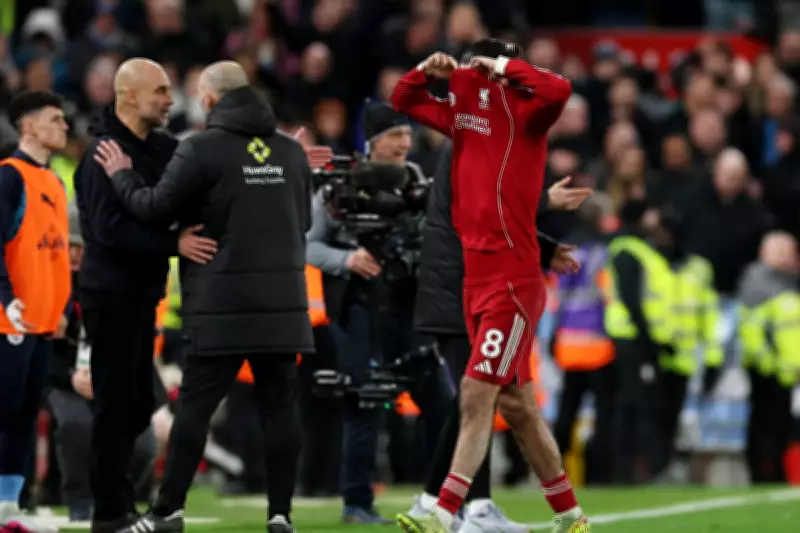
Yet the potential impact of this result manifests in the joy and defiance displayed afterwards. It can generate a multiplying effect. Players themselves acknowledged they believed the title race would conclude with defeat. Marc Guehi delivered an exceptional display, aside from that yellow card decision for pulling back Salah.
As has become almost a mantra in elite Premier League dressing rooms, "momentum is everything", and City now suddenly possess it. Even more crucially, they have it ahead of a forgiving period in their schedule, allowing them to build confidence and deeper tactical coherence. There will have been understandable frustration at Arsenal too. This could have been one of those pivotal days, determined by far more than VAR controversies alone.