Giacomo Puccini passed away just a decade before the inaugural Glyndebourne festival. Now, 92 years later, his global operatic blockbuster Tosca—once dismissed as a "shabby little shocker"—has finally made its debut at Glyndebourne, launching the 2026 festival with a high-octane bloodbath directed by Ted Huffman. This production eschews shabbiness in favour of pure shock value, amplified by the festival's signature champagne and tuxedos.
A Slow Burn to Chaos
Huffman and conductor Robin Ticciati masterfully play the dramatic long game. The curtain rises on a mid-20th-century church interior, complete with wooden pews, a small Madonna and child on the wall, and period-appropriate details: uniformed boys assist men in cassocks, a real mop bucket sits nearby, and a wooden ladder stands ready for the artist-hero. Mid-century modern spotlights illuminate his work, showcasing the production's meticulous attention to lighting and set design. Although the setting is not 1800, it is unmistakably Tosca, with all its familiar elements.
Musical Lulling and False Security
Musically, the audience is lulled into a false sense of security. The woodwind lines are gorgeously capacious, but Ticciati maintains tight control over the London Philharmonic Orchestra's phrasing and dynamics. As Cavaradossi, Matteo Lippi delivers a heroically burnished performance, evoking the sobbing tenors of yesteryear. Caitlin Gotimer's Tosca achieves an emotional 0-60 in seconds, her gleaming top notes slicing through Puccini's orchestration while her lower register bristles with intensity. The smaller roles are exceptionally well sung, adding depth to the ensemble.

Scarpia's Entrance Tightens the Screws
With the entry of arch-villain Scarpia, the production's tension begins to mount. Vladislav Sulimsky, clad in a double-breasted pinstripe suit, cuts a figure of a scrubbed-up bruiser and sounds dangerously smooth. Ticciati coaxes midnight-black sonorities from the LPO's lower registers. The drumrolls and bell-tolls of the Te Deum are carefully overamplified, creating sensory overload that hints at real nastiness, underpinned by the chorus on fine form.
A Powerful Acceleration
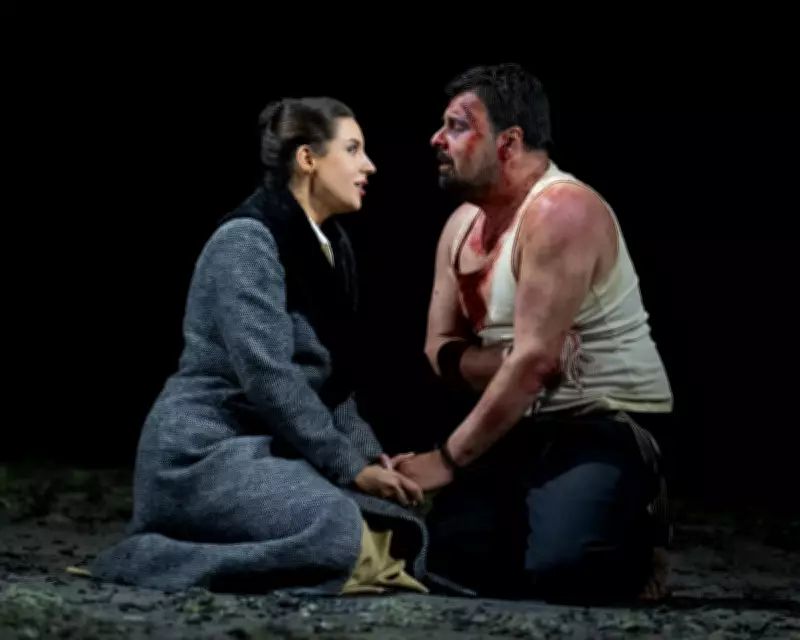
Thereafter, the production accelerates away from the traditional Tosca paradigm. The Palazzo Farnese is reimagined as a high-end restaurant, with Scarpia, the secret police chief, playing the role of a social-misfit maître d'. He brings a burger and squirts ketchup with pantomime relish, while collaborators giggle and stare as Cavaradossi is brought in and tortured in the kitchens. Scarpia pops out for a quickie as Tosca sings "Vissi D'arte." Gotimer performs the hit beautifully, but her desperate shout of "Muori" as she stabs Scarpia is even more powerful. Ticciati now allows the orchestra free rein to snap and bark, its violence barely contained.
The Final Act: Most Compelling
The final act is the most compelling of all. The setting is an abandoned nowhere, lit with appalling, painterly beauty by car headlights. Lippi's heartfelt polish in "E Lucevan le Stelle" and the orchestra's luminous burst of optimism as Tosca enters provide grim counterpoint to the semi-darkness on stage. Huffman's take on the famous denouement is too neat to spoil here, but it makes absolute sense, even as it leaves the audience reeling.
Performances at Glyndebourne, Sussex, continue until 22 June and from 4 to 30 August.