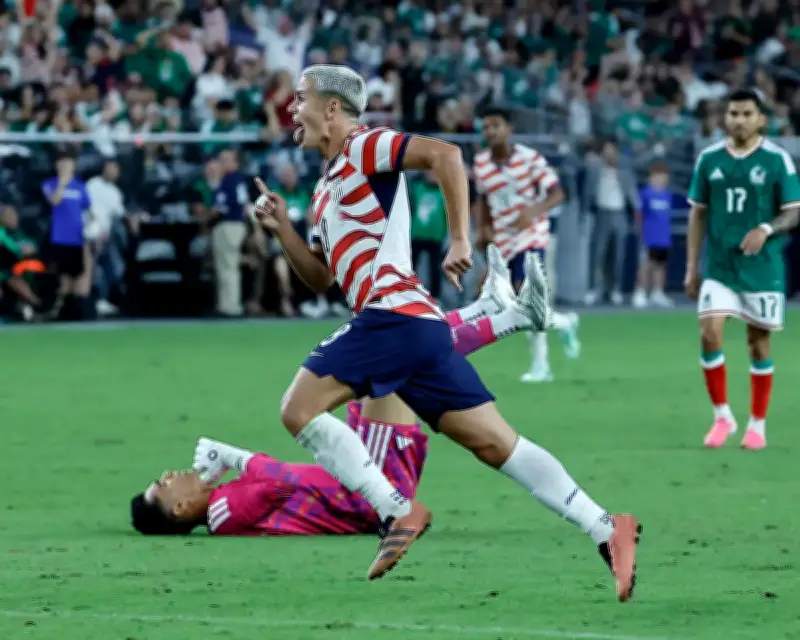
Cavan Sullivan's first international goal was one to remember. The 17-year-old became the US men's national team's youngest-ever goal scorer on Saturday, chipping Mexico goalkeeper Raúl Rangel from 35 yards out after picking off a poor pass, in a 3-0 win. He celebrated with a knee slide toward the corner flag, a moment he said he had visualized before the match.
“I was amazed. I was excited,” Sullivan said of learning he'd start. “I texted my family right after, and after lunch, I took a nap. Before I go to sleep, I visualize and try to manifest good things for the night. Some things come to fruition, some don't.”
“That wasn't the way I pictured scoring a goal, but the celebration was,” he added.
A youth movement in full swing
The more incredible thing about Sullivan's moment, aside from its historic nature and its semi-dreamy origins, is how normal it is for this window for the US. All but one of the 13 potential debutants called in by Mauricio Pochettino have seen time on the field, most of them impressing. Julian Hall, 18, has scored in all three of his appearances. Mathis Albert broke Christian Pulisic's decade-old benchmark to become the program's youngest goalscorer and held the record for a whole four days before Sullivan's chip.
Given the opponents so far, it's fair to say these players aren't inching into the shallow end of the pool. They've been thrown in at the deep end, and they are swimming. Peru and Chile missed this summer's World Cup, but they are far from pushovers. While the US struggled to keep them off the scoreboard, the Americans made up for defensive miscues with a commitment to attacking, scoring four goals in each friendly.
Weathering the storm against Mexico
On Saturday, the US showed they can weather a storm. Pochettino's young side were unable to get anything going in the attacking half for most of the first 45 minutes. Mexico stymied the hosts with a man-marking scheme that was appreciated by the El Tri faithful, whose numbers in the stadium dwarfed those of the US. And yet, as Pochettino put it, a lineup with an average age of 23 years and 25 days “suffered together” without conceding before a shock US opener flipped the script.
“It's really important to play this type of game,” Pochettino said. “To build our experience, to know what [is needed] to play this type of game, and the adversity. I think it will help when we start the qualification for the World Cup. I think that experience will help the team to manage the pressure and stress in a different way. You need to feel that.”
New faces in key areas
Importantly, this added experience comes to several new players who offer reinforcement in crucial areas of need. Diego Kochen has been the standout of the four selected goalkeepers, more confident commanding his area than Chris Brady and more natural in possession than Matt Freese. Sullivan has quickly found ways to affect the game at right wing, a role Pochettino largely entrusted to Sergiño Dest throughout the World Cup summer. Hall's exceptional off-ball movement makes him another capable goalscorer as an alternative to Folarin Balogun (and even more competition for Ricardo Pepi).
Others also look like safe bets to stick around. Albert and Justin Ellis are dynamic options for the team in transition. Neil Pierre and Adri Mehmeti could be useful additions in central defense and midfield, respectively. There's little room for complacency among Pochettino's core.
“They're battling for it, and I love to see it,” center-back Chris Richards said Saturday. “I mean, the young guys, they're hungry. They have a bit of swag to them, and that's something that I've been very impressed with.”
A different path from 2018
This mass debut event differs considerably from the last one, which immediately followed the US's failure to qualify for the 2018 World Cup. That period saw the emergence of Adams, Weston McKennie, Antonee Robinson and Tim Weah, giving the fanbase sorely needed fresh faces. They joined a team with few, if any, senior figures around for the rebuild. This time around, the young guys can get their sea legs without the additional pressure.
“I think the balance that we've been able to have in lineups, surrounding them with guys that have experience, they can go under the radar for some parts of the game,” Adams said. “They don't have to put in crazy, crazy performances. We just want to get them in the good spots where they're comfortable to score goals, to go 1v1, to show the qualities that they have, and we were able to do that.”
The trick, then, will be to keep the good vibes of this camp from being an aberration – to avoid the wild fluctuations that have defined much of Pochettino's USMNT tenure so far.
“We need to protect them. We need to support them,” Pochettino said. “Our responsibility now is [ensuring] that this group of talented players [will] grow in the right direction. Today, they were so excited to play. Again in St Louis, against Chile, they were so excited, and they were so excited in playing against Peru in Orlando.”
“We need to continue with that idea, keep that feeling. Every time that they can be part of this national team is the most important. OK, maybe it's tough to say that, but I think that is what we expect [as] a coaching staff. It's not 'play well or not'. It's that commitment and the desire to play, that today is the best and the most important game in your life. That is what we try to translate. We need to come to the national team for business, not for fun, and that is what is most important.”