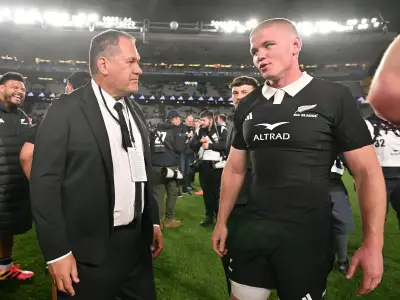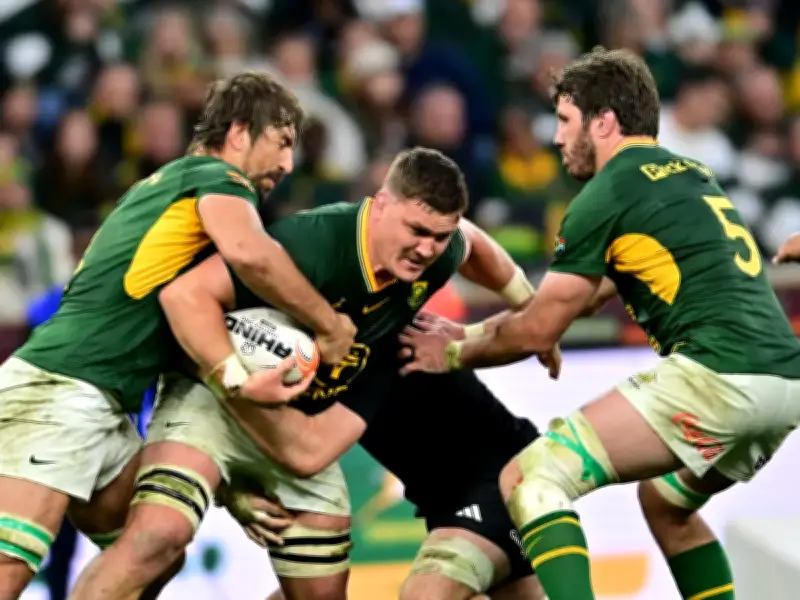
South Africa gained revenge on New Zealand to level the series with a 33-26 victory in Cape Town. The Springboks pack powered their way to victory, but the All Blacks still caused them plenty of problems as they outscored their hosts four tries to three.
This has set up a mouthwatering third Test in Soweto next Saturday. As one would expect, there has been a vocal reaction to South Africa's victory.
Media reaction to the Springboks' victory
Clinton van den Berg of South African Rugby Magazine said: "It was a flex of coaching muscle, timing a personnel switch to maximise pressure on a fraying New Zealand pack. Depending on where you sit, Erasmus’ switch was either shrewd game management or something closer to cynical, but nobody can argue it did not work."

He added: "Crucially, South Africa converted every 22m entry into points in the first half, a marked improvement on last week’s wastefulness at Ellis Park, where clinical finishing deserted them at the crucial moments. This time, power was blended with aggression at the collision and clinical execution followed."
Erasmus's tactical gamble pays off
Alex Lowe of The Times wrote: "This was another thunderous Test match. The Springboks have not lost back-to-back Tests for more than five years and they rebounded like champions from defeat at Ellis Park, drawing level with the All Blacks in this enthralling four-Test series."
He noted: "In contrast to the first Test, the Springboks were able to make their superiority count, chiefly because they took the points when they were on offer. Armed with a commanding lineout on both sides of the ball and a maul that the All Blacks struggled to contain, South Africa scored three first-half tries, from Jesse Kriel, Damian De Allende and Siya Kolisi. But it was the goalkicking of Cheslin Kolbe, as Malcolm Marx led an assault on New Zealand’s breakdown, that saw them home, despite a spirited effort from the All Blacks, who once again outscored them on tries."
Lowe added: "Erasmus was under pressure and he spent all week playing games with his team selection, in a flagrant breach of the spirit of the regulations if not the wording."
All Blacks' late rally falls short
Gerard Meagher of The Guardian said: "The Boks are back. Level at one apiece in the series after a return to what they do best. Blending power and directness, blood and thunder, to edge far enough ahead of New Zealand and withstand a gutsy comeback from the All Blacks."
He added: "Throw in some brazen mischief from Rassie Erasmus, who swapped his entire front row just an hour before kick-off, and this was much closer to a trademark Springboks performance, after they were unrecognisable a week ago. South Africa were far from flawless but constantly ferocious. It was not a knockout blow – not least given how the All Blacks finished the match – but it was some counterpunch after last week’s humbling."
Daniel Schofield of The Telegraph wrote: "Victory then and vindication too for head coach [Rassie] Erasmus, who was rewarded for nearly all of his big calls and garnered the response he craved following the 33-16 defeat at Ellis Park. Some of his methods push the boundaries of sportsmanship – s***housery might be a better term for it – such as swapping his starting and replacement front row en masse an hour before kick-off."
He added: "Yet whatever his lack of a moral compass, there is no doubt that Erasmus is a visionary. Other coaches talk about using hybrid players and may experiment for 10 or 15 minutes in the right circumstances. Erasmus, meanwhile, replaced captain and flanker Siya Kolisi with centre Andre Esterhuizen in the 43rd minute. The former Harlequin duly won the match-sealing penalty at the breakdown. And which other coach would trust a winger with goalkicking duties in the biggest match of their World Cup cycle? Kolbe finished with a 100 per cent record."
Gregor Paul of the New Zealand Herald said: "The little moments went the way of New Zealand last week, but in Test two of Rugby’s Greatest Rivalry series, it was South Africa who knew how to convert pressure into points and how to squeeze the All Blacks into an anxious knot."

He added: "The hosts played the better rugby. That’s a painful fact for the All Blacks, but it’s true. The Boks are so-often derided for their devotion to one-dimensional strategies – faintly accused of bringing the game into disrepute for having the temerity to enjoy scrummaging. But in their Cape Town, the Boks they had a bit of pass and catch in their mix, enough certainly to effectively balance their box kicking, build the pressure and finish their opportunities."
Paul noted: "As Erasmus noted, this All Blacks team is not the one it was a year ago and there was an underlying sense of relief that his side had sneaked home given how tight the margins were between winning and drawing. And that that’s the crazy thing – it felt like the All Blacks were a little overwhelmed by South Africa’s ball-carrying, battling to stop their maul, constantly playing with the defence in their face and not quite winning the high ball as often as they would have liked, and yet they were maybe two phases away from salvaging a draw. Credit to their spirit – they hung in there, playing the role of the Hollywood apocalyptic Zombie and refusing to go away."
Craig Ray of the Daily Maverick wrote: "A ferocious first-half onslaught by the Springboks was enough to withstand a late rally by the All Blacks in a pulsating encounter that underlined the intensity of the old rivalry in 80 riveting minutes. The Boks, stunned by a 33-16 loss in the first test at Ellis Park, ripped into the New Zealanders from the outset and laid down a marker. There would be no soft moments on this day as they deservedly took the spoils to inflict a first defeat on new All Black[s] coach Dave Rennie in his ninth outing. It was far from perfect, but the intensity was higher and in the first half, they wasted far fewer chances than a week earlier."
Dustin Wetdewich of Nova News said: "What looked comfortable at 33-19 with nine minutes remaining became absolutely terrifying as the All Blacks scored seven points and threw everything at a Springbok[s] side desperately trying to close out a match that swung from clinical dominance to nail-biting desperation. When the final whistle blew, relief washed over the home crowd. The Springboks had delivered the response Rassie Erasmus demanded after Ellis Park’s horror show, playing with intensity, accuracy and the kind of clinical edge that was completely absent six days earlier. But they made it harder than it needed to be and the All Blacks’ refusal to surrender nearly produced another famous comeback."