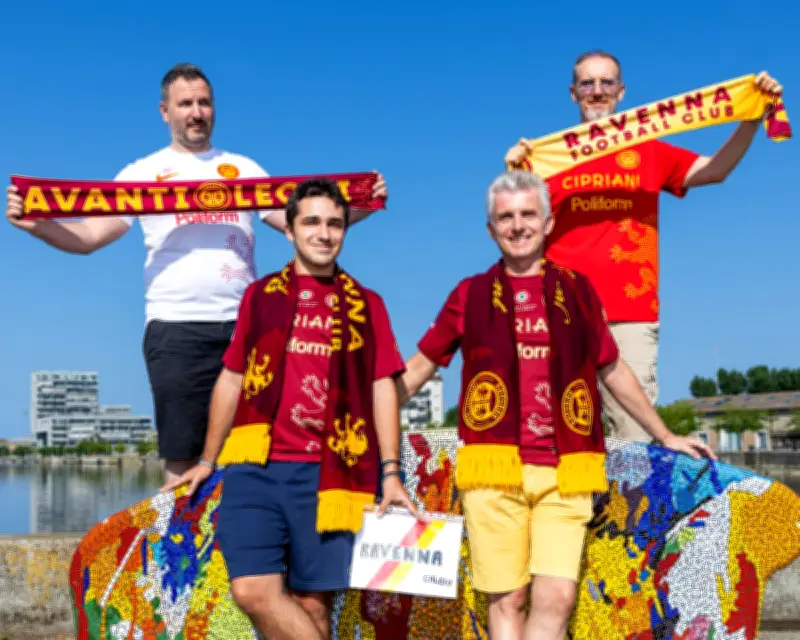
On a scorching summer afternoon in Ravenna, a city better known for fifth-century Byzantine mosaics and Dante’s tomb than for footballing glory, locals are keeping an eye out for one of world football’s most recognisable figures: Ronaldo de Assis Moreira, better known as Ronaldinho. The 2005 Ballon d’Or winner and 2002 World Cup champion also featured in the World Cup final half-time show alongside Madonna and Ronaldo. Four Ravenna supporters sitting at a cafe flick through La Gazzetta dello Sport, Italy’s famous pink sports daily, with dry irony: “We haven’t seen him yet.” They are sceptical, viewing the signing as a purely commercial operation, yet they still harbour the dream of seeing him wear their yellow and red shirt.
A president with Serie A ambitions
The whirlwind engulfing Ravenna is largely down to the business instinct of Ignazio Cipriani, heir to the Venetian hospitality dynasty behind Harry’s Bar. The Ravenna native took over the club in 2024 when they were in Serie D, the fourth tier of Italian football. He is the grandson of Raul Gardini, the Italian chemicals tycoon and sailor who steered Il Moro di Venezia to the 1992 America’s Cup final.
In his first year as president, Cipriani oversaw victory in the Serie D Cup and promotion to Serie C. But that is just the first step, he says: “It’s not a provocation. Serie A is the goal I declared from day one because I intend to reach it. And the Champions League remains the ultimate horizon we want to walk towards, step by step. I made this statement because I like working with my back against the wall: when you have no way out, you are forced to find solutions instead of excuses. I prefer to remove every alibi from the beginning.”
How the Ronaldinho deal came together
This summer, Cipriani pulled off a move so surprising that many assumed it was a prank: bringing the 46-year-old Ronaldinho back as a player. The deal was announced in Miami in June, with Ronaldinho holding up a Ravenna top alongside the club president.
“We met through Lorenzo Tonetti and Ariedo Braida,” Cipriani says, “two people who worked for over 20 years at AC Milan and had Ronaldinho as a player. The idea of involving him was a dream I cultivated as soon as I bought the club. Thanks to Lorenzo and Ariedo, we met, started talking, and a genuine friendship grew. From that relationship came many ideas for the club’s growth. And to the question everyone is asking, I am happy to answer: Ronaldinho will wear the Ravenna shirt as a player, and he will try – maybe scoring the last goal of his career with us!”
A tradition of small budgets
The announcement sent shockwaves through the city. A dedicated website put a special-edition shirt with the “R10” logo on sale, and it sold out within hours – a striking collision of high-end global branding, small-town football and brilliantly executed marketing.
“If someone had told me three years ago that Ronaldinho was coming to Ravenna, I would have sent them straight to the psychiatric ward,” says Fabio, a lifelong supporter. “The night the news broke, international headlines everywhere read ‘Ronaldinho to Ravenna’. It was an extraordinary operation.”
Ravenna is no footballing giant. Plagued by bankruptcies in 2001 and 2012, the club has spent decades bouncing around the lower tiers, with seven seasons in Serie B the highest point. Historically a volleyball stronghold, the football scene was used to modest budgets and regional rivalries.
Building a global bridge
For Cipriani, Ronaldinho is more than a headline. “Ronaldinho is a unique icon,” he says. “His way of playing made my generation fall in love with the game. We want him today to make the next generation of fans, in Italy and around the world, fall in love with Ravenna. It’s not just a visibility stunt; it’s about building a bridge between different eras of football and growing a truly global fanbase around it.”
To support that project, the club is working with the municipality to renovate the Stadio Bruno Benelli, raising capacity beyond 6,300. The president’s ultimate dream is a new multi-purpose venue open seven days a week, with retail spaces, concert facilities and an integrated Hotel Cipriani linked to the city’s international tourism expansion.
Mayor sees wider benefits
Ravenna’s mayor, Alessandro Barattoni, sees the arrival as fitting into a broader strategy to promote the city globally. Ravenna has been expanding its international reach beyond traditional beach tourism and commercial ports, with renewed ties to the Anglo-Saxon world highlighted by a recent visit from the British royal family and the opening of the Lord Byron Museum.
“Ronaldinho brings a whole new level of global fame,” Barattoni says. “When the news broke, my phone exploded with messages from former schoolmates. For younger kids today, he might be someone to discover on YouTube, but the fascination remains intact.” He adds, with a smile, that if his schedule permits he would be delighted to personally guide Ronaldinho on a tour of the city’s cultural heritage.
The mayor is also quick to define the institution’s role: “Our common ground with the club is internationalisation: bringing Ravenna’s image to the world. Ronaldinho has been a global ambassador for countless brands. There is an overarching project that can bring great visibility to the team and allow the city to showcase its initiatives beyond standard routes.” He adds: “Even before Ronaldinho’s arrival, the club did a fantastic job engaging younger generations. The average age in the stands is lower, more vibrant, and more engaged than ever before. A genuine sense of community is forming.”
Traditional fans stay wary
Nevertheless, fears of a hyper-commercialised image linger among traditional supporters. In the Curva Mero, marketing moves are treated with caution. “There is a certain reluctance among some factions,” Fabio admits. “Modern football pushes values that many don’t share: rising ticket prices, losing accessibility for lower-income families. As a result, visibility and marketing stunts risk being viewed sideways.”
Cipriani insists the club’s roots will not be forgotten. “Without roots, no global project makes sense,” he says. “Ravenna is not a brand we are building from scratch; it’s a history and an identity that existed before us. Tradition isn’t a brake on ambition: it’s the foundation. A club without its people is worth nothing.”
Giovanni, another fan, says: “I’m 50 years old and I’ve been coming to the stadium since my school days. I’m rediscovering the enthusiasm of the past. If it takes an icon like Ronaldinho and a local entrepreneur to make us dream of Serie A, then so be it. The important thing is never to forget the people in the stands.”
Season tickets and a summer festival
Riding the wave of the “Ronaldinho Effect”, the season-ticket campaign has just launched with a target of selling 2,800. Ticket prices have risen by an average of about 12%, with variations across different stadium sections.
For now, Ravenna is soaking up a dizzying, galvanising atmosphere. On the pitch, the club is assembling a squad to win the league; off it, the city awaits 20 August, when Ronaldinho is expected to appear during a three-day summer festival in nearby Marina di Ravenna, organised in signature Cipriani style.