Manchester City are set for another trophy-laden era, even if they receive the worst possible punishment after being found guilty of 114 Premier League rule breaches. At least according to everyone's favourite management game, Football Manager.
City, who continue to deny any wrongdoing and have appealed against the independent commission's verdict, and the rest of football are waiting to see what punishment will be meted out to the eight-time Premier League champions. Potential sanctions include expulsion from the top flight, a points deduction and a huge fine. The most severe penalty could see City booted all the way down to the National League, leading to matches against the likes of Boston United, Hornchurch and a derby with Altrincham.
Setting up the FM experiment
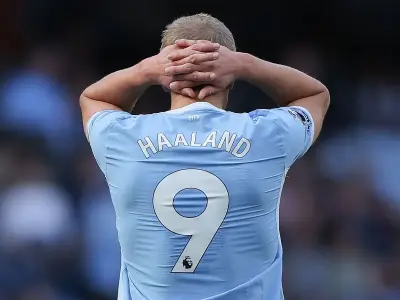
After demoting City four consecutive times, we granted the highest-placed club in each division a reprieve from relegation. That handed a lifeline to West Ham United, Oxford United, Exeter City and Harrogate Town in their respective leagues. Following that, we tweaked a number of behind-the-scenes statistics to mirror the club's decline in reputation and morale, taking into account how players such as Erling Haaland, Enzo Fernandez and Gianluigi Donnarumma would react if they were suddenly expected to compete in the fifth tier.
Using a custom database refreshed with the summer's most significant transfers, we set about our task. With everything loaded up and ready to go, we simulated 10 seasons to discover whether City could fight their way back to the summit.
National League reality
The player exodus was instant. Six of City's top earners, including Haaland, demanded a move. The likes of Fernandez and Donnarumma had little appetite to stick around for fixtures against Southend United or Gateshead, either. Haaland secured a move to Barcelona, with Rayan Cherki following him to the Catalan capital. Real Madrid swooped for Fernandez, while Donnarumma and Jeremy Doku headed to Newcastle, and Antoine Semenyo left for Atletico Madrid. The remainder of the squad surprisingly stayed intact.
City were utterly dominant in their first season in the National League. The Citizens won 44 of their 46 matches, drawing two, and stormed to the title with 134 points. Despite holding on to a host of big-name stars, however, the club were dumped out of the FA Cup by MK Dons. There was cause for celebration, as the club lifted the FA Trophy, though this triumph stood in stark contrast to the European night supporters had grown accustomed to.
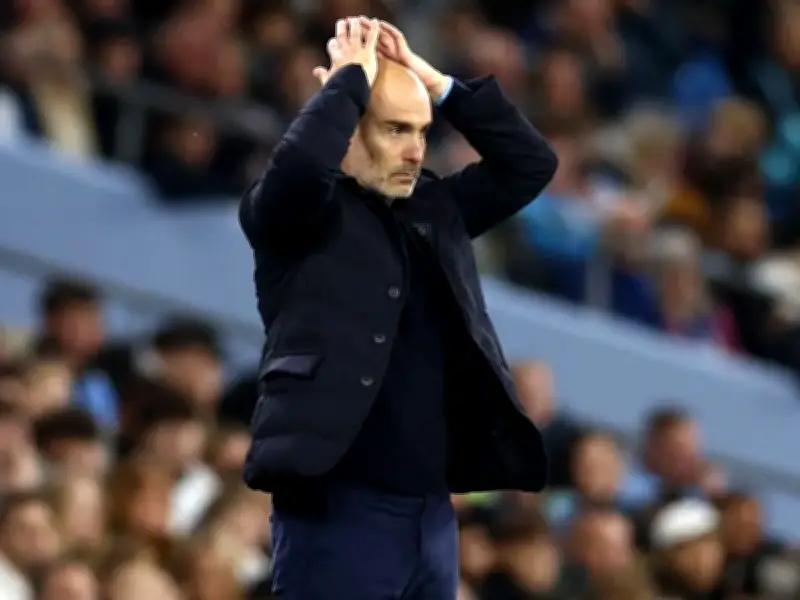
Enzo Maresca remained at the helm and oversaw a remarkable transformation in Nico O'Reilly, who emerged as the club's leading scorer that campaign with 23 goals. Unsurprisingly, City opted against dipping into the transfer market, and none of their star names departed until the summer.
Back in the EFL
City's return to the EFL also got off to a flying start. Another commanding league campaign saw City cruise to the League Two title, though they did suffer two defeats and draw eight times, clinching the championship with a staggering 34-point margin over runners-up Chesterfield. Further FA Cup misery followed, with a third-round exit at the hands of Bolton Wanderers. Season two brought no additional silverware, as Norwich City knocked the Sky Blues out of the League Cup, while Millwall triumphed in a penalty shoot-out in the FA Cup quarter-finals.
New free signing Milan Smit from Stoke City was City's leading marksman with 19 goals as City finally opened their chequebook again. On this occasion, it was a comparatively modest outlay for James Justin from Leeds United at just £5.5m that represented their biggest expenditure. The departures before the season kicked off were equally noteworthy. Elliot Anderson, O'Reilly and Josko Gvardiol were amongst the high-profile names who had remained at City despite the club languishing in the fourth tier. All three eventually moved on during the summer. Anderson departed for Bournemouth for £29.5m, while O'Reilly switched to Spurs for £26.5m. Gvardiol reunited with Haaland at the Camp Nou in a staggering £88m transfer.
Further glory followed in the third year of exile. Another league title was clinched in League One, as the Citizens swept past runners-up Salford City by 25 points, amassing 107 points from 33 victories and eight draws, although that was the sole piece of silverware in season three.
Maresca's time runs out in the Championship
Back up to the Championship, then, with just one promotion standing between City and a Premier League return. In theory, at least. However, the City train ran out of steam upon entering the world's toughest domestic non-top-flight division. Having raced through the lower reaches, City couldn't break free of mid-table mediocrity in year four and finished 11th.
Maresca was eventually dismissed, with legend Richard Dunne stepping in for the remainder of the campaign as caretaker boss before making way in the summer for Regis Le Bris. The Frenchman didn't deliver instant success, guiding City to 10th place. But in their third year of Championship action, five years after being booted out of the Premier League, they finally reached the promotion play-offs.
The Blues overcame West Brom in the semis to set up a nail-biting final against Coventry City, which ended in disappointment for Le Bris' troops in a 3-2 loss. It wasn't the end of City's suffering. Twelve months later, they were back in the play-offs. After disposing of West Brom once more in the semi-finals, Wolves crushed City's dreams of returning to the top tier with a 1-0 victory at Wembley.
Determined to put things right, Le Bris invested heavily in the summer. A whopping £88m was splashed on Porto's Brazilian forward William Gomes, while a combined £95m secured Marc Pubill from Bayern Munich and defensive midfielder Marc Cascado from Sunderland. At last, City secured their return to the Premier League. Le Bris masterminded a league campaign that clinched the Championship crown at the fifth attempt with 86 points.
Back in the big time
Having cemented his status as a City cult hero, Le Bris' next challenge was to climb the Premier League standings as rapidly as possible. Opting to place faith in the majority of his current squad, the City manager decided against lavish spending upon returning to the top division. Striker Defari Richardson proved the marquee acquisition in a £20m switch from Aston Villa. Le Bris' judgment proved largely sound as his team finished seventh to secure Europa League qualification at the first opportunity. The following year, City invested a combined £75m on fresh talent ahead of European competition. However, it proved insufficient.
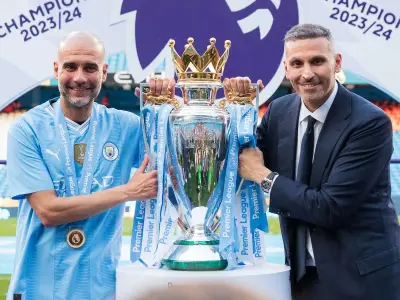
City crashed out of the Europa League at the quarter-final stage, succumbing to eventual runners-up Real Betis. Chairman Khaldoon Al Mubarak was in an unforgiving mood as Le Bris was dismissed in January 2036 after five years at the helm with City 14th in the table. Fellow Frenchman, Julien Stephan, who had captured the Championship, League Cup and FA Cup with Ipswich Town in our simulation, assumed control. He guided City to a modest 11th place.
What about Man United and the wider football landscape?
City's expulsion created a void at the summit of English football. Manchester United supporters could scarcely dream of a more satisfying scenario than their club stepping up to fill it. But would United turn that golden opportunity into tangible success? Sadly for the red half of the city, not quite. Instead, Arsenal tightened their grip on the division, forging a new dynasty. The Gunners claimed the league title six consecutive times in our simulation, adding two more championships after arch-rivals Spurs and Liverpool each won the Premier League.
United were far from disgraced over the 10-year period, although Michael Carrick was dismissed in December 2026. His successor, PSG chief Luis Enrique, took the reins at the close of that season, and the transformation was striking. He remained at the helm throughout the entire simulation, overseeing 510 matches across a nine-year spell. He emerged victorious in 309 of those outings, collecting three trophies for the Red Devils along the way. Two FA Cup triumphs were complemented by a Europa League crown, as league finishes fluctuated between third and sixth.
The Premier League even witnessed the same trio of sides occupying the top positions for three successive seasons. Arsenal, runners-up Liverpool and third-placed Newcastle dominated the standings for three years on the trot. On the European stage, Arsenal finally got their hands on the Champions League trophy by defeating Liverpool in the final during season four. Barcelona, PSG, Liverpool and Real Madrid all lifted the prestigious prize at least once during the simulation. Haaland guided Barca to three Champions League titles, while Pep Guardiola went on to manage both Portugal and Germany before making a dramatic return to club football. His surprise appointment as Chelsea boss nearly produced a Champions League title, only for them to fall short against PSG in the final.
City's starting XI 10 years after relegation to the National League: Zion Suzuki (GK), Marc Pubill (RB), Jaydee Canvot (CB), Abdukodir Khusanov (CB), Daniel Svensson (LB), Mamadou Coulibaly (DM), Marc Casado (DM), Cole Campbell (RW), Allan (CAM), William Gomes (LW), Hamza Abdelkarim (ST).
City's punishment simulated on FM26 - at a glance: Season 3 - League One - 1st; Season 4 - Championship - 11th; Season 5 - Championship - 10th; Season 6 - Championship - 4th - Defeated in Play-off Final; Season 7 - Championship - 4th - Defeated in Play-off Final; Season 8 - Championship - 1st - Promoted to Premier League; Season 9 - Premier League - 7th - Europa League qualification; Season 10 - Premier League - 11th - Defeated in Europa League quarter-finals.