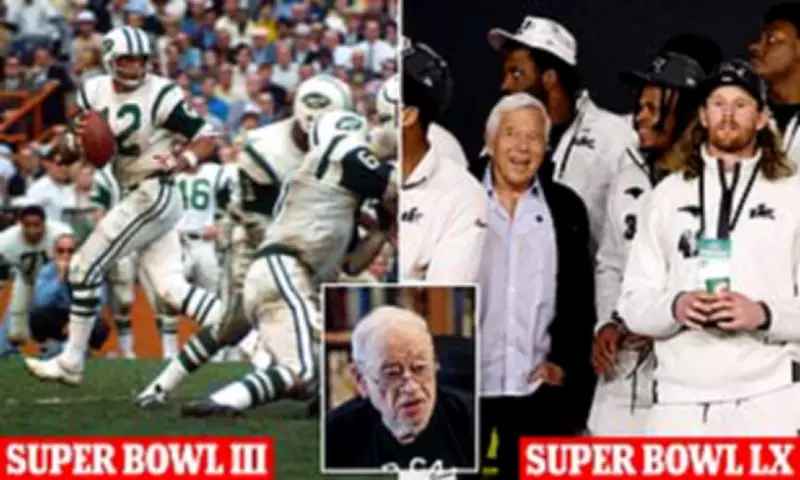
Jerry Izenberg, the legendary sports columnist who personally attended the first fifty-three Super Bowls and witnessed more Muhammad Ali fights than any other journalist, speaks with unparalleled authority when he declares that the NFL's premier event has lost its competitive edge. Now aged ninety-five, the best-selling author shared his candid reflections with the Daily Mail from his Nevada residence, lamenting the transformation of what was once a fiercely contested championship into a corporate spectacle.
The Golden Era of Authentic Drama
"The initial five or six Super Bowls were absolutely fabulous because they featured genuine drama," Izenberg explained. "Today, everyone involved is essentially a business partner. There is no real incentive among the team owners anymore, and the entire atmosphere has changed completely." His new literary work, titled 'Damn You, Josh Gibson,' explores the obscured history of one of baseball's most exceptional talents, while he continues his writing duties for NJ.com, the digital successor to the now out-of-print Newark Star-Ledger.
Unrestricted Access and Personal Connections
The Super Bowl that Izenberg first covered in 1967 stood in stark contrast to the heavily commercialised extravaganza it has become. At that time, the American Football League remained the NFL's lesser-known sibling, three years prior to their eventual merger. Teams such as the Kansas City Chiefs, Oakland Raiders, and New York Jets were battling fiercely for legitimacy and respect.

According to Izenberg, rival owners were driven by mutual animosity, while players, earning modest salaries, desperately needed the winners' bonus cheques to make ends meet. Reporters enjoyed virtually unlimited access to coaches, owners, and athletes who were eager for media attention. Izenberg himself developed friendships with two NFL commissioners: the iconic Pete Rozelle and his successor, Paul Tagliabue.
"Super Bowl I occurred before the NFL Gestapo assumed control," Izenberg remarked, criticising the league's contemporary media relations strategies. "Nowadays, you cannot go anywhere independently; you meet them at the hotel at a scheduled time. When I covered the first six or seven Super Bowls, I conducted interviews with players in their own hotel rooms."
Revealing Human Stories Behind the Game
It was within those hotel rooms in Los Angeles, Miami, and New Orleans that Izenberg uncovered the authentic human drama of the Super Bowl. He recalled a poignant lunch with EJ Holub, nicknamed "The Beast," the middle linebacker for the Kansas City Chiefs, just two days before Super Bowl I.
"I asked him if he was nervous," Izenberg recounted. "He extended his hands and said, 'feel my palms.' I felt the massive linebacker's sweaty palms and, recognising his emotional state, inquired whether a Super Bowl victory would prove 'he belonged' among football's elite. Holub responded, 'no, we win this game, we make $15,000.' That amount is mere tip money today, but Holub confessed, 'I'm scared to death because my wife has already spent it.' That encapsulates what the Super Bowl truly was."
Although Holub's Chiefs lost to the Green Bay Packers, he still received a $7,500 bonus—a sum that might barely cover two tickets to a modern Super Bowl. The inaugural event failed to sell out, whereas Super Bowl LX ranks among the most coveted tickets in global sports.
The Turning Point: Super Bowl III
The Packers triumphed again in Super Bowl II, defeating the Raiders, but it was the third installment that finally legitimised both the game and the upstart AFL. Most football enthusiasts know the story: New York Jets quarterback Joe Namath famously guaranteed victory over the heavily favoured Baltimore Colts, a team many considered the greatest ever assembled.
Namath's legendary guarantee occurred during an MVP banquet dinner, but as Izenberg revealed, it was not the first time Broadway Joe predicted glory that week. Days earlier, Namath and his roommate encountered two Colts players at a Miami restaurant. After some verbal sparring, Namath picked up both dinner checks and drove the Colts players back to their hotel, delivering a final taunt: "I'll see you Sunday, and we're going to kick the crap out of you."

Izenberg attributes Namath's bold pronouncement partly to his "favourite traveling companion at the time, 'Johnny Walker Red.'" Namath, who has since announced his sobriety, earned Super Bowl III MVP honours after the Jets' stunning 16-7 upset, though Izenberg believes running back Matt Snell was the true hero with his 121-yard, one-touchdown performance.
The Erosion of Competitive Spirit
Izenberg's criticisms focus less on the on-field action, which he still finds compelling, citing memorable moments like David Tyree's "helmet catch" in Super Bowl XLII and Mike Jones' game-saving tackle in Super Bowl XXXIV. The fundamental change, he argues, has occurred off the field, where financial interests have diluted competitive intensity and distracted from the sport itself.
"It changed when everybody started making money and the teams merged," Izenberg stated. "Now they are thirty-two business partners. It's the same team; it's called the 'Green Team.'" He recalled a conversation with Commissioner Pete Rozelle, who dismissed the idea of making the Super Bowl a pay-per-view event, calling it "the greatest ad the NFL ever had."
However, Izenberg believes today's ownership groups will inevitably move towards pay-per-view because they prioritise profiting from the Super Bowl over actually winning it. "Nothing gets in the way of their unsatiated quest for money, money, money," he declared.
Halftime Shows and Modern Distractions
The columnist has never had patience for the mid-game concerts, now promoted as the "biggest stage in music." "I never saw a halftime show," Izenberg admitted. "I was always working at halftime, and then I used it as an excuse to go take a piss, so I don't want to see that crap. It has nothing to do with football."
He notes that controversies like Bad Bunny's selection as halftime performer generate more headlines than actual game analysis, illustrating how the business of the Super Bowl now overshadows the competition.
A Reluctant Participant in Modern Spectacle
Despite his grievances, Izenberg still plans to watch and write about the upcoming Super Bowl, predicting a Seattle victory and suggesting a prop bet on Seahawks receiver Cooper Kupp catching more than 2.5 passes. "[The Rams] double-teamed those other guys," he analysed. "Who ended up on Cooper Kupp? A linebacker. He got open by default, and I think there will be a lot of that this Sunday too."
Yet his predictions should not be mistaken for endorsement. All thirty-two owners will profit regardless of the outcome, while players will receive either $178,000 or $103,000 in bonus money—a far cry from the financial desperation of earlier eras. The game's immense popularity means it no longer requires promoters like Izenberg, freeing him to adopt an adversarial role by reminding the NFL of what has been lost.
"The game has lost its way as it fell into more gold than Fort Knox," Izenberg concluded. "It's about greed. And I'm tired of hearing about old so-and-so's girlfriend resplendent in a skin-tight gown. Who cares about that? I'm not saying the game is such a great thing, but it was better when it didn't have the crowds."