For nearly two decades, the Gallowgate End scoreboard at St James' Park was a focal point for Newcastle United supporters, evolving from a simple wooden structure into an electronic centrepiece before disappearing in the mid-1990s.
When the old Leazes End closed late in the 1977-78 season ahead of demolition and redevelopment, Newcastle United's singing contingent were forced to find a new home. They chose to decamp to the opposite side of the ground, gathering on the vast, unroofed terraces of the Gallowgate End.
From wooden relic to electronic marvel
By the late 1970s, the original wooden scoreboard was a relic from another era - a simple, weather-beaten structure whose numbers were manually hung and rattled into place by club staff. But change was coming.
In November 1980, the Chronicle reported: "Newcastle United's new giant electronic scoreboard will be unveiled next month. The £65,000 board situated at the Gallowgate End of the ground is run on the lines of the American showpieces and is described by United's commercial manager as 'the most sophisticated on any sports ground in Britain'."
The scoreboard formed part of a six-figure sponsorship deal with Scottish and Newcastle Breweries, whose blue star logo appeared on United's shirts in non-televised matches. The new system displayed the score, the number of the scoring player, the number of any substituted player, and the minutes played. There was also space for local advertisers and simple electronic messages such as "Well Done The Lads", along with Pac-Man-style figures that danced whenever Newcastle scored.
Atmosphere and tribulations
Much of the atmosphere on match days came from fans packed onto the steps of the rounded corner section of the Gallowgate End, and from the central section behind which the scoreboard stood. If you wanted to sing, jump about and didn't mind a bit of crowd heave-ho, you stood either in "the corner" or "the scoreboard".
If the hierarchy were proud of their technologically advanced scoreboard, the club's fortunes told a different story. Newcastle were struggling in the Second Division during the 1980-81 season - playing quality was scarce, crowds were low, the ground was shabby and money was tight. After a dire 0-0 draw with Bristol City, The Journal noted: "The only fellows who enjoyed this were the little illuminated chaps on the new scoreboard. The thing is, these creations from silicon chips have no emotions. They jump and dance at the flick of a switch."
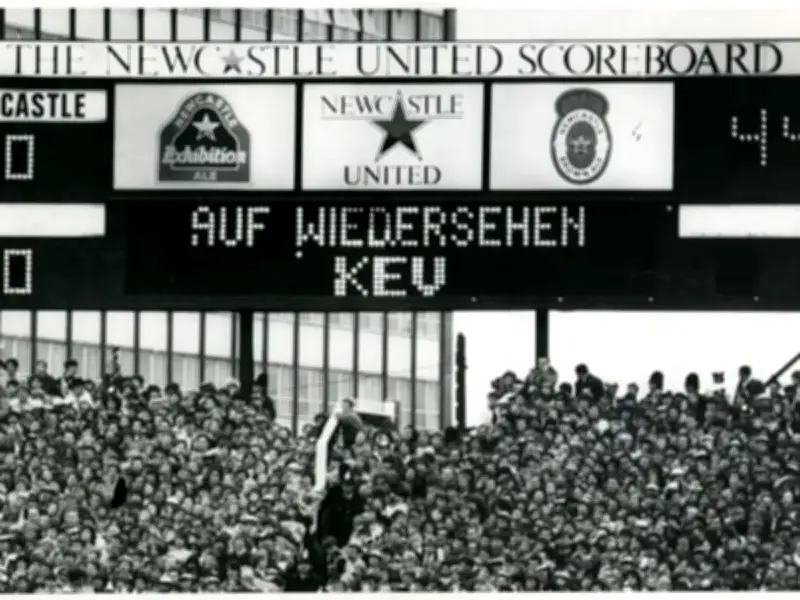
There were brighter moments. At the end of Kevin Keegan's testimonial against Liverpool in May 1984 - after he had helped lead United back to the top flight - the scoreboard memorably flashed "Auf Wiedersehen, Kev", a nod to the hugely popular TV series of the time.
A new board and its quirks
In 1988, a new, bigger scoreboard was unveiled, built by NEI Electronics of Gateshead. Costing £150,000, it was claimed to be "the most up-to-date in English football". Even so, it malfunctioned during an FA Cup tie with Nottingham Forest in 1991. With United 2-0 up, the scoreboard went blank, unable to record Forest's fightback in a match that finished 2-2.
That same year, it was reported: "Newcastle United directors have had a firm word in the ear of their scoreboard operator" after a gloating message appeared during a game against Leicester City. Much to the crowd's delight, it read simply: "Mackem misery. Cambridge 3 Sunderland 0".
By 1993, with Keegan now manager, a reborn Newcastle were tearing up the Second Division and heading for the new Premier League. During a 6-0 demolition of Barnsley, the crowd and players were briefly bemused when the scoreboard credited Andy Cole's hat-trick to Anthony Cole, a reserve player who had left a year earlier.
The end of an era
The Gallowgate End scoreboard, along with the famous terracing itself, disappeared at the end of the 1993-94 season as St James' Park continued its transformation into a modern all-seater stadium. Three decades on, memories of the old scoreboard live on as a small but cherished piece of Newcastle United folklore from a simpler, pre-digital age.