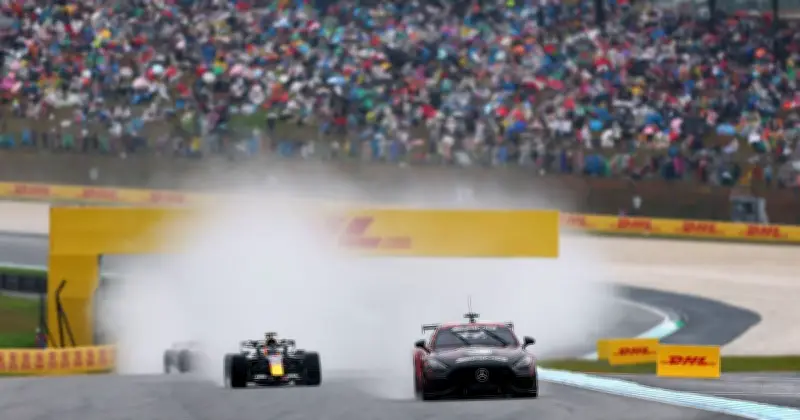
Formula One's return to Malaysia brought no shortage of entertainment, but also a reminder that this version of the sport is not quite what it should be. It was 93 minutes after the scheduled start time that Sunday's rearranged Bahrain Grand Prix finally got going. Nobody will argue that the first delay wasn't necessary as lightning flashed and biblical rain lashed the Sepang circuit.
But it wasn't a great look for the sport to see multiple cars stopping on track during the two formation laps held behind the safety car, at the aborted first attempt of getting the Grand Prix going. They all got going again and filed back into the pit lane. It took 53 more minutes before they emerged from it again.
Software update and driver criticism
The FIA explained after the race that a software update had been required to fix an "unprecedented combination" of factors which led to these hi-tech computers on wheels essentially needing a forced reboot. And it worked – the race got going and it was a gripping one at times, as Sepang delivered. It is a circuit the drivers love to race on.
Afterwards, though, there was again criticism of these much-maligned engine regulations. Lewis Hamilton, one of those whose car stopped on the formation lap, joked with winner Max Verstappen that it was "like the LEGO race," referring to the karts made of plastic bricks that were used for the drivers' parade at Silverstone in July.
Championship leader Kimi Antonelli called it "insane" and George Russell, who retired with an engine problem late on, said the situation "didn't feel very F1". Carlos Sainz, Russell's fellow Grand Prix Drivers' Association director, gave perhaps the strongest critique when he urged F1 bosses to "have a hard look at themselves".
Changes ahead and mitigating factors
Though that message suggests those in charge aren't in the process of making changes, which they are. Over the next two seasons, the engine formula is being tweaked to be less reliant on electrical power. Those changes will hopefully return the sport to what it should be: The very pinnacle, with the fastest and most challenging cars in the world. Sunday's pre-race scenes showed there is a way to go on that front.
But, of course, there are mitigating factors that have to be considered. F1 was not supposed to visit this track this year – the event was sponsored and mostly paid-for by Bahrain after their own race was lost back in April – and the layout was named by the FIA as one of the contributory factors to the software bug. The whole event was put on in just a couple of months and was largely considered a success, though there were some traffic management issues outside the circuit too.
And, most importantly, none of the problems led to any cars retiring. It would have been a true farce had Hamilton, for example, not been able to start that race after one of his best qualifying performances in years. Instead, while minorly embarrassing for the sport, as long as it doesn't repeat it will likely be an incident soon forgotten.