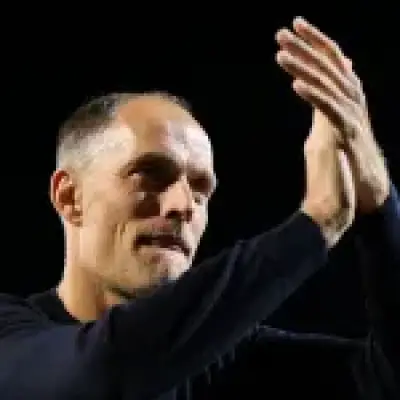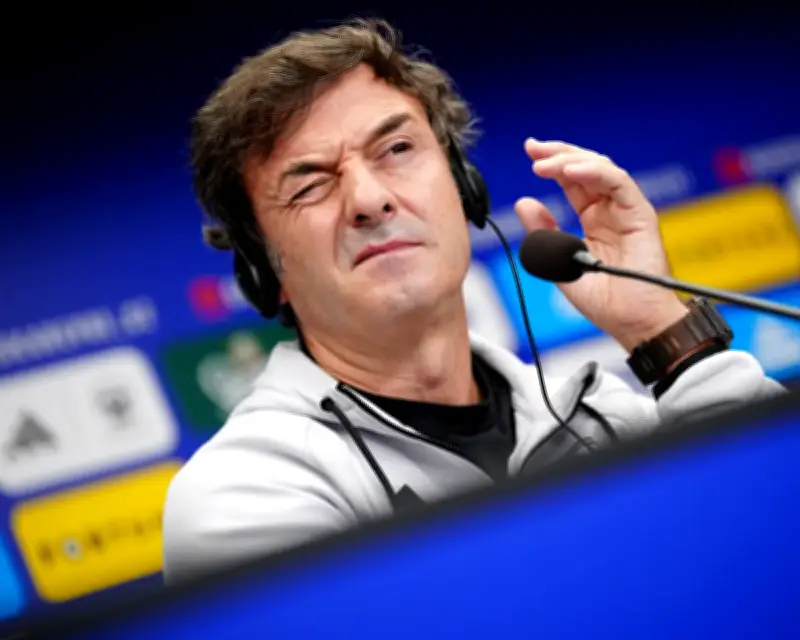
After a 2-0 defeat by England in Prague, Czechia coach Santi Denia shook Thomas Tuchel's hand and said something he had never said at full-time: “See you soon.” Seven days later, they meet again at Wembley. “Four matches in 11 days, no time to train, for anything; I haven't heard a single national coach say they like the new setup,” Denia says, but it's not all bad and there's a big smile too.
A long history with Spain's youth
The opportunity to become Czechia's coach came during a conversation with an old friend, at the World Cup where Denia watched Spain beat Argentina. Of Spain's 26 champions in New Jersey, 23 had played under him during his 15 years at the federation, coaching the under-15s, 17s, 19s, 21s and 23s and working across the academy structure.
Along the way, if there were kids whose path he kept crossing, they were England's. There's a fondness for Phil Foden going back a decade – “differential”, Denia calls him – and a defence of the Football Association and this England generation. “You're this close to winning a World Cup,” he says, signalling the tiniest of gaps between thumb and forefinger.
Respect for English football
Among those Denia met often is Anthony Gordon. “Gordon? What a player!” Denia replies. “What a footballer, my God. He's at the same level as … I don't know, I was going to say Lamine. Young, daring, one-on-one, speed. And what great work English football has done bringing through players like him.”
“England are very, very good; they're no distance from a World Cup final. None. I defend the English FA a lot. England are among the two or three best in the world, always there. The FA saw, invested, and I would encourage them to keep doing so: in young players, in St George's Park, in forming coaches. That's the key. In 2006, Spain had as many trophies as Czechia.”
Proud of his former players
Seeing Ferran Torres score Spain's World Cup final winner felt familiar to Denia. “When Ferran scores in the final you get a deja vu. He scored in the final of the under-19s Euros, won the under-17s Euros, and that's taken to the seniors. You've got Lamine and [Pau] Cubarsí who came to an under-15s tournament in Sweden.”
“I can't be objective about Rodri,” he says. “I first saw him at Atlético with José María Amorrortu, the academy head. Watching an infantil [under-14] session from a balcony above the pitch, there's this little lad who is amazing. Josema [Amorrortu] says: 'That's Rodri.' I say: 'He's a second ahead of everyone but he's tiny.' He says: 'Yeah, but look …' Rodri's parents are in the stands and they were so tall. 'He'll grow! I think we can wait for him!'”
A new chapter with Czechia
The Czechia coach Miroslav Koubek had resigned and Denia was watching a game with Radek Bejbl, the former Czech Republic international with whom he played at Atlético. “Radek says: 'I know Pavel Nedved [Czechia's general manager]. Send me a résumé, what you did with Spain.' The federation president, David Trunda, was in New York too. We met there and again in Prague, with Nedved. We talked about how we would build. And I'm delighted.” Bejbl is now on Denia's staff.
“Czechia is incredible. Prague is … wow,” he says. “We talk to them in English,” Denia says. “Pablo Amo, my assistant, speaks great English. Radek translates some things. The occasional Spanish swearword slips out. If you have three or four key words [in Czech] and speak some English, it's OK: football is a universal language. Getting to the World Cup was an achievement; now we want to develop, grow, open a pathway. We know the football we want and the players have identified with the style.”
The immediate objective set is qualification for the Euros. England again. “Sign me up!” Denia says. “A Euros in England. I know the stadiums and training grounds, remember visiting [Aitor] Karanka at Middlesbrough. The hard part was driving; the other part, the football, I love. I'd be delighted to play there again. And imagine another final with England! I'm dreaming here, aiming high, but why not?”