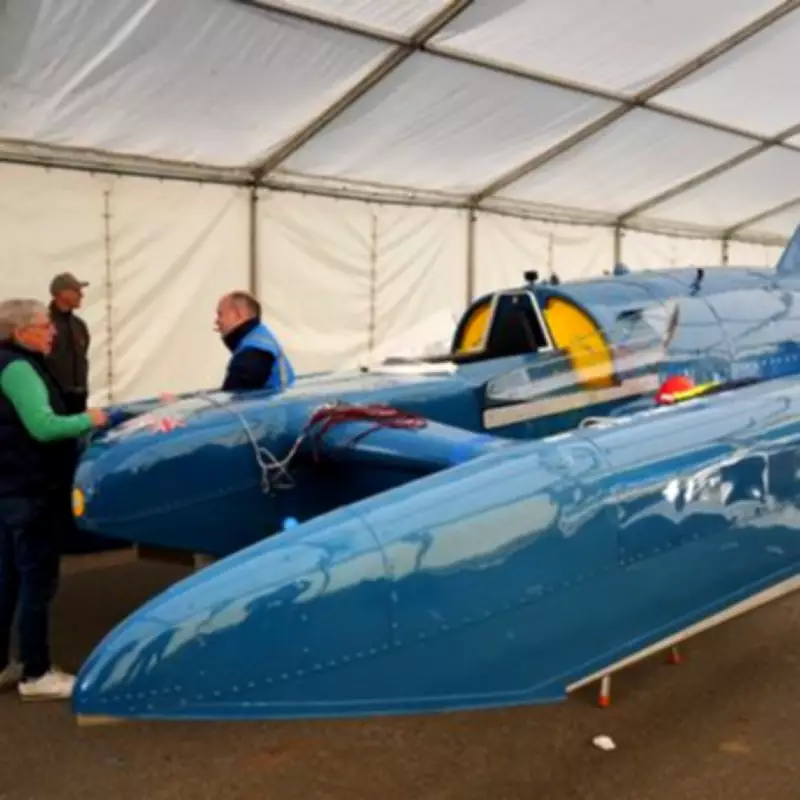
Donald Campbell's restored Bluebird returned to Coniston Water today for the first time since the crash that killed the speed legend almost 60 years ago. Thousands lined the shoreside as the hydroplane prepared to take to the water, marking a poignant return to the site of the tragedy.
The Return of Bluebird
Campbell, who had set a total of eight world speed records on land and water in the 1950s and 60s, was trying to break 300mph (480 km/h) on 4 January 1967 when the craft somersaulted and sank. The wreckage and Campbell's body were recovered from the lake in 2001. A team of volunteers known as the Bluebird Project rebuilt the hydroplane on Tyneside, and it resumed running in 2018 at Loch Fad on the Isle of Bute.
The Bluebird K7 The Festival, to celebrate its return to Coniston Water, is due to run every day until Sunday, with Bluebird taking to the water each day, weather permitting. The course began in the middle of the lake, by the Boating Centre on Lake Road, and finished opposite the Priestley Centre.

Safety and Speed
There will be no attempt to match the speeds achieved by Campbell, who set four of his water speed records on the lake, the fastest being 260.35 mph (418 km/h) in May 1959. For safety reasons, Bluebird was keeping to about 150 mph (240km/h). It will be piloted by Australian Dave Warby, a world water speed record challenger and the son of the late Ken Warby MBE, the current world water speed record holder.
Eyewitness Account
Bluebird support crew member Anthony Robinson told how the return took him back to the fateful events of 4 January 1967. Robinson, then in his early 20s and known to Campbell as 'Robbie,' was first on the scene in a support boat, along with mechanic Leo Villa and photographer Geoff Hallawell. He said: "Bluebird had sunk by the time we got there. So we had no idea how much damage had been done to the front of the boat. We found Donald's gloves, shoes, socks, Mae West life vest and helmet floating on the surface. Leo's first thought was to get some oxygen because he thought Donald might still be breathing while strapped in the cockpit and still breathing. We know now, of course, that was never the case."
The crumpled, rusting Bluebird and its daredevil pilot remained on the lake bed until 2001 when a dive team led by Tyneside-based engineer Bill Smith brought her back to the surface. Campbell's remains were also found later and buried in a local cemetery. An inquest, held in 2002, recorded a verdict of accidental death. Coroner Ian Smith concluded that Bluebird was likely unbalanced by factors including rough water and the speed of travel.
Legacy and Tribute
The speed king clocked 202.32mph (325.6 km/h) aboard the hydroplane at Ullswater, in the Lake District, in 1955. The revamped craft went on display for fans to mark the anniversary of the milestone on July 23 last year. Daughter Gina Campbell paid tribute to the 'absolute steel' of her dad to break a record when many experts said it was impossible. Gina, 79, said last July: "It's really humbling to see the interest in what my father achieved, and to see that he still has such a huge following. I have to pinch myself each time and say what a legacy he has left for me, my family and our nation. Looking at doing 200 mph on water 70 years ago, it almost seems inconceivable. To have gone on and broken further records, I always say he must have had a heart of absolute steel."
K7 was the first successfully jet-powered hydroplane and became known throughout the world for her revolutionary design. It flipped as it travelled at more than 300 mph (483 km/h) during Campbell's bid to break his own water speed record. He broke eight absolute world speed records on water and on land in the 1950s and 1960s. He remains the only person to set both world land and water speed records in the same year. As the hydroplane flipped, Campbell, 45, famously uttered: 'I'm going' on his radio. Those last words were carried in the report of the tragedy carried by the Daily Mirror the day after Campbell's death.