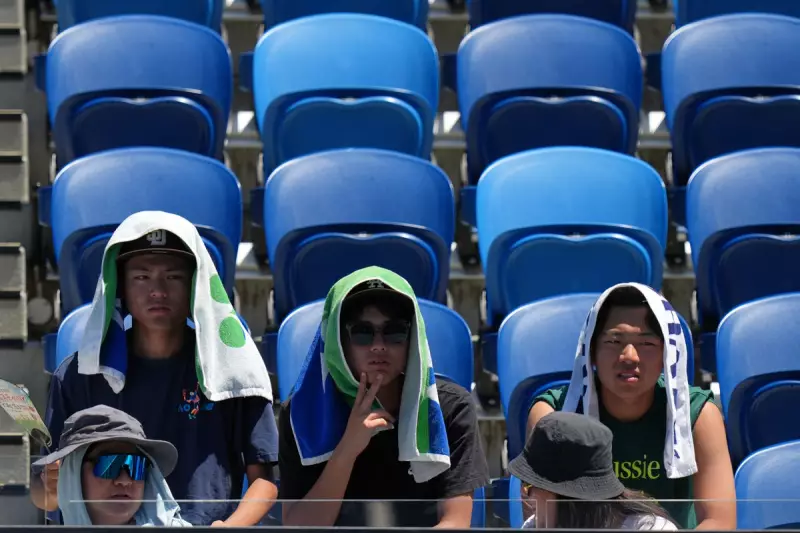
Players visibly wilted on court while spectators desperately sought refuge in shaded areas as a severe heatwave struck the Australian Open on Saturday, bringing outdoor matches to a halt as Melbourne Park baked under relentless sunshine.
Tournament Heat Policy Activated
While hot weather is an expected characteristic of the year's first Grand Slam event, the particularly stifling conditions deterred thousands of potential attendees on a day that traditionally attracts large crowds. Tournament organisers were compelled to invoke the extreme heat policy early in the afternoon, resulting in an immediate suspension of matches on the outer courts.
Scheduled restart times were repeatedly postponed throughout the afternoon as conditions remained stubbornly oppressive. The tournament's official "Heat Stress Scale" reached level five, its maximum threshold, early in the day and remained fixed at that critical level through the entire afternoon period.

Indoor Advantage
The main showcourts eventually resumed play following a brief interruption to allow protective roofs to close. Defending champion Jannik Sinner expressed particular gratitude for competing at Rod Laver Arena, where he experienced severe cramping during his four-set victory against determined American opponent Eliot Spizzirri.
The Italian tennis star openly acknowledged that the roof closure had been instrumental to his survival in the competition. "Got lucky today," remarked the four-time Grand Slam champion. "It changed a bit also the way of how to play certain points. That helped me today, for sure."
Scientific Heat Assessment
The Australian Open operates under a comprehensive extreme heat policy that evaluates multiple environmental factors including air temperature, radiant heat, wind speed and humidity to assess playing conditions. This scientific approach enables officials to delay or suspend matches when predetermined safety thresholds are exceeded.
Play had commenced one hour earlier than usual to capitalise on the relatively cooler morning temperatures, yet conditions were already oppressive when women's defending champion Madison Keys began her third-round match shortly after 10:30am local time.
Player Adaptations
American competitor Madison Keys required only seventy-five minutes to defeat Karolina Pliskova, while her Florida-based compatriots Jessica Pegula and Amanda Anisimova both progressed to the next round. "I didn't have to kind of kill myself today," commented Pegula following her swift 6-3, 6-2 victory over Oksana Selekhmeteva.
In an ironic twist, men's fifth seed Lorenzo Musetti discovered that playing indoors presented its own unique challenges after the John Cain Arena roof closed during his gruelling five-set battle against Czech opponent Tomas Machac. "With air conditioning, that was really, really, I don't want to say extreme, but was kind of getting extreme," revealed the Italian player.
Attendance Impact
Tournament organisers issued warnings to spectators, advising them to wear protective hats, maintain hydration by drinking plenty of water, and utilise the misting fans distributed throughout Melbourne Park. Despite these precautions, significant numbers of potential attendees opted to remain at home rather than brave the extreme conditions.
The day session attracted an attendance of 51,048 spectators, representing a substantial decline of approximately 10,000 compared to day six on Friday, and falling even below last year's corresponding session figures. This notable reduction highlights the direct impact that extreme weather conditions can have on major sporting events and spectator participation.