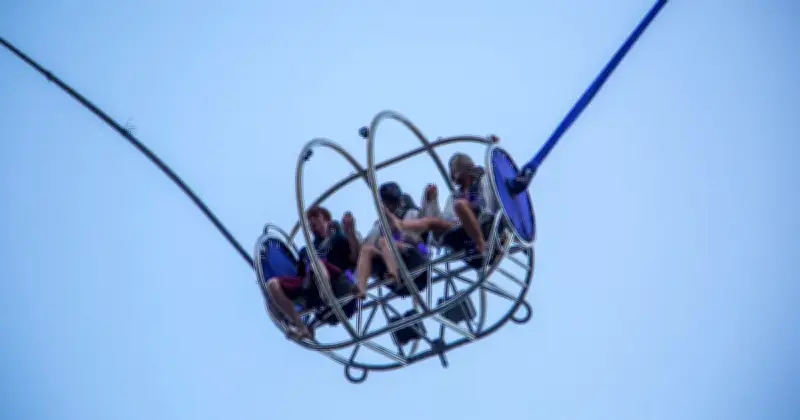
Two teenage boys died in a bungee cage jump accident after safety failures by the attraction's owners led to the cage plummeting 150 feet to the ground. The tragedy occurred on August 10, 1993, at the Beach Bungee attraction in Atlantic Beach, South Carolina, USA.
Victims and the Accident
Zachary Steinke, 17, travelled to the Beach Bungee attraction located along the Grand Strand in the North Myrtle Beach/Atlantic Beach region. The venue featured a 175-foot tall steel archway that enabled visiting jumpers to be elevated in a cage resembling a lift. On the evening of August 10, 1993, Zachary stepped into the cage with "bungee jump master" and attraction worker Michael Nash, 19.
The duo were being hoisted to an elevation of approximately 150 to 160 feet in the steel jump cage. Both were completely oblivious that the original chain-driven lifting mechanism was broken. Instead of installing a like-for-like replacement to fix the defect, the proprietors chose a makeshift commercial shrimping winch deployed alongside a wire rope. These items were not fit for purpose.
Fatal Failure
That particular day proved exceptionally wet and rainy. As the cage was being lifted into the evening sky, visibility diminished and the wire rope proved incapable of bearing the weight. Under strain, it snapped. The cage, containing Zachary and Michael, plunged 150 feet to the ground, causing catastrophic impact injuries which neither teenager would survive.
In a heartbreaking turn of events, Zachary's parents were watching from below and were forced to witness their son's fatal fall. They are reported to have tried CPR before emergency services reached the scene.
Legal Aftermath
Following the tragedy, a legal dispute unfolded. John Kassel, the attorney representing the families, detailed on the Kassel McVey website how the cable failed: "Without relieving the tension the cable would eventually fail and break. The scenario is well understood and actually has a name: two-blocking. Unfortunately, the bungee jump winch system had no safety devices of any kind. The system two-blocked. The cable ripped apart. The cage fell to the ground. Both boys were killed in front of a crowd of people, including the parents of one of the boys."
Kassel added: "I was a young lawyer. I tried the case against the owners and the shrimper in federal court. One issue was to find individual liability and not simply get a verdict against a defunct corporation." Kassel prevailed. In 1995, the victims' families secured a $12 million judgment against the individual proprietors of Beach Bungee. The court determined the owners could be held personally responsible because they bypassed safety systems by fitting the defective shrimping winch in an attempt to prevent losing summer tourist trade.
Further Legal Action
Kassel was far from finished. He explained: "I tried a second case in state court against the South Carolina Department of Labor, the responsible regulatory agency. There, a major hurdle was overcoming multiple immunities enjoyed by the state. We received a $2 million verdict. The verdict was affirmed on appeal to the South Carolina Supreme Court. I became close to the families of both boys."
The historic 175-foot Beach Bungee arch structure is long gone, but there remain a number of attractions at Myrtle Beach. The tragedy serves as a stark reminder of the consequences when safety systems are bypassed in pursuit of profit.