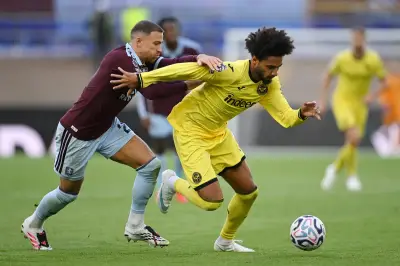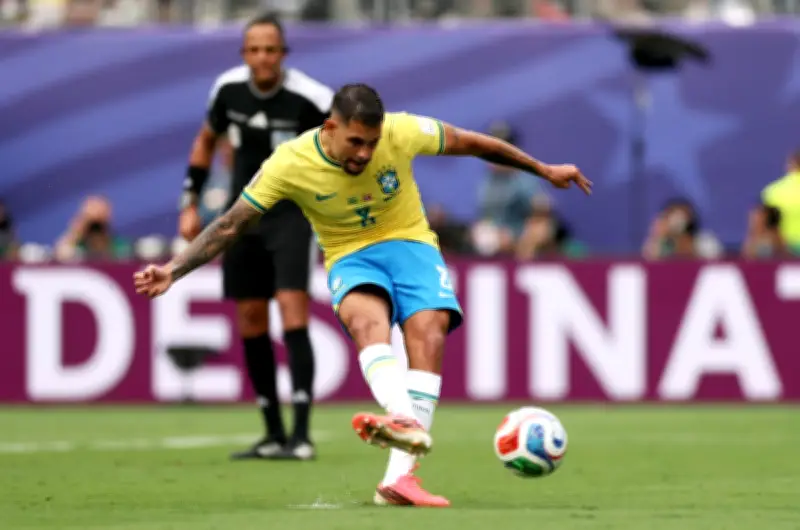
Bruno Guimarães' stutter-step penalty failure proved costly as Brazil were eliminated from the World Cup by Norway on Sunday. The midfielder's weak spot-kick was saved by goalkeeper Ørjan Nyland, who dived to his left to parry the effort in the first half of the last-16 match in New York-New Jersey. The game remained scoreless until two second-half goals from Erling Haaland secured Norway's victory, with substitute Neymar scoring a consolation penalty deep into stoppage time after another halting run-up.
Stutter-Step Penalty Under Scrutiny
The stutter-step penalty, popularised by Pelé, remains one of football's most controversial techniques. Guimarães' botched attempt revived debate over the method, which has been both celebrated and reviled. Social media reactions were harsh, with one user suggesting that players who use the stutter-step should be "blindfolded and left out in the desert."
Among the technique's famous practitioners is Cristiano Ronaldo, who scored a penalty for Portugal in their 2-1 win over Croatia. The 41-year-old used a long run-up, veered left, briefly slowed, and sent Dominik Livakovic the wrong way. Kylian Mbappé also converted similarly in France's 1-0 victory over Paraguay, while Lionel Messi missed a hesitant spot-kick during Argentina's 2-0 win over Austria.
Brazilian Origins of the Paradinha
The paradinha, Portuguese for "little stop," has Brazilian origins. Pelé explained in his autobiography that teammate Didi invented the trick in 1959 during a training session. "He ran up to the ball, but just before he kicked it he stopped and instantly looked up to see which way the keeper was moving," Pelé wrote. The move was considered brilliant but slightly against the rules, as kickers are supposed to strike the ball before the goalkeeper moves.
In 2010, Neymar, then an 18-year-old prodigy, scored a paradinha for Santos that caused a sensation. The International Football Association Board (Ifab) subsequently banned the move, making it a yellow-card offense on the basis that it was unsporting. However, in 2016-17, Ifab tweaked the wording, allowing feinting in the run-up but forbidding it after the kicker has completed the run-up. This compromise permits stopping and swaying until the standing foot is planted next to the ball.
Psychology vs. Power in Penalty Taking
Penalty-takers face two fundamental choices: pick a spot and strike with power and accuracy, or use mind games to send the goalkeeper the wrong way. The stutter-step relies on psychological deception, provoking the goalkeeper into committing early. However, the risks include mis-hitting the ball due to an off-balance run-up and leaving the shot soft and central if the goalkeeper holds their nerve.
Guimarães' attempt exemplified these dangers, as Nyland saved a weak effort near the centre of the goal. In contrast, Neymar's penalty was also saveable, but Nyland did not dive, allowing the ball to pass him.
Mixed Results and Future of the Technique
The stutter-step has brought mixed results in the tournament. It was costly for Arsenal in the Champions League final and ridiculed by France goalkeeper Mike Maignan during Euro 2024. Despite criticism, the technique persists, adopted by stars like Harry Kane, who varies his style to thwart opponents. Kane's stutter effort in England's 4-2 win over Croatia was saved, but he scored the re-take after a smoother run-up after the goalkeeper moved off his line early.
In an era of data analytics, where goalkeepers study patterns, the stutter-step offers unpredictability. As Kane explained, "When I watched the clips, I saw that he likes to move early, pretty much. So I knew there was a chance, if I [did] the stutter, that he would come off the line."
Raúl Jiménez also used the technique with success for Mexico, combining psychology with technical precision. Despite the risks, the stutter-step penalty is likely to remain a part of football's tactical landscape.