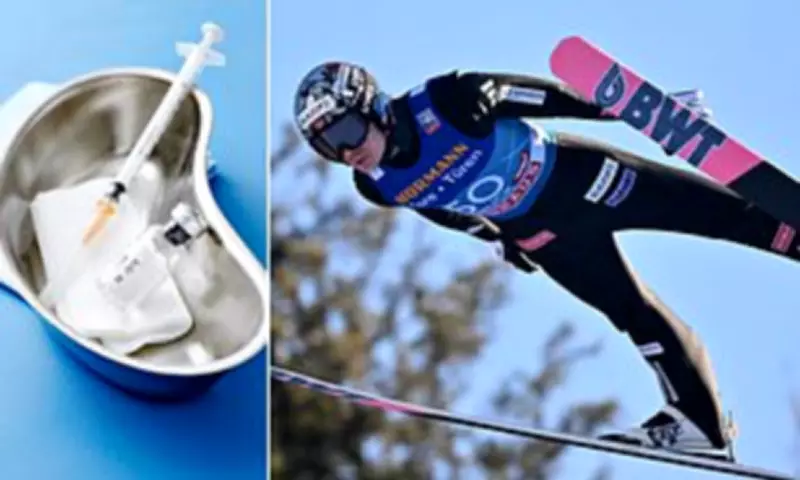
Winter Olympics Doping Watchdog Faces Surreal 'Penis-Gate' Questions
The team responsible for maintaining anti-doping integrity at the Winter Olympics found themselves addressing one of the most unusual questions in sporting history on Thursday. Officials from the World Anti-Doping Agency were asked directly about extraordinary allegations that certain ski jumpers might be artificially increasing the size of their penises to secure an unfair competitive advantage.
A Surreal Saga Gripping the Games
From Milan to the towering peaks of the Dolomites, a bizarre saga colloquially dubbed 'penis-gate' has taken a surreal hold on these Winter Games. The controversy stems from unsubstantiated claims circulating about members of the ski jumping community allegedly resorting to extreme measures to enhance their performance through anatomical modification.
For the first time in sporting history, the concept of 'enhancement' has taken on an unusually literal meaning. The specific allegation suggests that some ski jumpers have been injecting hyaluronic acid directly into their genitalia, though these claims remain entirely unverified and anonymous in origin.

WADA's Official Response to Extraordinary Allegations
When confronted with questions about hyaluronic acid injections and whether such practices might trigger an official investigation, Olivier Niggli, the Director General of WADA, offered a measured response. 'I'm not aware of the details of ski jumping - and how this can improve - but if anything was to come to the surface we would look at anything if it is actually doping related,' he stated during Thursday's briefing.
Niggli continued with cautious professionalism: 'We don't do other means of enhancing performance but our list committee would certainly look into whether this would fall into this category. But I hadn't heard about that until you mentioned.'
Standing alongside Niggli, WADA President Witold Banka - formerly Poland's Minister of Sport and Tourism - added his own perspective with a touch of national interest. 'Ski jumping is very popular in Poland so I promise you I'm going to look at it,' Banka remarked, acknowledging the seriousness with which the agency would treat any legitimate doping concerns.
The Scientific Basis for Unusual Performance Enhancement
While the specific allegations about acid injections remain unsubstantiated, the broader concept of ski jumpers manipulating their anatomy for competitive gain has scientific precedent and has previously attracted official scrutiny. The underlying theory, supported by multiple scientific studies, suggests that any increase in the surface area of a competitor's skinsuit can effectively transform the jumper into a more efficient human glider.
The principle is straightforward in aerodynamic terms: the larger the frontal bulge, the further an athlete can potentially fly. This scientific understanding has been cynically exploited in the recent past, as demonstrated by a significant scandal that erupted during last year's world championships.
Recent Precedent: The Norwegian Team Scandal
A major controversy unfolded when it emerged that the Norwegian ski jumping team had deliberately adjusted seams around the crotch area of their competition suits to create additional surface area and aerodynamic advantage. The fallout from this revelation was substantial and resulted in serious consequences for those involved.
Norwegian head coach Magnus Brevik, his assistant coach Thomas Lobben, and another staff member named Adrian Livelten all received 18-month bans for their roles in the scheme. Even defending Olympic ski jump champion Marius Lindvik and his teammate Johann Andre Forfang faced three-month suspensions, though investigators determined that the athletes themselves were unaware of the illicit modifications to their equipment.
The Aerodynamic Science Behind the Controversy
The scientific foundation for these unusual methods of potential enhancement is well established within sports research. A study published in the respected journal Frontiers demonstrated that every additional two centimetres in suit circumference could reduce aerodynamic drag by approximately four percent while simultaneously increasing lift by around five percent.

In practical competitive terms, these aerodynamic improvements could translate to an extra 5.8 metres in jump length - a potentially decisive advantage in a sport where victories are often determined by mere centimetres. This scientific reality has created an environment where competitors and coaches might explore unconventional methods to gain even the slightest edge.
From Tabloid Speculation to Official Inquiry
The specific allegations about hyaluronic acid injections first surfaced in the German tabloid Bild following the Norwegian team scandal. While the details remained vague, anonymous, and completely unsubstantiated, the sensational story spread rapidly across media platforms and sporting circles, even reaching the snow-covered venues of the Winter Olympics themselves.
What remains beyond dispute is that more plausible methods of increasing anatomical measurements for aerodynamic advantage have already been implemented in competitive ski jumping, as evidenced by the Norwegian team's sanctioned actions. The cheaters in that case were armed with legitimate scientific understanding about how even minor increases in surface area could dramatically impact performance outcomes.
The Lingering Mystery in the Mountains
For now, the bizarre saga of 'penis-gate' has at the very least provided a definitive answer to the long-standing question of whether size matters in elite ski jumping - according to aerodynamic science, it unquestionably does. Whether competitors are actually resorting to extreme measures like acid injections to achieve such enhancements remains a mystery currently lost somewhere in the mountainous terrain hosting these Winter Games.
The World Anti-Doping Agency has committed to investigating any legitimate doping concerns that emerge, but for the moment, the surreal allegations continue to generate more questions than answers in one of the most unusual doping discussions in Olympic history.