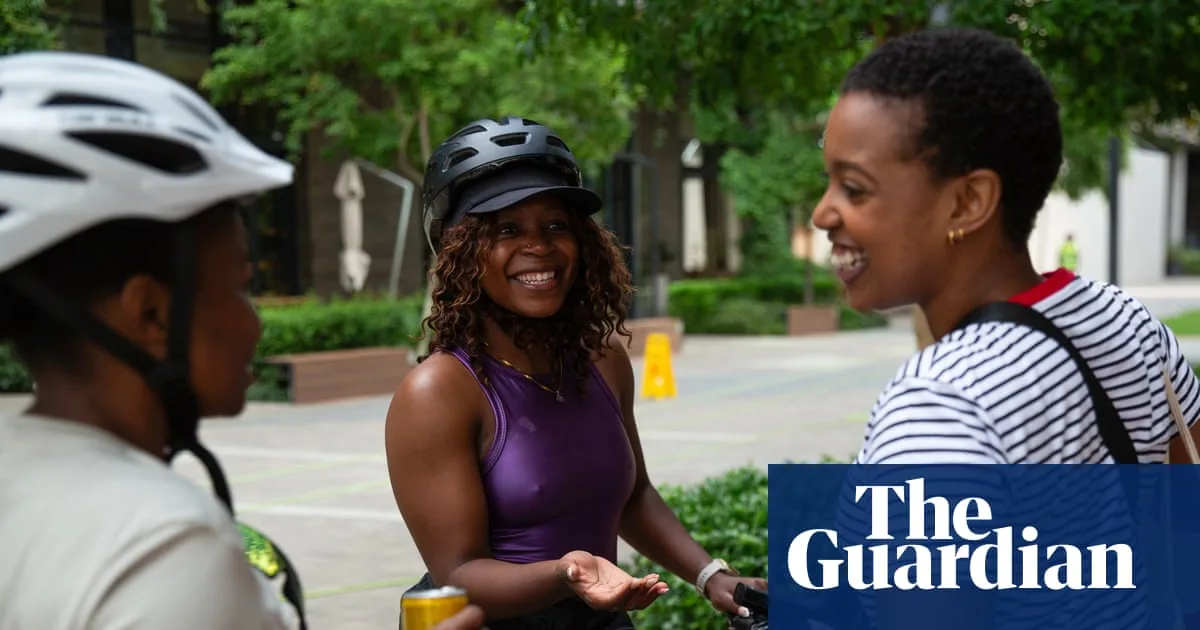
On a hot Saturday spring morning, Karabo Mashele urged a group of female cyclists up the hills of a plush Johannesburg suburb. “Come on my ladybugs,” the 32-year-old shouted over the sounds of 4X4 cars overtaking the riders. “You can do hard things!” Twice a month, Mashele, who only learned to cycle aged 29, leads Girls on Bikes casual rides for up to 25 women in their 20s and 30s, through Johannesburg or Pretoria.
Johannesburg, with a population of nearly 5 million, is not designed for cyclists or pedestrians, with dense townships and sprawling suburbs connected by highways. Less than 1.5% of the City of Gold’s commuters cycle to work, the majority of them migrant workers from other southern African countries, according to Njogu Morgan, who has studied transport in the city. Bikes are usually seen as either an elite hobby or a last resort for the poor.
South Africa’s metropolitan areas haven’t changed much since apartheid ended more than three decades ago, with poorer black workers commuting to wealthier areas from the townships into which the white minority regime forced their communities. However, the members of Girls on Bikes and other young cycling enthusiasts are reclaiming the streets of South Africa’s largest city.
“It is a political statement to see people of colour on bikes, in suburbs. Like right now, in front of us, you see the eyes and how people are looking at us,” said Titi Mashele, who launched Banditz Bicycle Club in 2018. He also encouraged his younger sister Karabo to start Girls on Bikes. Karabo Mashele said she wanted to change the perception of cycling among black South Africans, recalling how children in Soweto thought their group were tourists.
At the other end of Johannesburg’s cycling spectrum is spinning and “Stance culture”. It started with cars – souped up BMWs spun in tyre-burning circles in Soweto in the 1980s, towards the end of white minority rule, often at gangsters’ funerals. In recent years, children in Soweto started spinning on modified bikes. Crews of mainly teenage boys, such as Soweto Street Fighters and Bikerboyz, took over township streets, battling each another over their mastery of tricks.
In Brixton, Percy Zimuto, 20, and Lesedi Mosima, 18, of the Sentech Croozers crew, showed off their creations. They had lowered 20in frames on to 16in wheels, then added silver mudguards and huge forward-tilted handlebars shaped like antelope horns. “I saw Stance culture as a way to … have movement and art at the same time,” said Zimuto, the crew’s leader. Recent rides have included cycling 12 miles from Soweto’s FNB Stadium, through the old Central Business District, to the new business district towers of Sandton.