
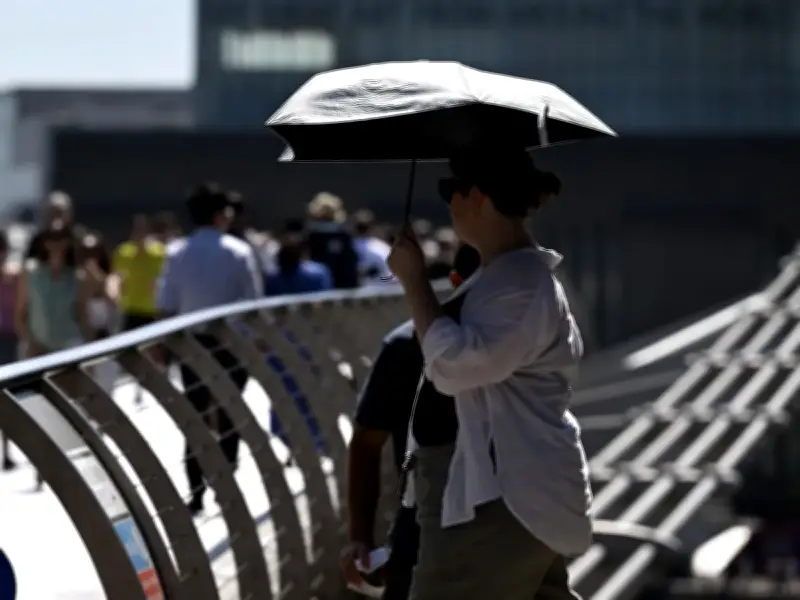
The government has confirmed that the Health and Safety Executive (HSE) will carry out a consultation on maximum workplace temperatures, as parts of the UK could hit 38C and pharmacists suggested a 32C limit for home workers.
The Met Office has issued rare amber "extreme heat" warnings for London, parts of the South East, East Midlands, East of England, West Midlands and South Yorkshire from 9am to midnight on Thursday. Temperatures could reach 33C on Wednesday and highs of 37C or 38C on Thursday, the forecaster said. Some areas face a fifth heatwave of the summer, and the UK is on course for its hottest summer on record.
Calls for an upper limit
The common result of temperatures exceeding 35C in the UK has prompted growing calls for an upper workplace heat limit on health grounds, as is already the case in numerous countries. The National Pharmacy Association has urged people to "check the room temperature" at different times and "ideally, the room temperature should be kept below 32 °C during the day and 24 °C during the night."
In a parliamentary question, MP Tanmanjeet Singh Dhesi asked the Secretary of State for Work and Pensions what recent assessment his department has made of the adequacy of legislation in ensuring workplaces are maintained at a reasonable temperature during periods of extreme heat.
Government response
In answer, Sir Stephen Timms, Minister of State for Social Security and Disability, said the Workplace (Health, Safety and Welfare) Regulations 1992 place an obligation on employers to provide a "reasonable" temperature in indoor workplaces. He added that there is a legal obligation under the Management of Health and Safety at Work Regulations 1999 for employers to assess risks to workers' health and safety, including risks from extreme weather events such as heatwaves.
Sir Stephen said the HSE is progressing a wider review of the Approved Code of Practice (ACOP) for the Workplace (Health, Safety and Welfare) Regulations 1992 to ensure it is fit for purpose for a modern workplace.
MP Ayoub Khan asked how many inspections the HSE has undertaken relating to excessive workplace temperatures in each of the last five years. Sir Stephen replied that there have been no proactive inspections specifically relating to excessive workplace temperature, as the HSE prioritises its resources on the most serious risks. He outlined the main interventions: communication, guidance, advice and information; collaboration and partnership; following up reports of health and safety issues; inspection of work activities; investigation of incidents; and enforcement.
Consultation planned
Sir Stephen confirmed that this year the HSE will launch a public consultation on proposed changes to the Approved Code of Practice, including those relating to workplace temperature.
During last month's heatwave, the HSE urged employers to "act now" to safeguard workers as temperatures rocketed, emphasising that employers are obligated to plan for and support staff working in extreme heat. While no legal maximum workplace temperature exists, heat is regarded as a hazard and should be handled in the same way as other workplace risks.




