

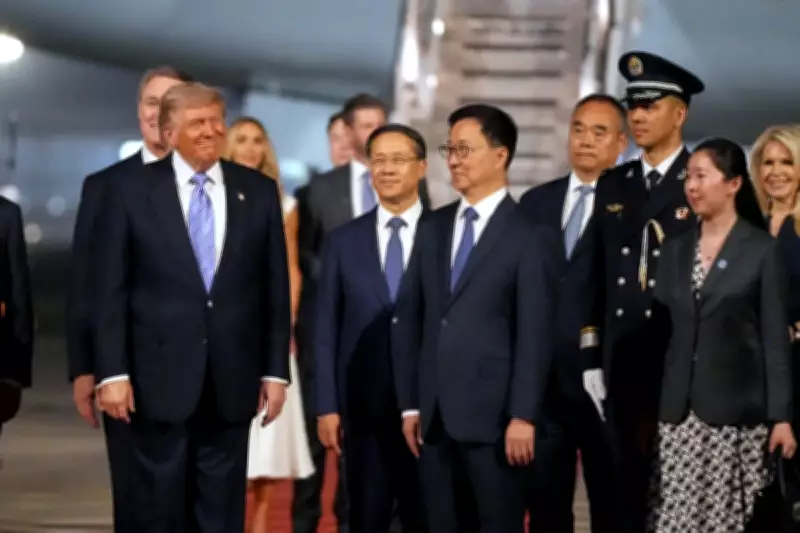
Presidents Xi Jinping and Donald Trump commenced a high-profile summit in Beijing on Thursday, with the primary aim of stabilising the fraught U.S.-China relationship. The two-day meeting, held at the Great Hall of the People, encompassed discussions on trade, the Iran war, technology, and the delicate issue of Taiwan. While both leaders expressed a desire for cooperation, few concrete breakthroughs were anticipated on the most divisive topics.
Xi's Stark Warning on Taiwan
During their closed-door meeting, Xi Jinping delivered a pointed message regarding Taiwan, a self-governed island that Beijing considers part of its territory. According to China's official Xinhua News Agency, Xi told Trump that if the Taiwan issue is handled properly, U.S.-China relations “will enjoy overall stability.” However, he warned that mishandling could lead to “clashes and even conflicts, putting the entire relationship in great jeopardy.” This warning came after Trump authorised an $11 billion arms package for Taiwan in December, though delivery has yet to proceed.
Taiwan’s Ministry of Affairs responded swiftly, stating that “China is currently the only risk to regional peace and stability.” The ministry highlighted ongoing military activities by the People’s Liberation Army near Taiwan, including aircraft and ship deployments, as evidence of Beijing’s aggressive posture.

Trade and Business Focus
Trump aimed to steer the summit toward trade deals, particularly increased Chinese purchases of U.S. agricultural products and passenger planes. He proposed establishing a board to manage differences and prevent a repeat of the trade war that erupted after his tariff hikes. Xi, in turn, reassured American corporate leaders that China’s door to U.S. business would open wider, encouraging deeper cooperation. Trump echoed this sentiment, stating that the business executives accompanying him “all respect and value China.”
Chinese Premier Li Qiang reinforced this cooperative tone during a separate meeting with U.S. business leaders, including Elon Musk, Tim Cook, and Jensen Huang. Li emphasised the need for “mutual success and shared prosperity” through frank dialogue and collaboration, despite global turbulence.
Iran and the Strait of Hormuz
The Iran war emerged as a key topic, with Trump hoping China would leverage its influence to push Tehran toward U.S. terms for ending the conflict or reopening the Strait of Hormuz. A White House official confirmed that both leaders agreed on the necessity of reopening the strait to support global energy needs. Xi opposed any tolls on vessels crossing the strait, which has been effectively closed since the start of the U.S.-Israel war against Iran. Additionally, Xi expressed interest in China purchasing more U.S. oil to reduce dependence on Gulf sources.
Cultural and Symbolic Moments
The summit included a visit to the Temple of Heaven, a UNESCO heritage site, where Trump expressed admiration for its magnificence after over 600 years. Xi noted that the temple symbolises the traditional Chinese thought that “the people are the foundation of the state.” A state banquet later featured a menu blending Chinese and Western elements, including Peking duck, lobster in tomato soup, and tiramisu.
Elon Musk became a focal point for selfies as guests, including Xiaomi CEO Lei Jun, approached him for photographs. Director Brett Ratner confirmed he was in China to prepare for “Rush Hour 4,” having flown with Trump aboard Air Force One.
Analyst Perspectives
Analysts interpreted Xi’s stern tone on Taiwan as an indication that Trump did not make concessions on the issue. William Yang of the International Crisis Group noted that any meaningful concession would have appeared in Beijing’s official readout, but the lack thereof suggests Trump held firm. Wen-Ti Sung of the Atlantic Council emphasised that Taiwan remains China’s biggest red line, stating, “Get Taiwan right and we are friends; get Taiwan wrong and we might become foes.”
George Chen of The Asia Group consultancy said Xi aimed to set clear boundaries on U.S. actions regarding China, particularly on Taiwan, while reassuring U.S. businesses of profitable opportunities. Xi’s call for “strategic stability” could be seen as progress for the remainder of Trump’s term.

Global Reactions and Market Impact
Ukrainian Foreign Minister Andrii Sybiha linked a Russian attack on Kyiv to the summit, asserting that Moscow’s actions demonstrate its threat to international security. He urged U.S. and Chinese leaders to use their leverage to compel Russia to end the war. Asian shares were mixed, with Chinese stocks trading lower amid investor focus on summit outcomes. The Shanghai Composite fell 1%, while Hong Kong’s Hang Seng gained 0.3%.
Trump declined to comment on whether Taiwan was discussed when reporters asked, simply replying “great” about the talks. The summit concluded with a final private meeting on Friday, after which Trump was expected to depart Beijing.





