

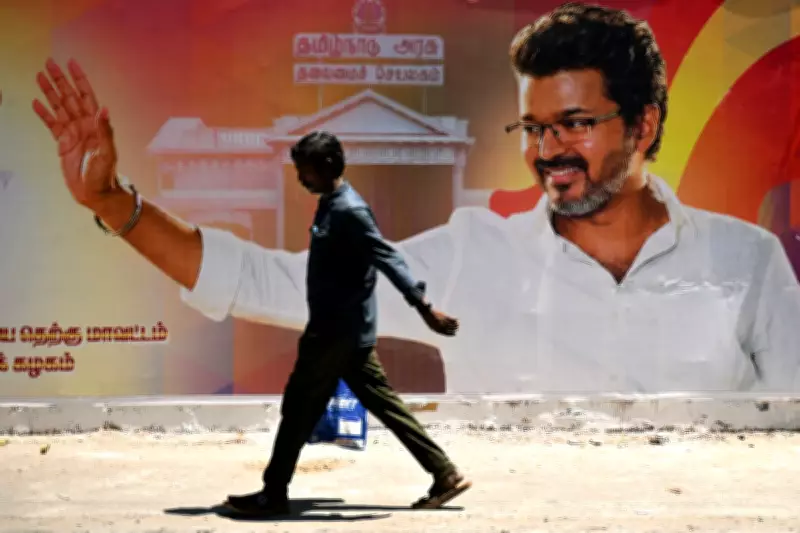
In the southern Indian state of Tamil Nadu, hero-worship is taken literally. Towering cut-outs of film stars drenched in milk offerings by devout followers are common, and such idols often become political leaders. What is unusual is the speed at which Joseph Vijay Chandrasekhar—known universally as Vijay—has gone from silver-screen hero to chief minister, having launched his political party less than two years ago.
A Stunning Election Victory
Vijay's party won 108 of the 234 seats in Tamil Nadu's state election results announced this week, one of several key polls that have significantly altered India's political landscape. In doing so, the film star has abruptly ended nearly 50 years of dominance by two major regional parties, the DMK and AIADMK. Both follow similar Dravidian ideologies, championing social justice and regional autonomy while opposing Narendra Modi's ruling BJP.
Vijay also opposes the BJP but mirrors its core pledge to improve lives through rapid economic growth. He has vowed to turn Tamil Nadu into a $1.5 trillion economy over the next decade.

From Screen to State
Tamil Nadu has a long history of screen icons leveraging appeal to build political careers, including actors MG Ramachandran, J Jayalalithaa, and screenwriter M Karunanidhi, all of whom served as chief ministers. Vijay, known as Thalapathy or "leader" by fans, was seen as an outsider riding a wave of public dissatisfaction with outgoing chief minister MK Stalin. Stalin lost even his own seat in the DMK stronghold of Kolathur to a candidate from Vijay's TVK.
"Despite its welfare schemes, the DMK government was plagued by dynastic rule, rampant corruption, poor service delivery, and law and order issues," says Kannan Rajarathinam, author and political analyst. He claims its economic pitch "failed to touch the aspirational youth, a majority of whom had to look for jobs outside the state." Vijay, in contrast, "is a superstar who quit acting for a public career. He is younger and communicates easily."
Why Vijay Succeeded
Kamal Haasan, another popular actor, failed to mobilise enough support. Vijay translated his massive fan base into a structured party following, charming women voters with welfare handouts and appealing to youth to convince their parents. Rahul Gandhi, opposition leader who broke the Congress-DMK alliance to partner with TVK, declared Vijay's victory "reflects the rising voice of youth."
Vijay's onscreen persona—the incorruptible, justice-dispensing angry young man—read like an extended political proposition. He appealed to the working class by playing an unemployed youth, a fisherman, a baker, and an honest police officer, though some films drew criticism for glorifying the male saviour figure. The 2018 film Sarkar saw Vijay step into electoral politics, highlighting voter fraud and electoral identity fragility.
A Decade-Long Build-Up
Although Vijay launched TVK formally only in 2024 after quitting acting, he had begun mobilising workers decades ago. He burst onto Tamil cinema as a teenager in 1992, but in 2009 his fan clubs were consolidated into Vijay Makkal Iyakkam. The group initially framed itself as a welfare network, building local presence through relief work and educational support. In the 2011 election, it backed the AIADMK-led alliance, marking Vijay's first electoral alignment. In the 2021 local body elections, its candidates won a majority of seats contested.
Vijay positioned prime minister Narendra Modi's BJP as his ideological adversary and the DMK as the immediate electoral rival, offering voters a fresh narrative. Analysts say voter fatigue with the entrenched DMK-AIADMK duopoly played a key role. "Voters under 40 saw hope in the newcomer and chose to challenge the status quo," says Rajarathinam.

Coalition Challenges
While Vijay's party is the largest, it faces the challenge of building a coalition to reach the majority mark. Vijay met the state's governor and submitted his claim to form the government on Thursday but could not take oath as chief minister, failing to secure the needed MLAs. "Tamil Nadu's politics has, for a second time, a credible third player outdistancing the first two. In 2005, actor Vijayakanth appeared as a third alternative, albeit until 2011. It remains to be seen whether Vijay's party will slowly eat away at the AIADMK and turn the state's electoral politics into a bipolar contest again," says Rajarathinam.
Digital Campaigning
Vijay's campaign endured restrictions after at least 41 people were killed in a crowd crush at one of his party's rallies last year. Restrictions did not affect his popularity, as the campaign moved online. Vijay turned 85,000 fan clubs into "virtual warriors" using holograms, virtual rallies, and AI to target youth and first-time voters. He urged young voters to help their "Vijay mama" (uncle) convince their parents. "It worked because people trust content more when it comes from friends and family rather than direct brand messaging. The audience becomes the medium," said Hariharan Gandhi, a digital marketing specialist in Madurai.
Welfare Promises
Vijay's campaign promises included eight grams of gold to women at marriage, monthly cash transfers of Rs 2,500 (£20) to women heads of households until age 60, a "baby welcome kit" with essentials and a gold ring, free travel on state-run buses, and six free LPG cylinders annually per family. Industrialists worry these measures could dent state coffers despite rapid growth—Tamil Nadu's economy grew nearly 11% in the last financial year.
People may look to Vijay as a new hope, but he faces the burden of delivery without tested policy and governance experience. The people of Tamil Nadu await the release of Vijay's last film, Jana Nayagan, as well as a new dawn in governance.





