
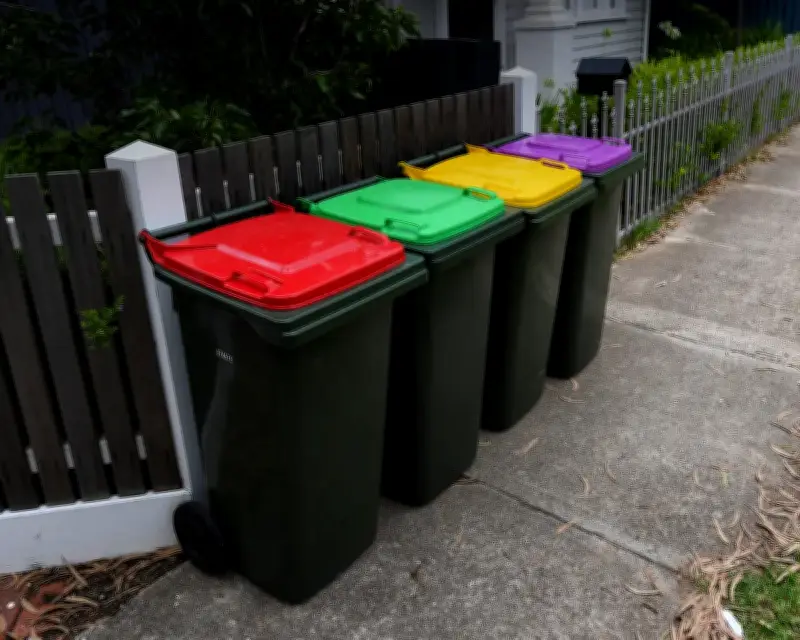
The leader of the opposition in Victoria has promised that under a government he leads, the red bin will be collected every single week, calling fortnightly collections 'disgusting'. The pledge has made bins a political talking point ahead of the state election.
Fortnightly collection: a rubbish idea?
In Victoria, more than 30 councils have shifted to fortnightly red bin pickups. Jess Wilson said, 'I have a council where it's collected every second week, and to be perfectly honest, it's disgusting.' She added, 'Weekly rubbish collection is an essential service that shouldn't depend on your postcode.'
But the shift isn't just happening in Victoria. Councils around the country are moving to a fortnightly red bin service, with the introduction of weekly food and garden organics (Fogo) collection. This arrangement – weekly organics, fortnightly rubbish – was 'generally considered best practice', a national waste report said, and was encouraged by guidelines in Western Australia, New South Wales and South Australia.
Jennifer Macklin, who researches waste systems and behaviour change at Monash University's BehaviourWorks, said: 'When you introduce a Fogo collection service and that food comes out of the red [rubbish] bin – either immediately or over time as communities get used to their Fogo service – then there's much less in the red bin and much less gunky matter in the red bin.'
A NSW audit of kerbside rubbish bins found organics made up 51% of the contents by weight, paper 18%, and glass and metals 6%, leaving 25% non-recoverable waste.
Gayle Sloan, chief executive of the Waste Management and Resource Recovery Association, said: 'Once you take out food waste, there's very little left in the red bin. If you take all your cardboard, your containers from your kitchen and bathroom and put that in the yellow bin, if you put your food waste in the green bin, there's very little normally left in a red bin.'
Do more bin collections mean higher waste charges?
The Coalition has pledged to increase collections while reducing household waste charges. But councils, which are now required to collect four different bins by the state government, have to decide whether to increase charges or wind back rubbish collection frequency.
The Labor environment minister, Jaclyn Symes, said: 'When you come out and make a blanket statement about your expectations of the council, and you don't say how you're going to pay for it, the obvious question is … what are you identifying you should cut? How is the council going to fund that? Obviously councils will have to cut things like maternal health, library services, road repairs.'
Amelia Leavesley, an urban sustainability scholar at Melbourne Business School, said each council determines bin frequency based on the needs of their community and operational requirements. 'The more bins we have, the more trucks need to be on the roads, and the more costly it is,' she said. 'Councils are really trying to juggle all of these different requirements and essentially deliver a really effective waste management service.'
Macklin said: 'If [councils] introduce a weekly Fogo service, there's costs involved in that, … If they can reduce the red bin service from weekly to fortnightly, they can keep the costs down for ratepayers with the waste charge, or keep the increases to the waste charge minimal.' Winding back rubbish collections also encourages households to put more food and organic waste in the Fogo bin, and helps cut back on neighbourhood truck movements and associated noise and emissions, she said.
Are fortnightly pickups inconvenient for some households?
In announcing the policy, Wilson said: 'Fortnightly collections are hugely inconvenient for larger families, households with young children, apartment residents, and people managing nappies and incontinence products.'
Macklin said there were some groups that could be underserved by fortnightly waste, particularly families with small children (which dispose of a large number of nappies), people with medical waste and larger households. But there were other ways to meet the needs of those households, she said, including providing larger bins or fee-based extra collections.
In terms of smell, research by one WA council found nappies began to smell worse after two to four days, while another found little difference between the odour after one week compared to two.
Why have kerbside bins become an election issue?
The Victorian Labor government's statewide rollout of four bins for household waste – organics (green), recycling (yellow), glass (purple) and rubbish (red) – is due to be completed on 1 July 2027, only eight months after the state election. The policy was part of a broader set of recycling reforms introduced in 2020 in response to waste export restrictions, the closure of major recycling company SKM Recycling and the limited availability of landfill in Melbourne's south-east.
So far, 42 of the state's 79 councils have implemented kerbside glass recycling, 65 have introduced a Fogo service, and about 33 have moved to fortnightly rubbish. But the changes have been contentious. A coalition of 35 councils called for the government to pause the glass bin deadline, citing surveys that show 83% of residents oppose a separate purple bin.
In the lead-up to the election, the opposition has committed to repeal the mandated purple bin to 'allow councils to use the waste and recycling system that best suits their communities' while at the same time announcing its new weekly rubbish requirement.
Sloan said it was unfortunate that politicians were 'back to focusing on bins' instead of talking about ways to reduce waste, by designing products to last longer and recyclable packaging. 'Politicians feel like it's a quick win, but unfortunately they're not seeing the bigger picture,' she said. 'What we really need to do is look at how we consistently help people waste less, use more and recycle more, and buy recycled [materials] back. But that's complex.'




