
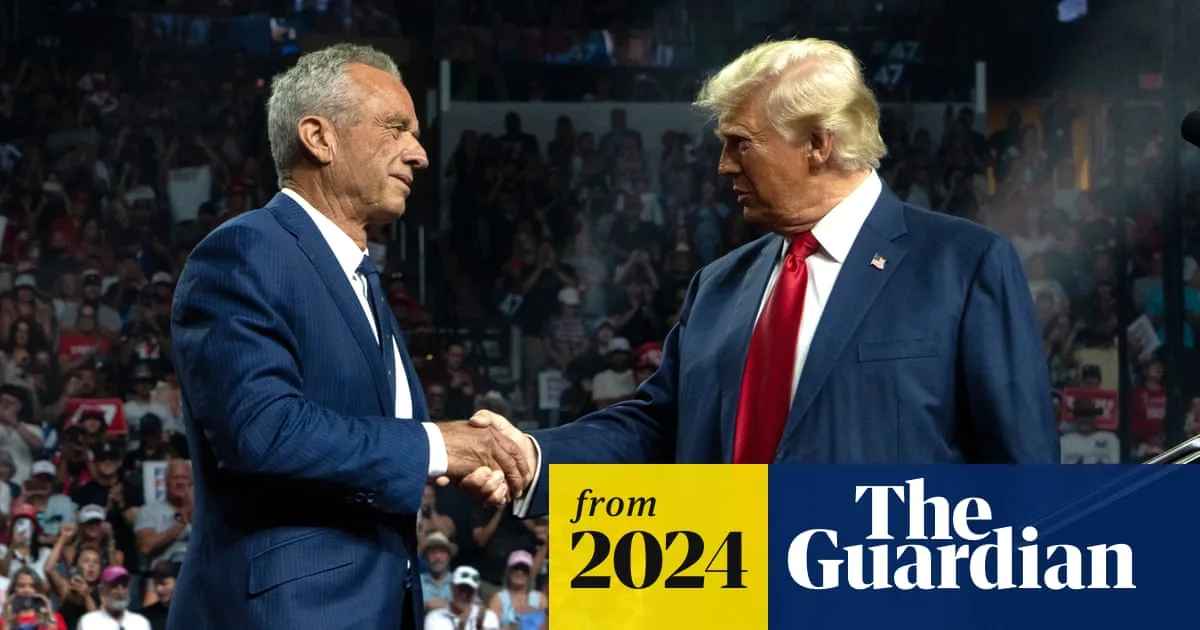
Robert F Kennedy Jr was asked if he would serve as Donald Trump's vice-president just hours after the former president survived an assassination attempt in July, according to reports. The proposal was made by an intermediary, Calley Means, who framed it as a gesture of national unity following the shooting at a Trump rally in Butler, Pennsylvania, on 13 July.
Kennedy, who was running as an independent candidate, rejected the initial offer but later called Means back to indicate he would be willing to speak with Trump. The revelation comes from a New York Times story exploring the rapprochement between the two men, which eventually led to Kennedy suspending his campaign and endorsing Trump on 23 August.
The timing of the approach was reportedly influenced by Kennedy's family history: his father, Robert F Kennedy, and uncle, John F Kennedy, were both assassinated. It is unclear whether Trump was genuinely considering Kennedy as his running mate at that stage, as he later announced JD Vance as his vice-presidential nominee at the Republican National Convention.
Earlier in April, Trump had mused about a 'Trump-Kennedy' ticket, and his campaign conducted internal polling on its potential electability. Kennedy had also considered the idea but dismissed the vice-presidency as 'the worst job in Washington'. After the assassination attempt, the conversation led to a call between Kennedy and Tucker Carlson, followed by a phone call between Trump and Kennedy, and subsequent meetings at Mar-a-Lago.
Kennedy's wife, actress Cheryl Hines, reportedly expressed reservations, calling Trump 'untrustworthy'. Despite this, Kennedy endorsed Trump, who later appointed him to his transition team. The charm offensive was driven by concerns that Kennedy's populist message, particularly on vaccines, could sway Republican-leaning voters in battleground states.




