

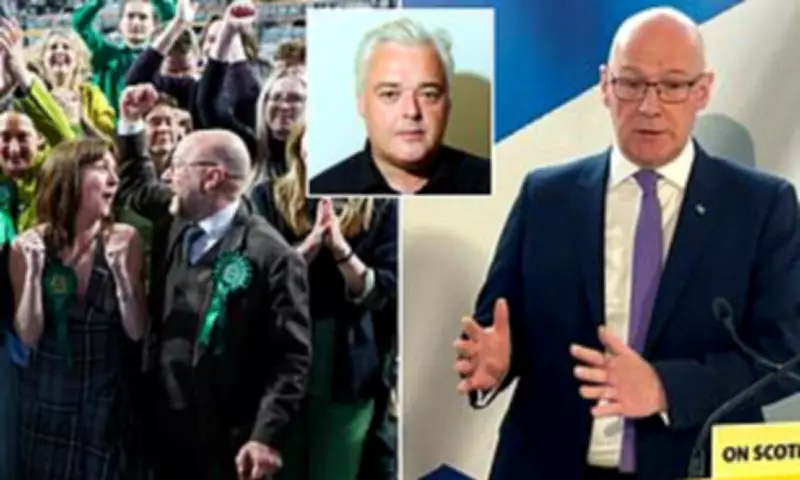
John Swinney's greatest weakness as a politician is his dullness. A low-energy leader short on charisma, he lacks the roguish cockiness of the late Alex Salmond or the easy connection with voters enjoyed by Nicola Sturgeon. Swinney is one of life's plodders.
Yet political strategists worked with what they had. Long before he became First Minister, they spun his weakness into strength: not dull, but dependable. Steady. This image of Swinney as a stable political presence worked for years. His bank-managerly demeanour suited a Finance Secretary, lending seriousness to the governments of both Salmond and Sturgeon.
As a frontman, however, Swinney leaves much to be desired. Lacking vision beyond independence regardless of consequence, and without serious ideas for tackling issues like the cost of living, the NHS crisis, and falling school standards, he appears weak and ineffectual.

Throughout a frequently dull, occasionally fiery election campaign, Swinney spoke of plans for governing after securing an SNP majority. He emphasised the need for a second independence referendum, pledging the inaugural Holyrood vote on the matter. But the SNP fell short, winning 58 seats—seven shy of a majority.
Despite this, Swinney intends to proceed with debating independence when MSPs return. This focus on a meaningless vote on a hypothetical Indyref2—given the Supreme Court has ruled Holyrood lacks authority—ignores families struggling with rising prices and global instability.
Swinney, with 58 MSPs, and the 15-strong Scottish Green group, led by Ross Greer and Gillian Mackay, will argue their combined 73 seats represent a pro-independence majority in the 129-member parliament. But unionist parties won 58% of constituency votes and 54% on regional lists, while pro-independence parties received 40% and 42% respectively. The first joint enterprise of SNP and Greens will be to display contempt for the unionist majority.
After that theatre, what comes next? Swinney will be beholden to a Scottish Green Party resembling a carnival of extremists. New Green MSPs will demand huge concessions on radical policies. For instance, Katie Nevens, elected for Lothians, suggested abolishing all prisons and releasing criminals. Iris Duane, a trans-identifying Glasgow MSP, wants biological males to use female facilities at Holyrood in return for Budget votes.
The 15-strong Green group is packed with cranks holding views ranging from impractical to deranged. Swinney must dance to their tune to govern securely for five years. Progress by feminists and free-speech defenders against Left-wing authoritarianism may be under threat. A majority of MSPs now favour banning so-called 'conversion therapy', which Green and Nationalist MSPs—including Swinney—define broadly to include any discussion between a parent or therapist and a trans-identifying child exploring their beliefs. This would legally oblige everyone to support any child unquestioningly.
People who play by the rules need a First Minister who understands that hammering them with taxes while they struggle is not the way to rebuild enthusiasm. They need a leader with courage to say No to the Scottish Greens' outrageous demands. Everything Swinney has done over three decades suggests he lacks the backbone to do so.






