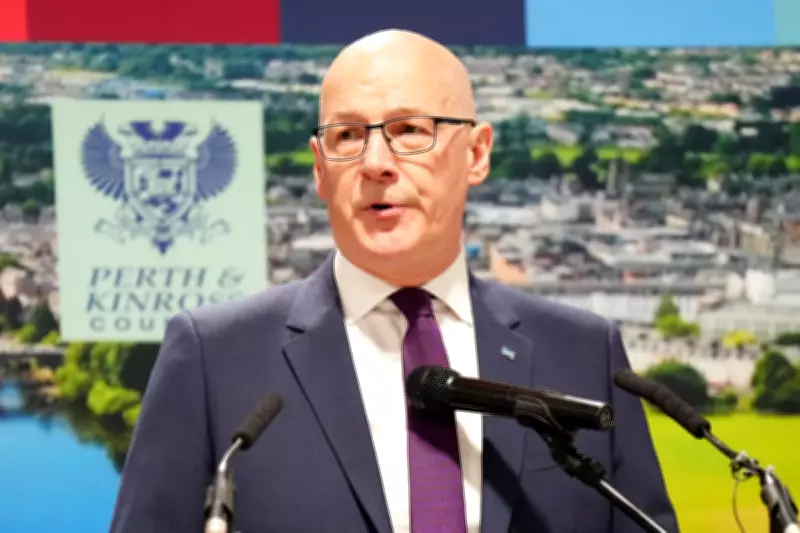
Nearly half a century after joining the SNP, John Swinney has led his party to a historic fifth consecutive Holyrood victory, though crucially failing to secure the outright majority he had desired.
This was the fifth election campaign Mr Swinney fought as party leader, and despite the lack of an overall majority, it remains his most successful. With the SNP once again the largest party at Holyrood, he is set to be reappointed as First Minister.
A Campaign Unlike Previous Ones
This election campaign stood in stark contrast to earlier ones he led. Swinney first held the party leadership between 2000 and 2004, succeeding and then being succeeded by Alex Salmond. During that period, he fought three elections: the SNP lost ground in the 2001 Westminster election and the 2003 Holyrood election, while the 2004 European election saw the party fail to overtake Labour in Scotland, leading Swinney to resign, taking “full responsibility”.

Two decades later, he returned to the helm after Humza Yousaf dramatically resigned, ending the SNP’s power-sharing deal with the Scottish Greens and facing a no-confidence vote. With the SNP in turmoil, Swinney was seen as the only figure capable of stabilising the party, whose support was slipping amid a police investigation into party finances.
From Turmoil to Triumph
Swinney took over as SNP leader unopposed in May 2024, but immediately faced a Westminster election campaign. Labour swept to power across the UK, and the SNP lost 39 of its 48 Commons seats, ending with just nine MPs. Swinney conceded the result was “very, very difficult and damaging”.
Since then, a reversal of fortunes has seen Labour’s popularity wane, while Swinney restored support for his party, though not to the level seen in the 2021 Holyrood election under Nicola Sturgeon, when the SNP won nearly half (47.7%) of constituency votes.
Despite the 2024 general election setback, Swinney sought to restore stability and unity within the SNP, which had been divided after the 2023 leadership contest between Yousaf and former finance secretary Kate Forbes.
A Long Political Journey
His second stint as leader began some 45 years after he first joined the SNP as a 15-year-old schoolboy in 1979. He rose to become SNP national secretary by 1986 and was elected MP for Tayside North in 1997, before representing the corresponding area in the first Scottish Parliament elections in 1999. He has represented the same area at Holyrood ever since, making him one of a handful of MSPs who have served since the parliament’s inception.
When the SNP came to power in 2007, Swinney became finance secretary in Alex Salmond’s government. In 2009, the budget was initially voted down after the Greens refused to back it, but spending plans were passed at the second attempt.
After the 2014 independence referendum, Salmond resigned, and Swinney became deputy first minister under Nicola Sturgeon. Over the years, he also served as education secretary and Covid recovery secretary, tasked with leading Scotland’s pandemic recovery.
He survived two votes of no confidence: the first in 2020 over the exam grading system that initially downgraded disadvantaged pupils; the second in 2021 amid a row over information given to a committee investigating the government’s handling of harassment allegations against Salmond.
After becoming First Minister in 2024, the SNP operated as a minority government, achieving key successes by passing budget bills through Holyrood in both 2025 and 2026.