

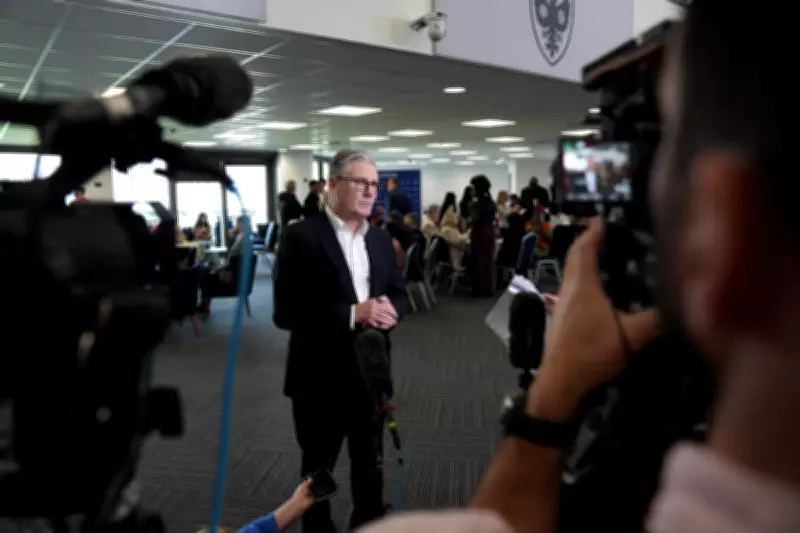
Sir Keir Starmer has pledged to offer more hope and set out a clear path forward as he continues to resist calls to quit following Labour's devastating losses in local elections. The Prime Minister acknowledged that the government had not provided enough hope in its first two years, but insisted he would not walk away, arguing that doing so would plunge the country into chaos.
Starmer Defies Calls to Resign
Speaking during a visit to AFC Wimbledon in south London, Sir Keir said he would be outlining the convictions and values that drive him in the coming days. He emphasised that while he would not resign, the party must respond, rebuild, and set out the path ahead. Labour needs to appeal to young people and articulate arguments about hope and the future, he added.
Dozens of Labour backbenchers have publicly suggested that Sir Keir should either step down or set a timetable for his departure. Former minister Catherine West announced she would launch a leadership challenge unless the Cabinet intervenes to oust the Prime Minister. She said she would begin the process of gathering the 81 MPs needed to trigger a contest if no leadership hopefuls emerge by Monday.

Deputy Leader Urges Unity
Deputy Labour leader Lucy Powell argued that setting a leadership timetable would be counterproductive, as it would spark a distracting debate. She warned that unless Labour wins back voters lost to Reform UK and the Greens, Nigel Farage could take power at the next general election. Powell called for unity and rejected the idea of a leadership challenge.
However, Clive Betts, the party's joint longest-serving MP, said the Cabinet should make clear to Sir Keir that he must go in the not too distant future. He urged a constructive process to bring in a new leader within the next few months.
Electoral Disaster
The local elections saw Labour suffer catastrophic losses across England and Wales. Reform UK made spectacular gains, taking control of Barnsley and winning 14 councils and 1,318 seats. The Green Party also surged, gaining control of four councils and 331 seats, while Labour lost control of Lambeth for the first time in 20 years. In Wales, Labour was reduced to just nine seats in the newly enlarged Senedd, with First Minister Baroness Eluned Morgan losing her seat.
Sir Keir plans to use a major speech on Monday and the King's Speech on Wednesday to reset his premiership. Health Secretary Wes Streeting said the Prime Minister would have his support in setting out the government's forward plan, but declined to say whether he believed Sir Keir was the right person to lead the party into the next general election.
Potential Leadership Contenders
Former deputy leader Angela Rayner and Greater Manchester Mayor Andy Burnham are widely viewed as potential challengers, but neither has commented on the results. Lucy Powell described Burnham as a great asset but reiterated that she does not want a leadership challenge.
In the aftermath of the elections, Sir Keir appointed former prime minister Gordon Brown as special envoy on global finance and Baroness Harriet Harman as adviser on women and girls. Plaid Cymru's Rhun ap Iorwerth announced his intention to form a minority government in the Senedd, while Scottish First Minister John Swinney said his SNP would work to keep Reform out of government at Holyrood, warning that the prospect of Nigel Farage becoming prime minister underscored the urgency of Scottish independence.
With 131 of 136 English councils declared, Labour had a net loss of 34 authorities and 1,113 seats. The Conservatives lost eight authorities and 428 councillors, while the Liberal Democrats gained three councils and 142 seats.






