
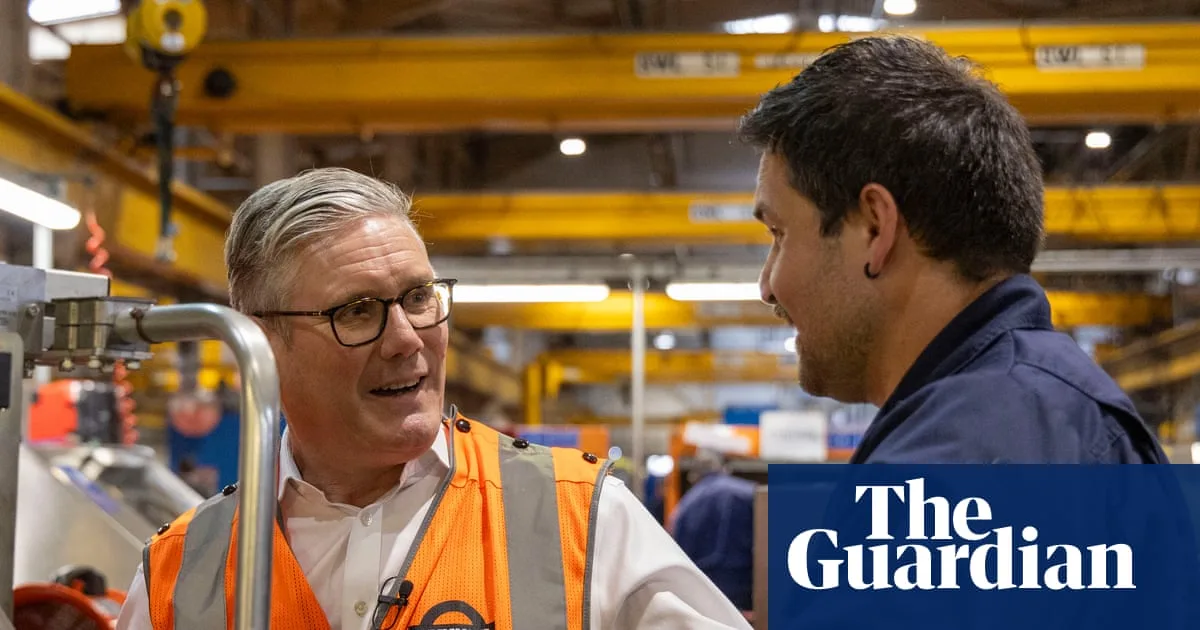
Sir Keir Starmer has dismissed Tony Blair's argument that his government is on the wrong track, insisting he is implementing the policies needed for today rather than the “very different” situation faced by the former prime minister in 1997. Speaking during a visit to an apprentice training centre in west London, Starmer said: “You won’t be surprised to know that I don’t agree with much that Tony says about what the government is doing.”
In a lengthy essay published on Tuesday, Blair castigated Starmer's record, arguing the government had abandoned the centre ground and was putting Labour's future at risk. Blair also said Starmer should have ditched manifesto pledges on workers' rights and net zero, and should have supported Donald Trump in his attack on Iran. The former PM further claimed there was a lack of coherent arguments from those, like Andy Burnham, seeking to challenge the prime minister.
Responding at length, Starmer said he agreed with Blair that policy and ideas should be discussed, but rejected the criticism that his policy choices were wrong. “Given what we inherited – a very different situation in 2024 to 1997 – dealing with what we had to turn around, the policy choices, we’re vindicated by them, because those changes have happened,” he said, citing economic stabilisation, wealth creation and improved public services. Downing Street later published a near-3,000-word essay by Starmer setting out his differences with Blair in more detail, while acknowledging that he agreed on some issues. Starmer accepted that the early mood had been “too negative” but said he remained confident the “big political choices” were right.
Andy Burnham, who served as a minister under Blair and is expected to contest the Labour leadership if he wins next month's Makerfield byelection, said Blair's analysis was undermined by the “gaping omission” of falling living standards since the 2008 financial crisis. Writing for the Times, the Greater Manchester mayor said the principal cause of the 2008 crash was a failure of regulation, adding: “Trickle-down economics did not in the end trickle down very much at all.” He argued that deregulation, as suggested by Blair, would risk repeating past mistakes and failing to regulate social media, artificial intelligence and big tech.
Burnham highlighted policies he had implemented in Greater Manchester, such as reversing the deregulation of bus services, saying the lesson was that “you can’t just leave it to the market”. He added that higher growth in areas without it required strong public control over investment and key enablers like transport, energy, water, education and housing. Nonetheless, Burnham welcomed Blair's intervention, saying it was “a beautiful thing” that it came during a byelection, allowing voters in Makerfield to see the debate.




