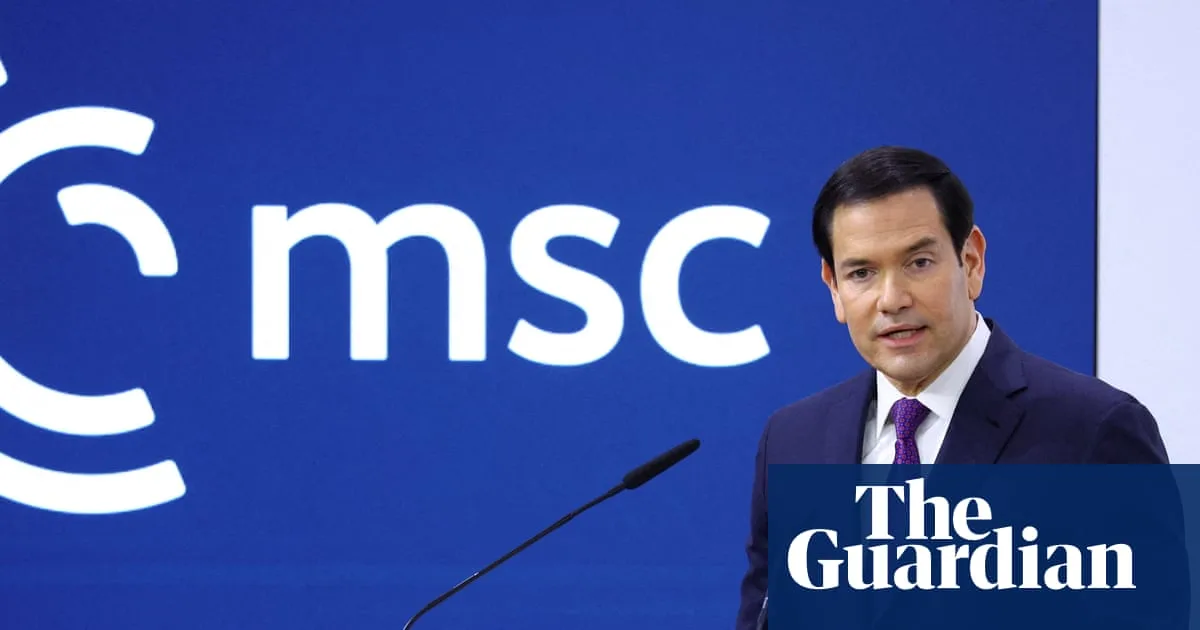
US Secretary of State Marco Rubio’s address at the Munich Security Conference last weekend has sparked speculation about a potential 2028 White House bid, even as European leaders reassessed its underlying message. Rubio’s soothing tone marked a sharp contrast to Vice-President JD Vance’s abrasive speech the previous year, earning a standing ovation from an audience that included Germany’s defence and foreign ministers and over 40 US officials.
Rubio declared that the US and Europe “belong together” and that America would “always be a child of Europe”. Wolfgang Ischinger, the MSC president, expressed relief, while European Commission President Ursula von der Leyen said she was “very much reassured”. EU chief diplomat Kaja Kallas noted the bloc could work with such a US approach.
However, closer analysis revealed that Rubio’s message echoed familiar “Make America Great Again” themes: concerns over mass migration, civilisational erasure, the decline of Christian culture, unfettered trade, weak militaries, and international institutions. The White House summary listed “sovereign nations”, “shared heritage”, “Christian foundations”, and “defence of western civilisation”.
Claudia Major of the German Institute for International and Security Affairs described the speech as “an offer of friendship – but on white, Christian, Maga terms”. Mujtaba Rahman of the Eurasia Group noted that Rubio’s call for allies “proud of their culture and heritage” echoed language used by the far-right Alternative for Germany (AfD).
Rubio’s subsequent bilateral visits to Slovakia and Hungary – to leaders described as “pro-Putin, anti-Brussels and Trump-loving” – reinforced fears of US efforts to promote disunity among allies. In Budapest, Rubio hinted at financial support for Prime Minister Viktor Orbán, the EU’s disruptor-in-chief, ahead of April elections.
Historian Phillips O’Brien concluded that Rubio’s speech “pronounced the death of the liberal, democratic system that has governed the European continent – and the US-led world – since 1945”, calling for a return to a world based on national interests rather than values. German Chancellor Friedrich Merz pushed back, stating that the EU does not believe in tariffs or protectionism, but in free trade.