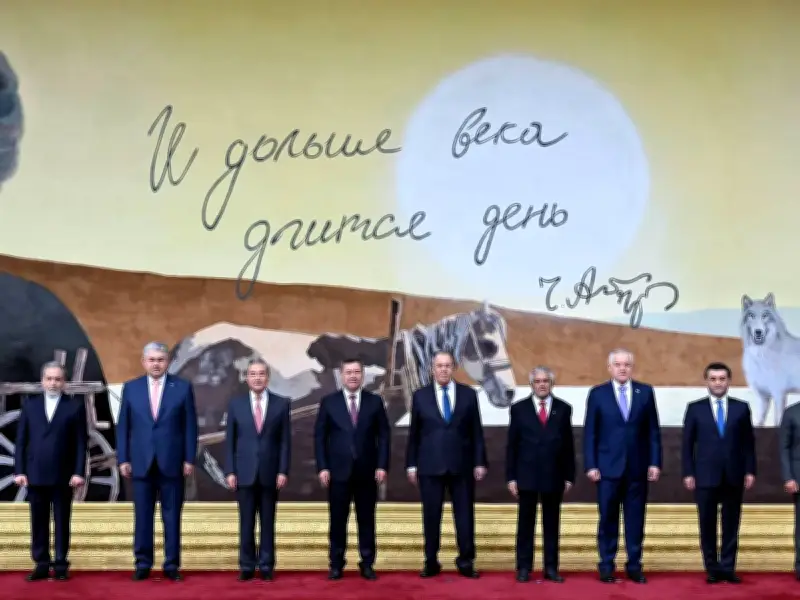
The leaders of China, Russia and India are among the heads of state gathering in Kyrgyzstan this week for the summit of the Shanghai Cooperation Organisation (SCO), a group positioned as a counterbalance to US global influence. Chinese President Xi Jinping, Russian President Vladimir Putin and Indian Prime Minister Narendra Modi are set to attend the proceedings in Bishkek, the capital of the Central Asian nation.
Bilateral meetings on the sidelines
Several bilateral meetings are arranged on the margins of the summit, including one between Putin and Xi on Monday, as well as discussions between the Russian leader and Iranian President Masoud Pezeshkian on Tuesday, the day of the official SCO sessions.
Russia, now four and a half years into its full-scale invasion of Ukraine, and Iran, six months into a war with the United States and Israel, view the summit as a crucial platform to bolster their relations with non-Western allies.

Background and expansion of the SCO
The SCO was established in 2001 by China, Russia and four Central Asian states as a security forum. Over the past quarter-century, it has expanded in size and influence, although its objectives and programmes remain unclear and its brand recognition limited.
It now encompasses 10 nations: Russia, China, India, Iran, Pakistan, Belarus, Kazakhstan, Kyrgyzstan, Tajikistan and Uzbekistan. Many other countries hold the status of "dialogue partners."
Alongside Russia, China has positioned the SCO as an alternative to Western-aligned bodies such as the G7, and in recent years has sought to broaden the remit and clout of the organisation, offering development and financial support. China's Ministry of Foreign Affairs stated last week that the organisation has successfully "explored a new path for regional cooperation." Beijing has persistently championed the concept of an alternative world order with Russia's backing.
Member interests and Turkey's ambitions
For numerous SCO members, the summit will represent a chance to demonstrate that they retain robust connections on the international stage despite deteriorating relations with the West. The organisation is not a cohesive political or military alliance, however, and analysts observe that its members have considerable disagreements and their own separate interests.
For nations such as India, experts suggest the summit is likely to focus more on appearances and strategic messaging than meaningful results. The forum is heavily dominated by China and includes Pakistan as a member - both of which are competitors for India.
Dinakar Peri, a fellow in security studies at Carnegie India, said the SCO provides India with a place at the table in a region increasingly defined by rivalry amongst the major powers, enabling it to safeguard its interests, monitor changing geopolitical trends and present itself as a dependable partner. "While it may not entirely shape the agenda, it gives New Delhi a first-hand view of the region and allows it to hedge its position with others," Peri stated.
Turkey, enjoying partner status within the SCO, is also keen to utilise this platform to bolster its regional standing. The country perceives SCO membership as a component of a balanced foreign policy that aims to preserve its traditional ties with the West as a NATO member, while amplifying its influence in Eurasia.
President Recep Tayyip Erdogan, who ushered his nation into the SCO as a "dialogue partner" in 2012, has consistently expressed his desire for Turkey to attain permanent membership. Despite having close trade relations with the European Union under a 1995 trade agreement, its bid for EU membership has been in limbo for over 25 years.