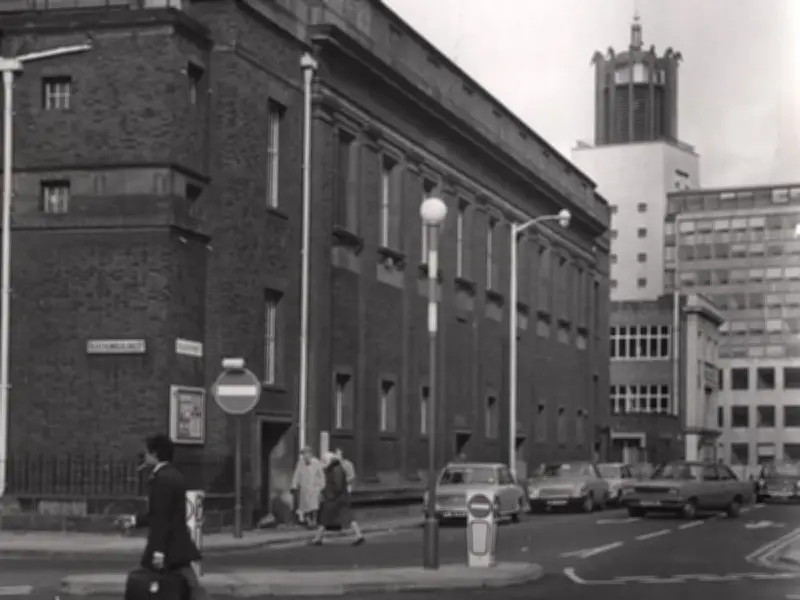
A photograph taken on Newcastle's Northumberland Road in 1971 looks up College Street, where two of the city's most important public buildings stand out. The image, captured 55 years ago, shows the City Hall on the left, next to the City Baths, and the Civic Centre in the background.
A century of City Hall
The City Hall, now branded as the O2 City Hall, was designed by the architectural partnership Nicholas & Dixon-Spain and will mark its centenary in two years. It has been part of the region's cultural and civic life for nearly 100 years, hosting concerts, political meetings, award ceremonies, classical music recitals, and prize-givings.
On November 11, 1928, The Journal reported on its opening: "Newcastle's new concert hall and baths are to be formally opened today. The city has reason to be proud of these additions to its architecture and social amenities. The City Hall is as fine as anything of its kind in the land. Its acoustic properties have yet to be tested. There is seating accommodation on the ground floor and on the single balcony, which sweeps in graceful lines from each side of the platform, for 2,300 people, and at the back of the stage is accommodation for a large chorus as well as orchestra."
Rock legends and civic pride
In its early years, orchestral, operatic, and choral performances dominated the City Hall listings. But in the second half of the last century, most of the world's major pop, rock, and jazz artists performed there. In 1971, the year of the photograph, performers included The Rolling Stones, Led Zeppelin, Yes, T Rex, Black Sabbath, Deep Purple, Genesis, Lindisfarne, and Emerson, Lake and Palmer.
The Civic Centre, designed by architect George Kenyon, was officially opened by King Olav V of Norway in 1968. It serves as the seat of local government and is also a prestigious venue for conferences and celebrations, as well as a meeting point for public demonstrations.
A lasting legacy
Plans for a new seat of local government to replace the old Town Hall in Newcastle's Cloth Market dated back to before World War II. The foundation stone was laid in November 1960, and the building was effectively operational from 1967, with the project completed for a total outlay of £4,855,000. It was officially opened on November 18, 1968, with around 400 people in attendance, including most of the region's great and good, as King Olav V led the toast to "Newcastle - Norway's gateway to Britain".
The Civic Centre has stood the test of time better than many of its contemporaries, with features such as the carillon tower with its 12 bronze seahorses, the River God Tyne statue, and murals by Victor Pasmore elevating it beyond a mere concrete 1960s tower block.